Category Archives: Countries

A Qibla Query: Facing Mecca and Fasting in Outer Space


(left to right) Sheikh Muszaphar Shukor of Malaysia, Yury Malen¬chenko of Russia, and Peggy Whitson of the US will fly on a Russian rocket.

How does an Islamic astronaut face Mecca in orbit?

Decisions by a conference of Muslim leaders and scientists will help a Malaysian doctor stay observant in outer space.

By Bettina Gartner | Contributor to The Christian Science Monitor

Allah is watching – even in outer space. And that poses a problem for a devout Muslim astronaut who is scheduled to fly to the International Space Station (ISS) aboard a Russian rocket this week.

Imagine trying to pray five times a day in zero gravity while having to face an ever-shifting Mecca hundreds of miles below. How do you ritually wash yourself without water? And, now that it’s Ramadan, how do you fast from sunrise to sunset when you see a sunrise and a sunset every 90 minutes? Sheikh Muszaphar Shukor, a Malaysian astronaut, must decide before the Oct. 10 launch.

“I am Islamic,” Sheikh Shukor told a press conference in Moscow, according to the Associated Press, “but my main priority is more of conducting experiments.” Continue reading A Qibla Query: Facing Mecca and Fasting in Outer Space
Chew Some Qat

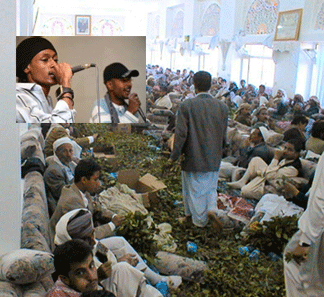
One of the unique aspects of living in Yemen is chewing qat, the tender young leaves of the shrub Catha edulis. In the late afternoon Yemenis often get together with their supply of qat, a water-pipe (narghila) and plastic bottles of spring water. Much has written about the plant and its use. For starters, check out the Qatalog on Yemen Webdate.

Youtube now brings you rap versions by Yemeni artists. Chew on this or this for awhile.

The Letters of Badr Shakir al-Sayyab: #6


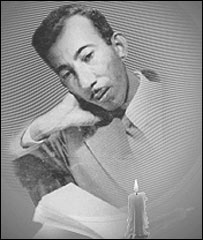
The Iraqi Poet Badr Shakir al-Sayyab

[Note: This is the sixth in a series of translations of selected letters of the noted Iraqi poet Badr Shakir al-Sayyab. For more information on the poet, click here.]

Letter #6 3/4/1956

Directorate of Public Trading, Baghdad

My Kind Brother, Dr. Suheil (Idris),

Sweet Arab greetings to you. Yesterday I received your kind letter and welcomed your decision to entrust “the reading of the previous issue” to Mr. Abdul Sabour. We hope that he will be fair in his criticism. Otherwise, our pens are ready, and we look forward to the precious opportunity to reevaluate much of the criteria and points of view. This is my opinion and it is also shared with our brother, Muhyyi al-Din (Ismai’l).

As for our brother, Kathem (Jawad), he blames you because you entrusted the “reading” of the issue of al-Adaab to “a person who is even ignorant of prosody,” but we, brother Muhyyi al-Din and I, have convinced him of the importance of the rationale that prompted you to do this: namely, to reveal the truth through the struggle between values and criteria. As of yet, we have not seen the last issue of “al-Adaab” – we have learned from trusted sources that it will imminently appear in the market. Continue reading The Letters of Badr Shakir al-Sayyab: #6

Don’t Debate, Rehabilitate.

“Don’t debate religion with fundamentalists: what they need is rehabilitation”

by Saad A Sowayan

Fundamentalism is a cultural phenomenon, though it dons religious garbs. It is a mode of consciousness shaped by cultural values, not religious principles. Thus we can understand it only if we examine it in its cultural context as a sociological rather than a theological question.

So, I will begin by taking a close look at the social incubators most likely to hatch fundamentalism.

I understand by fundamentalism strong adherence to an archetypal point of view and a fierce conviction of its fundamental truth, to the exclusion of any other alternate idea. Any alternative is resisted by a fundamentalist and treated not as a legitimate substitute stemming from a rational free choice, but as a detrimental antithesis of the fundamental truth of the archetype. The archetype is a model to be emulated and reproduced, not dissected or scrutinized. Continue reading Don’t Debate, Rehabilitate.

Anthropo covertus: A Disputed Species

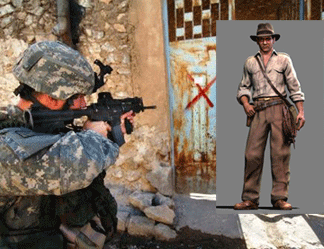
Get ready for a shock. Anthropology (the best kept discipline secret in American academics) made the front page of today’s New York Times. And, believe it or not in the Ripley tradition, it was not about finding the “missing link” or “Noah’s ark”. In a report filed by David Rohde and entitled “Army Enlists Anthropologists in War Zones,” the focus is on the Pentagon’s newly instituted “Human Terrain Teams,” a kind of social science intellectual swat team approach, in which the military uses experts on the local culture. In a video on the website, an American officer explains that his soldiers no longer routinely break down doors of houses and violate the cultural space of Afghan homes, but let their Afghan counterparts knock first while they wait respectfully outside. While I am not sure it takes an anthropologist to point out what should be obvious through simple experimentation, the basic argument of the article is that the military is being coached to listen and work with the local population rather than play knee-jerk mercenary search and destroy games.

It is hard to argue with the sentiment that talking and negotiating are better ways to accomplish a proposed peace-building mission than assuming everybody in sight is a terrorist or is hiding one. So anthropologists, especially recent graduates who have a hard time finding jobs, should be pleased that supply actually might be influenced by a newfound demand for their services. Take Marcus B. Griffin, for example, an embedded anthropologist in Iraq who has a blog discussing his work. Continue reading Anthropo covertus: A Disputed Species

Afghanistan: The Vaudeville Version

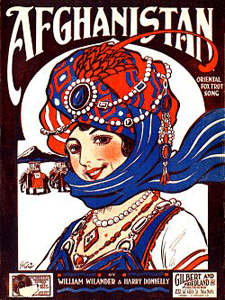
America not only flexes its military muscles and economic clout around the world, but at times takes the rest of the world for a song and dance. Vaudeville, the early 20th century dance hall and stage phenomenon, lyrically used and abused the world as a stage. But it seldom looked much like the real world of the time, and certainly not after almost a century later. Here was popular Orientalism, in the Valentino Sheik mode, for anyone who could afford sheet music. One of the wonderful nostalgic websites documenting this era is Parlor Songs, which publishes an online magazine.

If you would like to see how Vaudeville treated the Orient, check out the article by Richard A. Reublin in the 2005 issue. Among the songs discussed is “Afghanistan” written in 1920 by William Wilander and Harry Donnelly. Click here to listen to the song as you read the lyrics:

Afghanistan
A Romance of Asia
Words and Music by
William Wilander & Harry Donnelly
Published 1920 by Gilbert & Friedland, Inc.

[Verse 1]
In the land of Afghanistan,
There’s a Hindu maid and a man,
She swore by the stars up above her,
That he was the one to love her. Continue reading Afghanistan: The Vaudeville Version

Hip Hop Hijab Jabbing

To veil or not to veil: in Iran that is a question seemingly more relevant than getting an A-bomb. It is not so much the option of veiling as it is how to veil, how much to cover. With reports of a crackdown on what constitutes proper dress for Muslim women in public, the media has been flooded with stories of women with loose hijabs being harassed. For those who have bad feelings about Islam such stories add fuel to the fire of prejudice. But a toll is also taken on Muslims, especially in the West, who see themselves judged by the actions of an extreme case. Not surprisingly, some Muslims who do not see naked eye to veiled eye with the fashion enforcers in Iran are speaking hip hop to power.

Here on the Youtube Watch is an anti-hijab film by Mani Turkzadeh with a hip hop tune from GOZAR.

The Letters of Badr Shakir al-Sayyab: #5


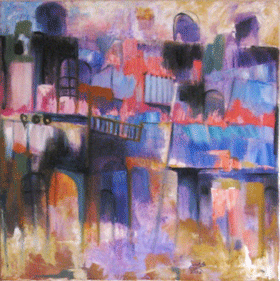
Mohammed Jafaar, Baghdad Things, Oil on Canvas, 2006

[Note: This is the fifth in a series of translations of selected letters of the noted Iraqi poet Badr Shakir al-Sayyab. For more information on the poet, click here.]

Letter #5 (6//19/1947)

Baghdad

My Kind and Respected Brother, Dr. Suheil Idris,

My sincere best wishes and scented greetings to you.

Your kind letter has overwhelmed me with joy. I am very appreciative of your good opinion of me, and I hope to remain worthy.

In your letter, you inquire as to what our brother, Kathem (Jawad), and I meant when we said in our commentary on your splendid novella, “A letter to My Mother,” that it appeared at the most opportune time. Explaining this could be very lengthy, but trust me that we intended to speak to you about this even if you had not asked. This is a topic that concerns every man of letters and every man who is faithful to his people and nation and who is concerned with their future and the future of Arabic literature. Continue reading The Letters of Badr Shakir al-Sayyab: #5