Category Archives: Countries

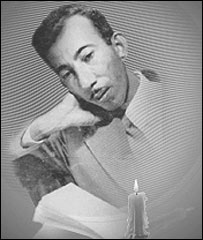
The Letters of Badr Shakir al-Sayyab: #8

[Note: This is the eighth in a series of translations of selected letters of the noted Iraqi poet Badr Shakir al-Sayyab. For more information on the poet, click here.]

Letter #7 2/18/1957

Directorate of Public Trading, Baghdad

My Kind Brother, the Soaring Poet, Mr. Yusuf al-Khal,

Sweet greetings. I have received all four of your letters, but only laziness has caused me to postpone responding to them day after day.

In the month of September I was in Beirut, and I searched for you a lot, but to no avail. I sat at Faisal Restaurant across from the American University, and I roamed the university, but I was not lucky enough to see you or two other brothers whom I was anxious to meet, Khalil Hawi and Munah Khoury. Continue reading The Letters of Badr Shakir al-Sayyab: #8

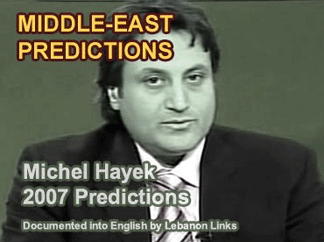
What the Heck, I mean Hayek…

[Webshaykh’s note: With so much discredited foreign policy decision-making, perhaps we should go back to the Nancy Reagan doctrine and look at the ouija board. Give political anti-realism a chance…what the heck, Mr. Hayek… See it for yourself on Youtube.]

‘Clairvoyant’ sees new Lebanese president, more assassinations, Hizbullah ‘surprise’

Daily Star staff
Tuesday, October 30, 2007

BEIRUT: Reputed clairvoyant Michel Hayek predicted late on Sunday that “Lebanon will witness the election of a new president despite current problems.” He also ruled out the “imminent” threat of civil war. In an interview with George Salibi on New TV, Hayek foresaw “a few skirmishes and problems” in the country.

“There is no impending end to the string of assassinations,” he said, referring to the political murders that have plagued Lebanon since 2005.

Nicknamed “the Nostradamus of the Middle East,” Hayek is known for his yearly predictions for Lebanon, the Middle East and the world. Continue reading What the Heck, I mean Hayek…

A True Culture War


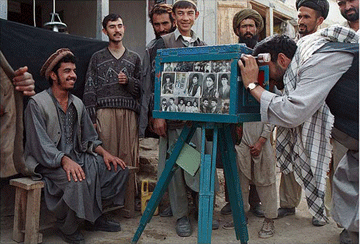
[Photograph taken in Afghanistan by Sergey Maximishin, 2001.]

[Webshaykh’s Note: It is a rare day when an anthropologist’s commentary is published in the New York Times. Here is yesterday’s op-ed by Richard Shweder of the University of Chicago, reproduced below. I invite readers to post their views here. I gave my own view of Anthropo covertus in an earlier post.]

by Richard Shweder, New York Times, October 28, 2007

IS the Pentagon truly going to deploy an army of cultural relativists to Muslim nations in an effort to make the world a safer place?

A few weeks ago this newspaper reported on an experimental Pentagon “human terrain” program to embed anthropologists in combat units in Iraq and Afghanistan. It featured two military anthropologists: Tracy (last name withheld), a cultural translator viewed by American paratroopers as “a crucial new weapon” in counterinsurgency; and Montgomery McFate, who has taken her Yale doctorate into active duty in a media blitz to convince skeptical colleagues that the occupying forces should know more about the local cultural scene.

How have members of the anthropological profession reacted to the Pentagon’s new inclusion agenda? Continue reading A True Culture War

Philby of Arabia

by Robin Bidwell

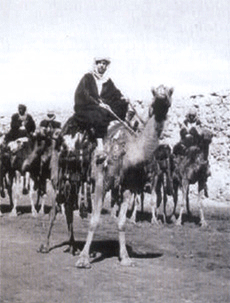
Philby’s grave in Beirut bears the inscription ‘Greatest of Arabian explorers’ and, in very many ways, this claim by his son is justified. None of the writers that we have discussed saw so much of the Peninsula, visited as he did practically every corner of it nor traversed it so many times in so many different ways. None of them spent more than twenty months in Arabia: Philby was there for most of forty years.

Harry St John Bridger Philby (generally called Jack or Shaikh Abdullah) was born in Ceylon in 1885 and used cheerfully to suggest that he was not really himself but a local baby mistakenly picked up by a careless nurse. After a very successful career at Westminster and Trinity College, Cambridge, he joined the Indian Civil Service and arrived in Bombay in December 1908. When, some two years later, he married, his best man was his cousin, the future Field-Marshal Montgomery. Philby acquired the reputation of being a difficult colleague—indeed he claimed to have been the first Socialist in the Service—but he made his mark as an exceptional linguist and a first-class administrator. Continue reading Philby of Arabia

Exiting Through the ‘Alley Gate’

[Note: Numerous excerpts of this popular Syrian Ramadan serial can be found on Youtube, starting with episode 1. The following is a commentary in Asharq Alawsat.]

by Mshari Al-Zaydi, Asharq Alawsat, Saturday 20 October 2007

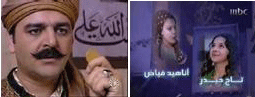
I will admit to watching the Bab al Hara (Alley Gate) series with the same fervor normally reserved for football finals. Moving from one café to another on Jeddah’s al Tahlia Street, I watched this session’s last episode. The young crowd present, dressed in t-shirts and baggy jeans, burst into a warm round of applause at the end of the show – which is quite a rare reaction among Saudi viewers.

This second-part sequel to the Syrian television series is, in fact, an undeniable phenomenon; some in Saudi even exchanged Eid ul-Fitr felicitations that were inspired by stories in the series.

But this phenomenon has reached farther and wider than just Saudi alone, many viewers in various Arab states; even Arabs living abroad, regularly tuned in and set their alarm clocks to the show’s airing time.

Perhaps this huge success is what prompted the show’s producers to make a third series for next year. Such was its popularity that even some clerics were involved in this commotion; among them was Sheikh Salah Kuftaro, son of the former late Syrian Grand Mufti Ahmad Kuftaro and the Director-General of the Sheikh Ahmad Kuftaro Academy, who publicly acclaimed the show and invited its cast to a Ramadan Iftar held in their honor. Likewise, Kuwaiti Islamist MP Walid al Tabtabai also praised the series. Continue reading Exiting Through the ‘Alley Gate’

When Will Chemical Ali Bite the Dust?

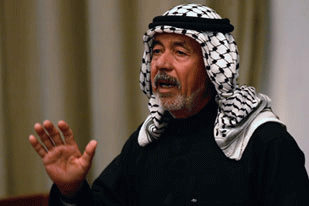
The demise of Saddam Hussein’s brutal regime took place over five years ago. Most of the card-carrying players in the American liberation deck have been found, including the literal ace in the hole, Saddam. In a trial so lengthy and full of delays that it has dropped almost entirely out of sight in the media, the next sacrificial wolf is the man dubbed “Chemical Ali” in the West. Lacking remorse, this chemical engineer of mass killing is well aware there is nothing he can do to stop his own death. But it ain’t over until the fat lady sings and the noose tightens. If the story of Chemical Ali has faded from your memory, here is a refresher from Al-Jazeera:

Ali Hassan al-Majid, Saddam Hussein’s cousin, and widely known as “Chemical Ali”, will be executed “in the coming days,” an Iraqi government spokesman has said.

Legal arguments and religious holidays have delayed al-Majid’s execution, which was confirmed on September 4 by the Iraqi supreme court and due to be implemented within 30 days.

Al-Majid was convicted earlier this year of presiding over the killing of thousands of Kurds during the Anfal campaign in the 1980s.

Asked whether he would be hanged soon, Ali al-Dabbagh said: “I think so, yes, in the coming days.”

Nuri al-Maliki, the prime minister, delayed the hanging of al-Majid until after the Muslim holiday of Eid al-Fitr, which ended on Monday. Continue reading When Will Chemical Ali Bite the Dust?

The Letters of Badr Shakir al-Sayyab: #7

[Note: This is the seventh in a series of translations of selected letters of the noted Iraqi poet Badr Shakir al-Sayyab. For information on the poet, click here.]

Letter #8 3/4/1958

Baghdad

Dear Brother, Yusuf (al-Khal),

“I have a million things to do.” These are your words that I now repeat constantly. The truth is that I feel embarrassed in front of you and my dear friend Adunis due to this silence on my part. But… if you were in my place, you would both forgive me. From early morning until long after midnight, I work constantly to earn a few dirhams…I also have a personal commitment to read and write poetry.

I have read what transpired during the Thursday gathering of Shi’r Magazine. I have also read your “exaggerations.” The colloquial language – as Adunis said – is incapable of sustaining the causes that the Modern Arab Poet writes about. Only the Communists insist that the poet should write in a language and a style that the general public understands. The general public lacks cultural awareness. If we wanted to conform to the general public, then we would need to lag behind culturally and intellectually. We would have to relinquish our depth and give up art and many other things. Poetry – like all sublime arts in our present age- is not meant to be for everyone or to be a political instrument. It is neither a movie nor a newspaper article. Continue reading The Letters of Badr Shakir al-Sayyab: #7

Reporting the Golf between Us

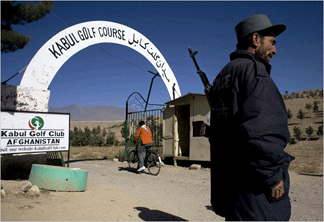
What might be the top story coming out of Afghanistan today? Another Korean missionary kidnapped by the Taliban, a new estimate of a bumper poppy crop, yet again a suicide bombing in Kabul? These are too obvious to be news anymore. How about the largely unused and downright laughable Kabul Golf Course? This is the front-and-center story with two color pictures on the front page of today’s New York Times. And for those who can click a mouse, there is a slide show with thirteen (not a lucky number for an amateur) photographs.

This is no ordinary golf course, which is one of the reasons it makes the first page. Here is the description reported today by Kirk Semple:

It is the Kabul Golf Course, Afghanistan’s only one, and Mr. Abdul, who picked up a putter for the first time when he was 10, is its director and golf pro.

The nine-hole course is extraordinarily rugged by any standard. Continue reading Reporting the Golf between Us