Category Archives: Countries

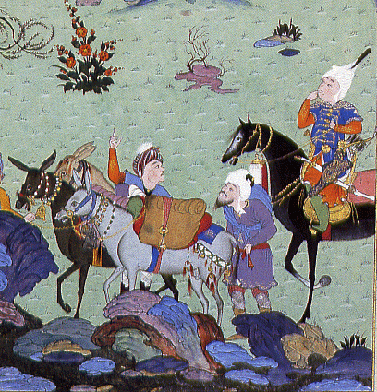
A 16th Century Caravan

The title of this watercolor painting by ‘Abdol-‘Aziz is “Zal is sighted by a Caravan” and is part of a scene from the Shahname in which the hero Rostam’s father, known as Zal, was born an albino and exiled by his superstitous father to the top of a mountain, where he was rescued by the legendary bird known as a simurgh. The caravan, shown here, saw Zal and reported this to his royal father, who was glad his son was alive and would be the ehir to the throne. The painting was done in Tabriz around 1525 CE.

Illustration from Abdolala Soudavar, Art of the Persian Courts (New York: Rizzoli, 1992), p.370.

Veiled Voices


Brigid Maher, Director of “Veiled Voices”

Veiled Voices is a one-hour documentary that investigates the grassroots movement of Muslim women in the Middle East who act as religious leaders. It introduces the viewer to a world rarely seen by outsiders: the world of devout Arab Muslim women leading other women in prayers and lessons. Veiled Voices concentrates primarily on Ghina Hammoud, a divorced mother separated from her children, who has a television program and a charitable foundation in Lebanon, and Huda al-Habash, who has a loving and supportive husband and children, and runs lessons and programs in a mosque in Syria. Veiled Voices also travels to Egypt, where women struggle for public recognition in roles of authority over men; this is contrasted with Syria, where some male religious authorities, such as the Grand Mufti, are encouraging of women in leadership roles. The film shows women empowered, while exploring the struggles they face on both a personal and a public level. Continue reading Veiled Voices

Cannons of the Past


Woman and a Fish, Asma al Fayoumi, Syria 1993

by Najeeb Nusair. Translated by Christa Salamandra and Suhail Shadoud
from Artenews, October, 2007

However much we moan and groan, however much we lament, reminisce, mull over, write, dig up, represent, glorify, venerate—even if we use the entire vocabulary of literature and science to conjure it up, the past will not return. Even if we cry, kick the ground with our feet like temperamental children, beg people, societies and nations, even if we consult scholars, historians, doctors, and feminists… the past will not return.

Instinctively we remember, as we practice our everyday cultural life, lavishly praising the past, and seeking to retrieve it in any possible way. But the past is within us; it has not and will not leave us. Asking for it to return is asking for what has fallen away, is gone, because it no longer works and has expired. The past is a gigantic mass, some of which is relatively good, and remains within us, and much of which time has consumed and flung aside, like lines in an arcane, long forgotten book. Continue reading Cannons of the Past

Observations on the Baboons in the Garden of the “Bostan” Restaurant (2)

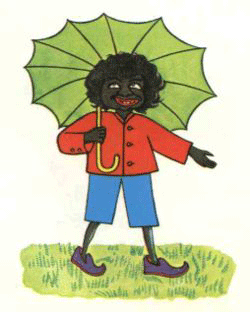
The infamous “Black Sambo” image.

Observations on the Baboons in the Garden of the “Bostan” Restaurant (Part Two)


[Note: These observations were first published in 1991 in Yemen Update and are archived online. The “Boston” has long since disappeared, but memories live on. For Part One, click here.]

Let me introduce you to the other guests besides myself, Flo and Eddy. At the table in front of me sat two Egyptian men who were soon joined by two Frenchmen. There was a rather abrupt shift from Cairene Arabic to French (or at least a form of French). What struck me was not the Egyptian or the French dialects, but the visual message on the back of a t-shirt worn by one of the French diners. This might have been purchased anywhere, of course, since all these designs are mumbo-jumbled internationally. First of all the color of the t-shirt was that of over-ripe banana pulp (it really was). Emblazoned on the back were four figures, each of them a replica of the racist “Black Sambo” image of Blacks in America during the “Amos ‘n Andy” era. One of these caricatures was boxing, another surfing, and so on. I suppose it was supposed to communicate nothing significant and for the most part it did here in Yemen. But I was somewhat appalled and was tempted to ask the fellow, whose back was a billboard for my face, to take off his shirt and wear it backwards (assuming only the over-ripe banana exuded on the front). Continue reading Observations on the Baboons in the Garden of the “Bostan” Restaurant (2)

Observations on the Baboons in the Garden of the “Bostan” Restaurant (1)

Observations on the Baboons in the Garden of the “Bostan” Restaurant (Part One)

[Note: These observations were first published in 1991 in Yemen Update and are archived online. The “Boston” has long since disappeared, but memories live on.]

It was a bright and breezy Friday afternoon in Sanaa. Having only recently arrived to the Sheba Hotel, I decided to forego experiencing the haute cuisine available in my room or at poolside for a Lebanese repast at the “Bostan Restaurant”. This Levantine oasis in Yemen is located only a stone’s throw away from the great wall of the Chinese Embassy on the road that parallels Zubeiri Street. On the sign outside you are welcomed to the “Bostan Tourism Restaurant”, although the astute diner will note that on the menu cover this metamorphoses into “Boustan”. (Perhaps the menu cover was printed in Paris? The French seem to love adding the letter “u” to words that can be perfectly well pronounced without: when I see “Bilquis” my tongue utterly fails). Continue reading Observations on the Baboons in the Garden of the “Bostan” Restaurant (1)

Woman by a Fountain

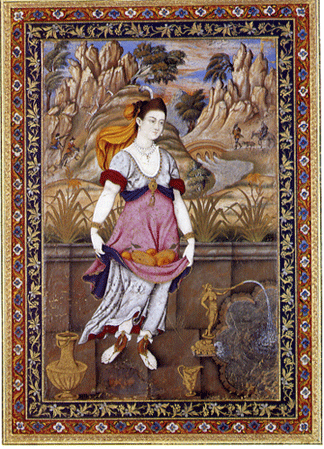
We are accustomed to Persian miniatures which depict the “Oriental” face, but later Persian art at times draws on Italianate style. The example above is entitled “Woman by a Fountain” and was painted by ‘Ali-Qoli Beyg Jebadar, around 1660 ce, probably in Isfahan.

Illustration from Abdolala Soudavar, Art of the Persian Courts (New York: Rizzoli, 1992), p.370.

Making Islam Democratic: Social Movements and the Post–Islamist Turn

Book Review of Making Islam Democratic: Social Movements and the Post–Islamist Turn (Asef Bayat)

by Richard Bulliet
Published on NYU Center for Dialogues website

Discussions of contemporary Islam in the United States tend to be held in black and white, with the religion depicted either as a backward, dangerous and hateful force, or as a misunderstood and moderate foundation for peaceful living. Discussions in Europe range over a somewhat larger spectrum because they are often based on experiences with immigrant communities, and usually engage cultural issues in addition to security–related ones.

The most colorful and useful expositions for readers in search of a deep understanding of Islam today, however, are those based on detailed and long–term observations made in Muslim–majority countries, where interactions with Euro–American sensibilities do not confound the issue. Having said that, the drawback with such in–depth analyses is that they typically examine a single country, leaving it to readers to decide how similar or dissimilar Muslim life in Morocco, say, is from that in Bangladesh or Somalia. Continue reading Making Islam Democratic: Social Movements and the Post–Islamist Turn

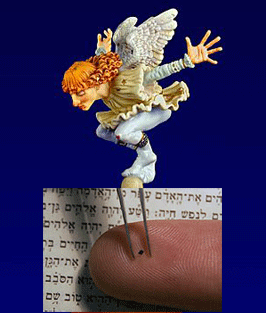
Pin the Biblical Tale on …

Riddle of the day (stretching back a bit): How many angels can dance on the head of a pin? Before you answer, here is what the theologian St. Aquinas had to say:

Q. 52, a. 3 – “Whether Several Angels Can Be At The Same Time In the Same Place? There are not two angels in the same place. The reason for this is because it is impossible for two complete causes to be immediately the causes of one and the same thing. This is evident in every class of causes. For there is one proximate form of one thing, and there is one proximate mover, although there may be several remote movers. Nor can it be objected that several individuals may row a boat, since no one of them is a perfect mover, because no one man’s strength is sufficient for moving the boat; the fact is rather that all together are as one mover, in so far as their united powers all combine in producing the one movement. Hence, since the angel is said to be in one place by the fact that his power touches the place immediately by way of a perfect container, as was said (Q. 52, a. 1) there can be but one angel in one place.”

So the devout answer would be “one,” assuming it was an angel who knew how to dance.

Next riddle: How many Bible tales can you inscribe on the head of a pin? Here is what the BBC has to say: Continue reading Pin the Biblical Tale on …