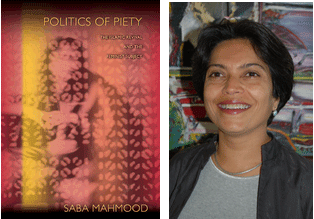
[In 2005 anthropologist Saba Mahmood published “Politics of Piety: The Islamic Revival and the Feminist Subject†(Princeton University Press). This important ethnography of the women’s mosque movement in Cairo not only presents an informative case study but challenges notions of how Muslim women’s involvement in pious movements should be analyzed in a feminist framework. The following excerpt is from the beginning of Mahmood’s book.]
Over the last two decades, a key question has occupied many feminist theorists: how should issues of historical and cultural specificity inform both the analytics and the politics of any feminist project? While this question has led to serious attempts at integrating issues of sexual, racial, class, and national difference within feminist theory, questions regarding religious difference have remained relatively unexplored. The vexing relationship between feminism and religion is perhaps most manifest in discussions of Islam. This is due in part to the historically contentious relationship that Islamic societies have had with what has come to be called “the West,†but also due to the challenges that contemporary Islamist movements pose to secular-liberal politics of which feminism has been an integral (if critical) part. The suspicion with which many feminists tended to view Islamist movements only intensified in the aftermath of the September 11, 2001, attacks launched against the United States and the immense groundswell of anti-Islamic sentiment that has followed since. If supporters of the Islamist movement were disliked before for their social conservatism and their rejection of liberal values (key among them ‘women’s freedom’), their now almost taken-for-granted association with terrorism has served to further reaffirm their status as agents of a dangerous irrationality. Continue reading Politics of Piety: A Case Study in Cairo