Category Archives: Countries

About that Surge

America must be victorious, but victory is out of the question. This is the election-year paradox facing voters. Assuming Obama’s delegate count surge continues through Texas and Ohio, the national campaign will bring the surge issue front and center in the race to replace Mr. Bush, the president who started a war he cannot finish. On the Republican side, John McCain’s resurrected political fortunes will pit the man who believes he has fixed the mopping-up problem in Iraq against the man who can claim in all innocence that he was against the Iraq war from the start. Both candidates support the troops and respect General Petraeus, who came close to being Time Magazine‘s “Person of the Year.” Either McCain or Obama may grace a future cover of Time as the man who ended the war that no one no longer wants but no one also wants to lose. But this is as unpredictable as the eventual success of the “surge” as a strategy to bring about a stable Iraq.

About that surge… Republicans in the main see it as working; democrats tend to see the whole war as a unilaterally Bush diversion from the real terrorists and the surge as a desperate ploy for time, too little and too late. So is the surge working? Continue reading About that Surge
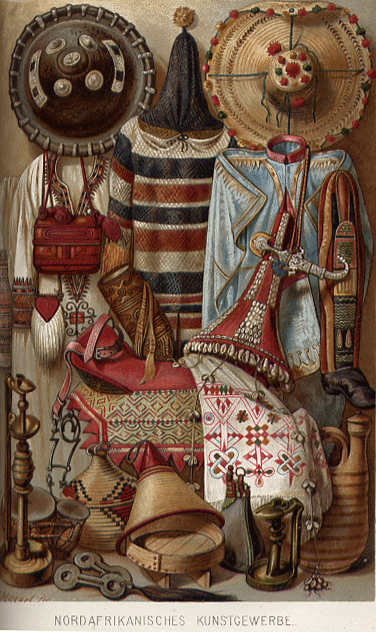
With Ratzel in North Africa

One of the most important German geographers of the late 19th century was Friedrich Ratzel (1844-1904), whose three-volume Völkerkunde (Leipzig and Vienna, Bibliographisches Institut, 1890) is one of those encyclopedia cultural accounts that circulated just as the discipline of anthropology was getting off (in this case literally “on”) the ground. While now a text for curiosity rather than critical scholarship on peoples and cultures, Ratzel’s work is still a fascinating portrayal of cultures being colonized for both revealing the biases of the day and the then-contemporary illustrations of people and material culture. My university library recently divested itself of uncirculated books in storage and one of these was an 1890 edition of the third volume on “Die Kulturvölker der Alten und Neuen Welt.” Whether it was the eye-watering althochdeutsch script of the volume or the mere fact it was written in German, no student or professor at Hofstra ever checked this volume out.

In salvaging a third of Ratzel’s opus for a mere dollar, I could not help but be drawn to the illustrations, mostly lithographs but with a few beautiful color plates. Continue reading With Ratzel in North Africa

International Conference: The New Draft Constitution of Turkey

The conference entitled “The Draft of the New Turkish Constitution” will bring together academics and politicians who have drafted the new constitution with scholars of democratic theory and comparative constitutions in a way that both side exchange critical views and share them with the public audience. The declared aim of the new constitution project is to contribute to the process of liberalization of Turkey’s political and legal systems as part of its integration to the European Union.

Monday, March 3rd: 9:00-6:30
International Affairs Building, Room 1501

This conference is sponsored by the Center for the Study of Democracy, Toleration, and Religion (CDTR) and the Institute for Religion, Culture and Public Life (IRCPL) at Columbia University, and Turkish Cultural Center (TCC).

For more information, please contact Ahmet Kuru: ak2840@columbia.edu Continue reading International Conference: The New Draft Constitution of Turkey

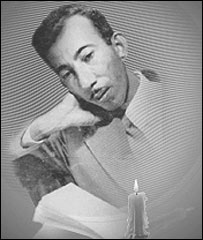
The Letters of Badr Shakir al-Sayyab: #15


The Iraqi Poet Badr Shakir al-Sayyab

[Note: This is the 15th in a series of translations of selected letters of the noted Iraqi poet Badr Shakir al-Sayyab. For more information on the poet, click here.]

Letter #15

Basra 3/16/1962

My Dear Brother Yusuf (al-Khal),

I miss you very much, but we will meet soon, God willing. I received a telegram from Simon Jarji in which he asks me if I can be in Beirut between the 10th and the 17th of April. He also says that the International Organization for the freedom of Culture will bear the expense of my travel and lodging. I will be in Beirut between these dates, with God’s help.

I now have “21” new poems, and I will strive to find a buyer for these poems in Beirut. I am in extreme poverty and will come to Beirut carrying only a few Dinars in my pocket. Perhaps you will be able to arrange something for me while I am in Beirut. As for waiting for a month, this is extremely difficult. I will write the “The Iraq Message” for you while I am in Beirut. All the literary news is in Baghdad…I will visit Baghdad on my way and will gather from there all the news that fits to be included in the “Message.” Continue reading The Letters of Badr Shakir al-Sayyab: #15

Dreams Stifled, Egypt’s Young Turn to Islamic Fervor

By MICHAEL SLACKMAN
The New York Times, February 17, 2008

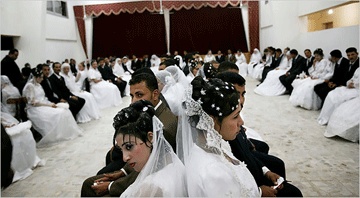
CAIRO — The concrete steps leading from Ahmed Muhammad Sayyid’s first-floor apartment sag in the middle, worn down over time, like Mr. Sayyid himself. Once, Mr. Sayyid had a decent job and a chance to marry. But his fiancée’s family canceled the engagement because after two years, he could not raise enough money to buy an apartment and furniture.

Mr. Sayyid spun into depression and lost nearly 40 pounds. For months, he sat at home and focused on one thing: reading the Koran. Now, at 28, with a diploma in tourism, he is living with his mother and working as a driver for less than $100 a month. With each of life’s disappointments and indignities, Mr. Sayyid has drawn religion closer.

Here in Egypt and across the Middle East, many young people are being forced to put off marriage, the gateway to independence, sexual activity and societal respect. Stymied by the government’s failure to provide adequate schooling and thwarted by an economy without jobs to match their abilities or aspirations, they are stuck in limbo between youth and adulthood. Continue reading Dreams Stifled, Egypt’s Young Turn to Islamic Fervor

To Sing or to Sin? Is that the Question?

Music is alive and well in Muslim societies; Arab, Persian, Indian and Indonesian pop stars abound on the satellite channels and perform at weddings and other celebrations. There are also famous music festivals, the Baalbek Music Festival being one of the most known venues. So it should not be a surprise that the Yemeni port of Aden, long a crossroads of Muslims traveling east and west, should be the home of an Arab music festival. The Aden Festival was booked for February 14 with the Syrian singer Asalah Nasri and Egyptian star Issam Karika. As noted in an article in the current Yemen Observer, the director of the Aden cultural office, Abdullah Kudadah, considers the festival as a primary step for creating a tourism culture that will contribute to the economic and cultural renaissance of Yemen.

He further mentioned that this coming concert was among several proposed festivals for singers from different Arab states, as well as the fact that Yemen is launching four new satellite channels.

“Music is an international language. We know how the ancient Arab tribes used to celebrate their poets because they used to believe that their poets would promote the tribe. The success of a poet is the success of the whole tribe,” said Kudada. He added that Ukadh used to be the forum for all Arab poets from different Arab regions.

The director of Aden festival, Marwan al-Khalid, said the festival is the first of its kind organized by the Aden governorate. He said the festival will be held in the 22 May stadium and that more than 400 prizes will be given to the audience. In addition to 400 cell phones and one million Yemeni riyals divided amongst twenty winners, the grand prize of a Hyundai automobile will also be given away. Al-Khalid added that there would be VIP tickets costing $100 each, which include dinner and beverages. Ordinary tickets will cost YR3000 each.

Organizers have also decided to donate 30 percent of the concert proceeds to the aid of the Palestinian people in Gaza and to cancer health care in Yemen.

Al-Khalid expected a great turnout for the festival due to the fame of the Syrian singer.

Cultural expression and tourism: what could be wrong with that? The Devil, quite literally it seems, is in the details, also noted in the Yemen Observer article: Continue reading To Sing or to Sin? Is that the Question?

Strolling Through Tarlabasi


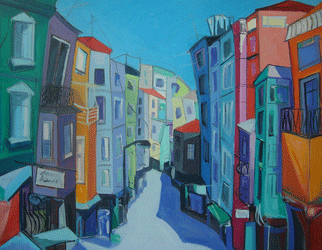
Tarlabasi, 2004, by Gamze Olgun, Oil Painting.

by Jenny White
Kamil Pasha Blog
Posted on January 24th, 2008

Tarlabasi is a district on the backside of the Beyoglu hill falling from the crest at Pera – where all the foreign embassies were in Ottoman times, now demoted to consulates – down in the direction of the Golden Horn. In The Abyssinian Proof, Kamil chases a wily criminal to his lair in Tarlabasi. The district is picturesque in the way of crumbling majesty on its last legs (a large part of Tarlabasi will be razed in 6 months, probably replaced by hotels). The steep, narrow lanes are strung with laundry, bustling with locals shopping at an outdoor market crammed into one of the lower streets. At the top of the hill near Istiklal Bouelvard are some lovely stone houses, now ruined or so shabby as to be nearly uninhabitable. A large stone house cracked down the side like an egg is posted for sale. As you walk down the hill, the houses become smaller, shabbier, sometimes outright ruins, less stone and more wood. In Ottoman times, Catholics and Greek Christians (Rum) lived near the top — shop owners, employees of the embassies — and poorer families near the bottom. Taylor Pepo’s apprentice lived in Tarlabasi with his family (The Abyssinian Proof). Today Tarlabasi is inhabited by Roma (gypsy), Kurds, the very poor, and social outcasts of various kinds. Continue reading Strolling Through Tarlabasi