Category Archives: Countries

TO BANISH THE “LEVANTINE DUNGHILL” FROM WITHIN

TO BANISH THE “LEVANTINE DUNGHILL” FROM WITHIN: TOWARD A CULTURAL UNDERSTANDING OF ISRAELI ANTI-IRAN PHOBIAS

By Haggai Ram, International Journal of Middle East Studies 40 (2008), 249–268.

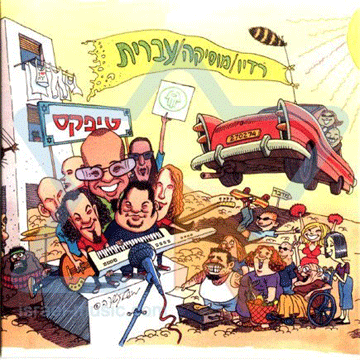
Held since 1956, the Eurovision Song Contest is an annual event traditionally dedicated to the eternal themes of love, peace, and harmony. Yet Israelis asked to pick a song for the 2007 contest in Helsinki paid little heed to these themes. Instead, they settled for “Push the Button,” a controversial number by an Israeli punk group called Teapacks; the song is generally understood as a description of life under the threat of a nuclear-armed Iran with its “crazy rulers.” Meanwhile, an Israeli fashion house (Dan Cassidy) commissioned a series of photos at a construction site in southern Tel Aviv that showed a topless model lying in a pit. The project was designed as a warning against the “holocaust” that would follow Iran’s possible nuclear attack on Israel; the pit, as the project’s creative director explained, represented “the mass grave of complacent Tel Aviv residents.” Continue reading TO BANISH THE “LEVANTINE DUNGHILL” FROM WITHIN

The Letters of Badr Shakir al-Sayyab: #21


The Iraqi Poet Badr Shakir al-Sayyab

[Note: This is the 21st in a series of translations of selected letters of the noted Iraqi poet Badr Shakir al-Sayyab. For more information on the poet, click here.]

Letter #21

Al-Ma’qil, 9/17/1964

My Brother, Adunis. Dearest Beloved (along with Muhyi al-Din Muhammad). May I be lucky enough to find Muhammad.

O Dearest Friend,

How are you? Correspondence between us has stopped for about nine months now. The two reasons for this are bad luck and my incurable disease. My general health is not bad, but my two paralyzed legs are still the same. My soul is overflowing with poetry, but it is poetry that flows from the fountain of deep pain and dejection, not of delight. Just yesterday, I wrote a poem void of sadness, despair, and pain because our brother, ‘Ali al-Sabti, met with my loved ones in Lebanon and carried joyful news about them to me with a promise that they will send me a letter. Continue reading The Letters of Badr Shakir al-Sayyab: #21

Open season on Egypt’s opposition, but Islam is not the solution

By Andrea Teti, Department of Politics and International Relations, University of Aberdeen

Following a wave of strikes and an equally spectacular tsunami of price increases in a range of essential goods over recent months, the April 8th local elections seemed for a brief moment to have become a focus for Egypt’s diverse opposition. A few days before a general strike proclaimed for April 6th, the coalition for democratic change Kifaya! (Enough!) published a statement saying it expected the Muslim Brotherhood’s active support. In the event, the Brotherhood defended Kifaya!’s right to strike, but did not participate in it. Then, following a wave of pre-election arrests and dirty tricks by the ruling National Democratic Party – resulting in a mere 21 MB candidates making it onto ballots out of the 5,754 put forward – the MB declared the elections beyond repair, and boycotted them. The NDP’s electoral victory (97% of posts) was as striking as the estimated 5% voter participation rate. Continue reading Open season on Egypt’s opposition, but Islam is not the solution

Tolerance takes a hit in Indonesia

Among Muslim majority states, Indonesia has a reputation for being one of the more tolerant, given the variety of religious persuasions in this multi-island nation. But recently there has been a flare up against the Ahmadiyya order. As reported on the BBC, the government of Indonesia is considering a ban on the Ahmadiyya:

About 2,000 people have gathered in the Indonesian capital, Jakarta, to protest against a minority Muslim sect, the Ahmadiyya community.

Speakers outside the presidential palace demanded the group be banned.

That was what a government panel recommended last week, saying the Ahmadiyya’s beliefs went against Islam as practised in Indonesia.

But the Ahmadiyya argue that, like other minorities, they are protected under the Indonesian constitution.

The Ahmadis believe their own founder, Mirza Ghulam Ahmad, who died in 1908 in India, was a prophet.

That contradicts the belief of most Muslims, who think the Prophet Muhammad was the last prophet.

The Ahmadiyya face persecution in many countries.

Less than a month ago, an Ahmadiyya mosque was destroyed by protesters, as can be seen in video. This is not a new situation, as persecution of Ahmadiyya has previously been reported for Indonesia.

Human Rights Watch has called on the Indonesia government not to issue the ban on the Ahmadiyya, a ban which would contradict the state’s constitution on religious liberty. For a pro-Ahmadiyya view of the situation, click here.

Bint al-Shati’: A Female Voice In Islamic Law

from al-Ahram, July 2004

Aisha Abdel-Rahman, better known as Bint Al-Shati’, might have become famous for her fiction and poetry but it was her stories on rural Egypt which launched her writing career in Al-Ahram. The “Daughter of the Shore”, writes Professor Yunan Labib Rizk, had a weak spot for the countryside and its people

From the outset of her career, Aisha Abdel-Rahman, a prominent scholar and writer, preferred to go by the name Bint Al-Shati’ (Daughter of the Shore). She adopted this pen-name, which alludes to her birthplace in Damietta, out of respect for her family’s customs — her father was a scholar in a religious institute in that northern Egyptian coastal city — and because it was also a custom of that age for women writers to conceal their true identities.

Bint Al-Shati’ first made her mark in Al-Ahram in the summer of 1935 when the newspaper allocated considerable front-page space to the problems of rural Egypt. She was only 23 at the time (she was born in 1913), which is not so odd in itself — it was Al-Ahram ‘s policy to give a chance to young and talented aspiring writers, of whom some later became its prominent featured writers and literary and intellectual celebrities. What was odd, given her conservative family background, was the level of education she attained. Her father, an Azharite, would not allow her “modern schooling” so he educated her himself, and so solid was his instruction that she came out first among all the female students who sat for the competency certificate for teachers “from their homes” in 1929. Thus encouraged, she received her secondary school baccalaureate in 1934. This was the only certificate she was armed with when she began writing for Al-Ahram the following year. But then whoever said that degrees make a writer? Continue reading Bint al-Shati’: A Female Voice In Islamic Law

Mullah Atari

Since the U.S.-led take-over of Iraq, now more than five years ago, a wide range of Iraqis have become mad as hell, or perhaps more accurately mad enough to make hell with both the U.S. military and against each other. Some are even mahdi as hell, resulting in the Mahdi Army virtually commanded by Muqtada al-Sadr, the grandson of a well-known shi’a grand ayatollah. This renegade militia is the major homegrown thorn in the side of President Nuri al-Maliki’s Green Zone republic. Starting in October, 2003, Muqtada put into play a shadow Islamic government and by August of 2004 he called on his supporters to fight the Coalition forces. For almost three years there has been a loose ceasefire, but that was shattered recently when al-Maliki attempted to oust the Mahdi Army from Basra. Continue reading Mullah Atari

Obama’s Indonesian Lessons

By Roger Cohen, The New York Times, April 14, 2008

When Barack Obama’s Indonesian classmates are asked to recall the boy they all called “Barry” (pronounced “Berry”), their description is unanimous: “chubby.”

He was the tall, chubby kid in Bermudas who joined their 4th grade class at the Besuki elementary school in 1970, the boy with the white mother and Indonesian stepfather who brought his own sandwiches to school (odd to a noodle-eating crowd) and, strangest of all, wrote with his left hand.

“It was so weird that he was left-handed,” recalled Ati Kisjanto, now a marketing consultant. “That was considered impolite here, and you were forced to write with your right hand.”

A dozen of Obama’s classmates were gathered at the house of Sandra Sambuaga, exchanging stories over Indonesian delicacies. Continue reading Obama’s Indonesian Lessons

Pollsters in Iran


Ayatollah Ali Khamenei

Iranians Favor Direct Talks with US on Shared Issues,

Mutual Access for Journalists, More Trade

Poll Finds Diminished Perception of US Threat,

General Thawing of Hostility

World Public Opinion, April 7, 2008

College Park, MD—A new poll finds that although Iranians continue to view the United States negatively, they strongly support steps to improve US-Iran relations including direct talks on issues, greater access for each others’ journalists, increased trade and more cultural, educational and athletic exchanges.

While majorities of Iranians think the United States threatens Iran and is hostile to Islam, these numbers have diminished over the past year. A growing number—now two out of three—believe it is possible for Islam and the West to find common ground. Continue reading Pollsters in Iran