Category Archives: Countries

Dancing with Snakes

For Yemen’s Leader, a Balancing Act Gets Harder

By ROBERT F. WORTH, The New York Times, Saturday, June 21, 2008.
SANA, Yemen

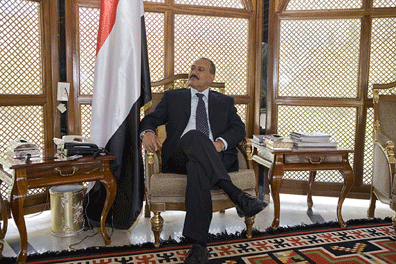
PRESIDENT Ali Abdullah Saleh’s face is everywhere in Yemen. He stares out from billboards, shop windows and living room walls, always with the same proud expression: eyes glinting, chest thrust out as if to confront a challenger. After 30 years in power, Mr. Saleh has become almost synonymous with the state in this arid, desperately poor corner of southern Arabia.

But lately the president, 66, known for his wicked sense of humor, has been uncharacteristically dour. A war with northern Shiite rebels has spread to the outskirts of the capital. Terrorist attacks have led embassies and foreign companies to evacuate their employees. With an insurrection rising in the south as well, the turmoil has renewed fears that this conservative Muslim country of 23 million, a longtime haven for jihadists, could collapse into another Afghanistan.

Mr. Saleh, his gruff voice tinged with anger, dismissed the rebels as “racists” who want to return to Yemen’s ancient system of religious rule. They have won popular support by associating his government with the United States, he said during an hourlong interview inside the sprawling, high-walled presidential palace compound. Continue reading Dancing with Snakes
Picturing Damascus

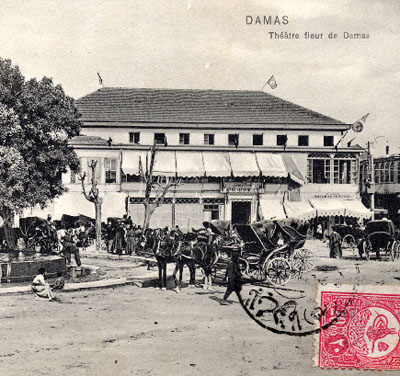
Visual archives abound on the Middle East and a growing number of these now appear on the Internet. One of these is mideastimages.com, which hosts a variety of historic photographs focusing on the cities of Aleppo, Baghdad, Cairo, Damascus, Istanbul, Jerusalem and Palmyra. Here is a postcard mailed from the Thomas Gate post office in Damascus during the Ottoman period. It depicts the Flower of Damascus Theatre, owned by Habib Shamas, in the Marje Square. In 1912 this theatre hosted the first movie played in Damascus. The theatre was converted to a Cinema in 1918. (Source: DAMASCUS BY Dr. K. SHIHABI 1986)

Darfur Crisis


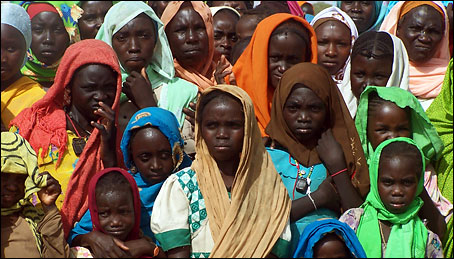
Freshly displaced Darfuris await the arrival of the UN relief coordinator Jan Egeland in the rebel held town of Gereida in southern Darfur, 07 May 2006.
AFP/Getty

The Washington Post has an informative and easy to use web presentation on the crisis in Darfur. Click here to start the tour.

Iraq after a Millennium

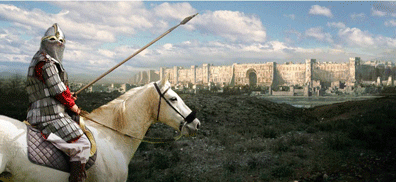
There is an old saying, renewed whenever we reflect on contemporary politics: the more things change, the more they remain the same. A little over a millennium ago, the widely traveled scholar Shams al-Din Abu ‘Abd Allah Muhammad al-Muqaddasi wrote a geographical compendium of the world. He is as opinionated as any op-ed columnist, but also an astute observer of the foibles of his own time. So how did al-Muqaddasi, who had traversed much of the known Islamic world in his time, view Iraq? Here is his assessment; c’est la vie!

This is the region of men of refinement, the fountainhead of scholars. The water is delightful, the air marvelous; it is the chosen place of the khalifs. It produced Abu Hanifa, the jurist of jurisprudents; and Sufyan, the best of the Quranic Readers. From here came Abu ‘Ubayda, and al-Farra‘, and Abu ‘Amr, author of a system of Quranic reading. It is the birthplace of Hamza, and al-Kisa’i: of virtually every jurist, Reader, and litterateur; of notables, sages, thinkers, ascetics, distinguished people; of charming and quick-witted people. Here is the birthplace of Abraham, the Compansion of God, thither journeyed many noble Companions of the prophet. Is not al-Basra there, which can be compared to the entire world? and Baghdad, praised by all mankind? sublime al-Kufa and Samarra? Its river most certainly is of Paradise; and the dates of al-Basra cannot be forgotten. Its excellences are many and beyond count. The Sea of China touches its furthermost extremity, and the desert stretches along the edge of it, as you see. The Euphrates debouches within its limits.

Yet it is the home of dissension and high prices, every day it retrogresses; from injustice and taxes there is trouble, and distress. Its fruits are few, its vices many, and the oppression of the people is heavy.

[Excerpt from al-Muqaddasī, The Best Divisions for Knowledge of the Regions. Translated by Professor Basil Collins. Reading: Garnet Publishing, 2001.]

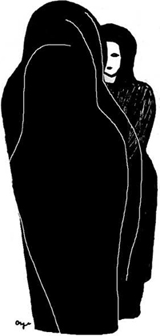
Me without my hijab

Removing my head covering changed how I saw myself and the world.
By Zainab Mineeia, Los Angeles Times, June 8, 2008

When I came to this country, I took off my hijab. It wasn’t an easy decision. I worried at night that God would punish me for it. That’s what I had been taught would happen, and it filled me with fear.

I was 27, coming from my home country of Iraq to study in California. I hoped that by taking off the hijab I had been wearing for eight years, I would be able to maintain a low profile. In Baghdad, you keep a low profile to stay alive. But in the United States, I merely wanted not to be judged.

Still, I was filled with anxiety. As I flew toward the United States, I wondered how I would feel when the moment came to appear with my head uncovered. Continue reading Me without my hijab

Hip hop subculture gets spotlight in Sana’a


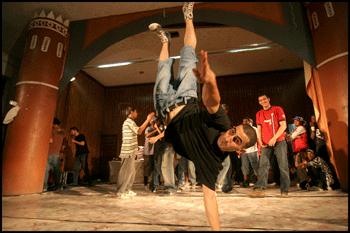
One of the competing breakdancers, Khaled Sinjab, performs complicated dance
moves for his crew “Blast Boyz.”

By Fares Anam, Yemen Observer, Apr 26, 2008

An enthralling show performed by Arab youth was held Wednesday night at the Yemeni Center for Studies and Research. Enlivened by hip hop music, these students studying in Yemen competed to be recognized as the best dancers and singers in Sana’a.

The hip hop festival, titled “Common Ground,” brought this unique American art form together with Arab youth by offering music and dance to the capital. The hip hop party was organized by the French Culture Center in cooperation with the German House, under the control of the Arbitration Commission. The event was supervised by French dancers Romo, Gohen and Fred Burki, in addition to DJ Malik and the Yemeni-American singer, Haggagi. Continue reading Hip hop subculture gets spotlight in Sana’a

Arabic ‘Threatens’ Israeli Supremacy


HEBREW FIRST: File photo of Limor Livnat speaking to the media in the United States in 2000: “In these times, when there are radical groups of Israeli Arabs trying to turn the State of Israel into a bi-national state, it is most urgent to put into law the unique status of the language of the Bible – the Hebrew language,” Livnat has argued. (Newscom)

By MEL FRYKBERG Middle East Times, June 10, 2008

JERUSALEM — In a move that has outraged both Arab Israelis and some progressive Jewish Israelis, a new bill was presented to the Israeli Knesset or parliament last week to relegate Israel’s other official language Arabic to that of a secondary language, leaving Hebrew as the only official language.

The bill was drafted by Likud Member of the Knesset (MK) Limor Livnat, a renowned right-winger, and was seconded by MKs Yuli Edelstein from Likud, Otniel Schneller from Kadima and Ya’acov Margi from the ultra-Orthodox Shas party.

Should this move be approved by the Knesset, then Arabic would be downgraded to the same level as English, a language native to only a small percentage of Israeli immigrants, and taught in schools primarily for the purpose of communicating with the international community.

Arabic is the native language of Arab Israelis or 20 percent of Israel’s population. Russian is spoken by 1 million people, out of a total comprising just over 7 million, with the remainder of the population speaking Hebrew as its first language. Continue reading Arabic ‘Threatens’ Israeli Supremacy