Category Archives: Countries

Not your Daily Bread


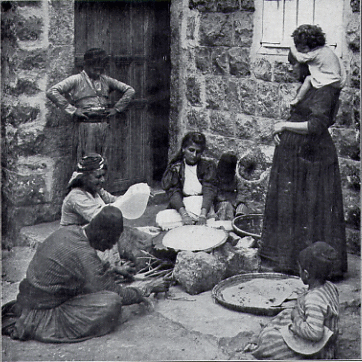
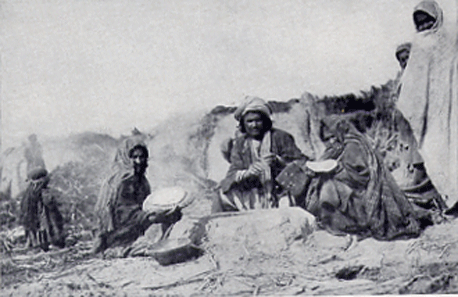
Baking bread in Seyistan on the Afghan Border

[It is hard to find a society in the Middle East without a thriving history of bread preparation. Before the modern loaf and bleached flour assaulted our tastebuds, a variety of flat breads were baked, either in clay overs or other makeshift ovens. Here is a description of both Afghan and Turcoman bread making from a century ago, as reported by Ellsworth Huntington in the National Geographic Magazine in 1909. Webshaykh.]

The method of cooking it was very different from that employed in the oases, where ovens of mud shaped like beehives, with a hole in the top, are heated with a fire of weeds, and the dough is stuck against the inside of the hot oven, where it hangs until it is so far cooked that it falls down into the ashes. The bread of the Afghan caravan was cooked by heating small, round cobblestones in the fire and then poking them out and wrapping dough an inch thick about them. The balls thus formed were again thrown into the fire to be poked out again when cooked. The bread tasted well there in the desert, although in civilized communities the grit and ashes would have seemed unendurable. Continue reading Not your Daily Bread
From Failed Resolution 1696 to Real Diplomacy


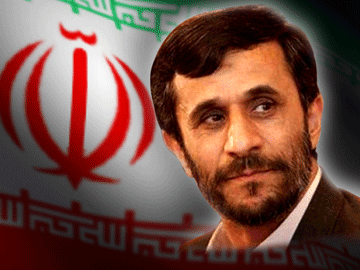
Iranian President Mahmoud Ahmadinejad

by William O. Beeman

The United Nations Security Council Resolution 1696 calling for Iran to suspend nuclear enrichment was passed on July 31, 2006 — nearly two years ago. Every sanction and demand placed on Iran since that time has been based on this Resolution (and its strengthened re-iteration, Resolution 1737 on December 23 of the same year).

Clearly after two years the Resolution and its follow-ups have not worked. Iran has not suspended its uranium enrichment activities, and indications this week are that it is not likely to do so in the future. The United States and its reluctant European allies obviously can not put enough pressure on Iran to cause it to abandon what the Nuclear Non-Proliferation Treaty — to which Iran (but not Israel, Pakistan or India) is signatory – provides as is its “inalienable right”: peaceful nuclear development. As long as it does not violate Provision One of the NPT, namely the agreement not to develop nuclear weaponry. Continue reading From Failed Resolution 1696 to Real Diplomacy

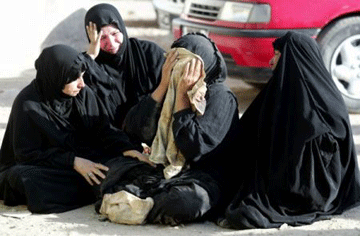
Despair Drives Suicide Attacks by Iraqi Women

By ALISSA J. RUBIN, The New York Times, July 5, 2008

BAQUBA, Iraq — Wenza Ali Mutlaq walked a bit uncertainly up the long street near the main government offices here on June 22, the hot wind stirring her heavy black abaya. She passed the concrete barricades put up to ward off suicide car bombers and made her way alone, almost haphazardly.

Suddenly, a police car zoomed in. A policeman got out to talk with her. And then their lives were over — torn apart, along with 14 other people, by the huge blast of fire from her concealed explosive vest.

Ms. Mutlaq, who was in her 30s and whose attack was captured on a security video, was the 18th female suicide bomber of the war to strike in Diyala Province, which has been hit by female attackers much more frequently than any other province of Iraq, according to Iraqi police records and the American military. So far, 11 of the 20 suicide bombings carried out by women in Iraq this year have occurred in Diyala. Continue reading Despair Drives Suicide Attacks by Iraqi Women

Virtual Vengeance

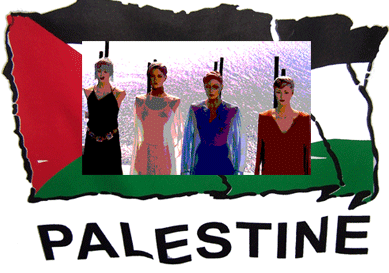
There are more online shoot-em-up games than a person can shake an MK-37 at. The enemies are always the ‘bad guys,’ including Muslim terrorists, who might as well be Nazi or Japanese kamakazi pilots. Of course, video gaming (unlike duck hunting) is all fantasy, I am told. Isn’t it better to shoot fake bullets and rip apart digital bodies online than harm real people (or ducks)? Surely it is. So, if you are interested in seeing the tables turned and are concerned about the usual representation of Palestinians as terrorists, you may find the following video of interest. And remember, it is of course only fantasy.

A Course on the Collision Course

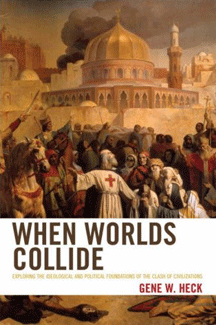
[The aftermath of 9/11 has yielded a stream of books on Islam and violence, so much so that it is rare to find a book about Islam that does not tackle the issue one way or the other. Part of this is due to media promotion of books like Bernard Lewis’s What Went Wrong? and the neocon mantra borrowed from Samuel Huntington’s Clash of Civilizations thesis. A refreshing rejoinder to all this clash talk is provided by Gene Heck in his recent When Worlds Collide: Exploring the Ideological and Political Foundations of the Clash of Civilizations. Here is an excerpt from his Introduction. Webshaykh]

What are the Causes of Modern Middle East Terror?

5. That the so-called Wahhabi movement is often unjustly maligned for alleged doctrines and precepts that do not comport with the actual teachings of the movement’s eighteenth-century founder, Muhammad ibn ‘Abd al-Wahhab, who advocated jihad by peaceful, not militant, means. Continue reading A Course on the Collision Course