Category Archives: Countries

Milking the Camel

One of the most common Orientalist tropes about the Middle East is the image of the camel, the ship of the desert. Bernard Lewis angered Edward Said by comparing one of the Arabic terms for revolution (thawra) to a camel’s rising, a point made in the old Arabic lexicons. But the camel strikes back on Sharjah Television. On the program “Medicine and Islam” the benefits of camel’s milk are spelled out, including some rather grand claims.

The video on Islamic Tube is accompanied by the following article from the Khaleej Times:

SHARJAH. A research body here is seeking global tie ups to produce drugs to treat deadly diseases including Aids from the unique antibodies found in camel`s milk. Continue reading Milking the Camel
Lebanon Cluster Bomb

Screening and Discussion:
Sneak Preview Screening of Jawad Metni’s “Lebanon Cluster Bomb”

To mark the 2nd anniversary of Israel’s brutal war on the people of Lebanon, Alwan for the Arts and Deep Dish TV present four evenings of films from Deep Dish TV’s new eight part television series NOTHING IS SAFE. The screenings are on consecutive Wednesdays July 23, July 30, Aug 6, and Aug 13.

July 30, 2008 Program
Free and Open to the Public
A sneak preview of Jawad Metni’s new feature documentary “Lebanon Cluster Bomb”

LEBANON CLUSTER BOMB
Sneak preview (2008, Jawad Metni, 90 min)

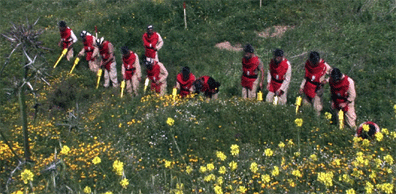
LEBANON CLUSTER BOMB follows the men and women of South Lebanon who were hired and trained to clear unexploded cluster munitions after the July 2006 war. The Israeli Defense Forces dropped nearly 1 million of these dangerous weapons across 40 million square meters of South Lebanon. Hundreds of thousands failed to explode, and continue to kill and maim civilians 2 years after the war. The film is a primer on the cluster munition problem in Lebanon, but much more so an intimate portrait of those struggling to rebuild their lives after the devastating 2006 war. The under-represented of South Lebanon are given voice here, as they work shoulder to shoulder to return the land back to their fellow Lebanese. Continue reading Lebanon Cluster Bomb

Dinosaurs in Yemen


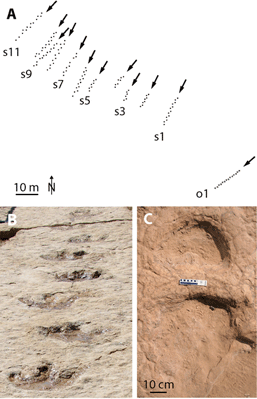
(A)-Map of tracksite with ornithopod (trackway o1) and sauropod (trackways s1–s11) trackways, (B)-Trackway of the ornithopod (trackway o1: steps 3–10), and (C)-Sauropod left manus and pes print (trackway s6: step 12).

Scientists have discovered the first dinosaur tracks on the Arabian Peninsula. In the May 21 issue of the journal PLoS ONE, they report evidence of a large ornithopod dinosaur, as well as a herd of 11 sauropods walking along a Mesozoic coastal mudflat in what is now the Republic of Yemen. “No dinosaur trackways had been found in this area previously. It’s really a blank spot on the map,” said Anne Schulp of the Maastricht Museum of Natural History in The Netherlands. He conducted the study with Ohio University paleontologist Nancy Stevens and Mohammed Al-Wosabi of Sana’a University in Yemen.

The finding also is an excellent example of dinosaur herding behavior, the researchers report. The site preserved footprints of 11 small and large sauropods — long-necked, herbivorous dinosaurs that lived in the Jurassic and Cretaceous periods — traveling together at the same speed. Continue reading Dinosaurs in Yemen

Colonizing Iraqi Cuisine

by Omar Dewachi

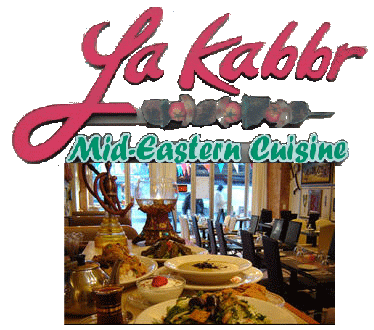
On April 23 , the New York Times published an article, “A Bit of Old Baghdad With a Western Twist,” in its ‘Dining and Wine’ section, reviewing La Kabbr, an Iraqi restaurant in New York City. Instead of drawing on an expert of Iraqi cuisine, the author of the article chose to focus on the Times Bureau Chief in Baghdad, now the editor of the world section of the Times Magazine, who had spent 4 years covering the war. The article celebrated how this restaurant in New York has become a “clubhouse for journalists and officials who have spent time in Baghdad, and for Iraqi expatriates and Iraqi-Americans.” Aparisim (Byline, Bobby) Ghosh the Baghdad Bureau chief seems to speak as an authority of Iraqi cuisine when he is quoted in the article saying:

“I wonder why Iraqi cuisine is not more sophisticated,” he said. “It is essentially peasant food, which I happen to love because it fits my palate perfectly. But intellectually, you wonder why, with all of its influences, the food isn’t more complex.”

Continue reading Colonizing Iraqi Cuisine

Can the Umm al Qura calendar serve as a global Islamic calendar?

by Khalid Chraibi

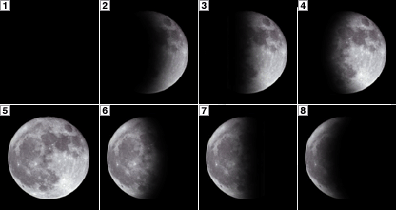
Over the past 50 years, the Arab League, the Organization of the Islamic Conference (OIC) and other similar bodies presented their member States with over a half-dozen proposals aiming at the establishment of a common Islamic calendar. Although none of these proposals was adopted, efforts in search of a solution that could be satisfactory to all interested parties continue to this day. For its part, the Fiqh Council of North America (FCNA) was also regularly confronted with the responsibility of telling its Muslim American audience when to start fasting, when to celebrate «eid al-Fitr», «eid al-Adha», etc. After several years of study of the legal issues involved, it reached a decision, which it announced in August 2006, to use henceforth a pre-calculated Islamic calendar, taking into consideration the sightability of the new moon anywhere on Earth. (1)

First, it retains the well-known principle of unicity of horizons (matâli’) which states that it is sufficient to observe the new moon anywhere on Earth, in order to declare the beginning of a new lunar month, applicable in all areas in which the information is received. Second, it uses the International date line (IDL) or Greenwich Mean Time (GMT) as its conventional point of reference to conduct its analysis. Continue reading Can the Umm al Qura calendar serve as a global Islamic calendar?

Playing Games with Iran


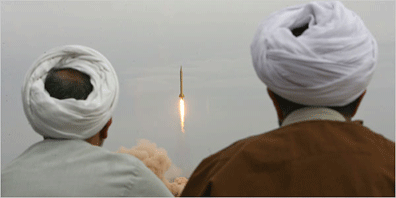
Clergymen watched a missile during war games Thursday near Qum, Iran. The exercise was conducted by Iran’s Revolutionary Guards. Fars News Agency, via Agence France-Presse

by William O. Beeman, Foreign Policy In Focus, July 21, 2008

By now the structure of the U.S. game with Iran is clear. In the first move, the United States and Iran make some small progress toward improved relations. In the counter move, hardliners in the United States and Israel launch attacks against Iran in order to sabotage these improving relations.

In the latest iteration of this game, the U.S. State Department has made an interesting gambit. It announced that Undersecretary of State William Burns would sit at the table on July 20 as members of the European Union entered into talks with Iran over its nuclear program. At the same time, the United States has been reported to be considering opening a formal American Interests Section in Tehran. These two actions will be the first serious public diplomatic activities between the two nations in nearly three decades. (Three earlier meetings in Baghdad between U.S. Iraqi Envoy Ryan Crocker and Iranian Ambassador to Iraq Hassan Kazemi-Qomi focused on security in Iraq). Continue reading Playing Games with Iran

Divided We Stand

Divided We Stand: A Woman’s Word about the Iranian-American Experience

by Dagmar Riedel

Gertrude Stein is alleged to have advised young Ernest Hemingway that he’d better stick to writing postcards if he had messages for his readers. It is understandable that Iranian-Americans want to reach American-American audiences with their stories about men and women with legs astride in two different cultures. But who is authorized to question a novel with a message, if its content is certified by the author’s traditional upbringing in Iran before the Islamic Revolution?

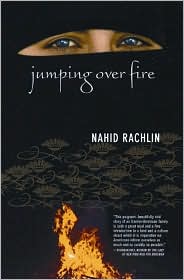
The fourth novel of Nahid Rachlin, Jumping over Fire (City Lights Books, 2005; cf. www nahidrachlin.com), has an intriguing black cover. Above the title a pair of blue eyes are staring intently at the viewer through the eye slit of a head scarf, while the bottom half merges a floral Arabesque with the yellow-red flames of a Nowruz bonfire. The title’s reference to the Nowruz purification ritual of jumping over fire is explained in the course of the novel. But on the cover the Zoroastrian tradition is presented as a variant of Western stereotypes of both the Oriental harem and Shia fanaticism because the collage promises a peek in the otherwise hidden world of a secluded Iranian woman and her burning desires. The reader has just to turn to the back cover to receive from Andre Dubus III, the son of the famous short-story author Andre Dubus, the confirmation that this is indeed a novel about a forbidden desire. The interpretation is further reinforced by the one-page biographical sketch in the back, written in the third person singular and designed to highlight in an objective language the author’s lifelong personal experience with displacement and gender-based social restrictions. Continue reading Divided We Stand

Gender Takes a Licking

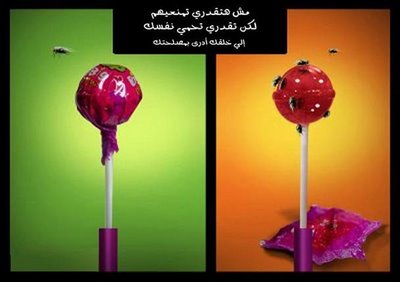
One thing that ethical reflection by most Muslims, Christians and feminists can agree upon is that female sexuality in advertising is degrading to women, turning them into objects for the male gaze. There is no question that sex sells and not just on Madison Avenue. A recent video commercial for Wall’s Magnum chocolate bar, starring Pakistani model Neha Ahmed, is as suggestive as any MTV video. Indeed Bollywood rivals Hollywood in depicting the female body as a focus of attraction. But exploitation is not only from companies out to make a buck by subliminally changing the letter “b” to the letter “f.” Sometimes those sincere individuals who think they are defending women’s honor end up reinforcing the stereotype. Such is the case for the image pictured above and posted on an Islamic website. There are many reasons why a woman would choose to wear hijab, but in this metaphor their gender takes a licking. The issue is not the wrapping, whether hijab or sticky paper, but the fact that flies will go for the candy no matter what you try to do. Does it occur to the creator of this image that the problem is not with candy, which is tasteful in the right context, but the nuisance of unzipped flies. Someone go find the fly swatter, please.

Luke R. E. Publican