Category Archives: Countries

A Persian Catwalk


Iran’s Catwalk Ban Is Only The Beginning

by Farangis Najibullah, Radio Free Europe/Radio Liberty, September 20, 2008

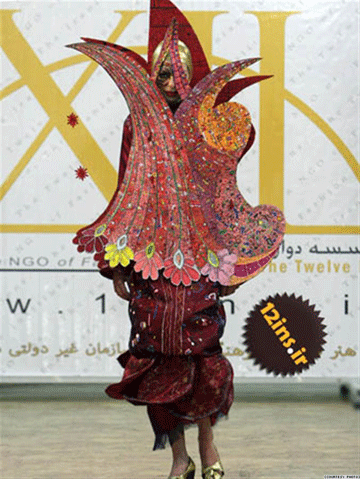
Move modestly. No garish makeup. Don loose and unrevealing clothing. Those are some of the new rules for Iranian models, who have been told not to attract too much attention during fashion shows.

The orders, handed down by the Culture and Islamic Guidance Ministry and published this month, are intended to promote Iranian and Islamic designs and stave off the influence of Western culture.

Live models “should avoid any behavior that would distract visitors’ attention from the clothes put on display,” according to the eight-part “Guideline For Fashion And Dress Shows.”

“Models are not allowed to show off the curves of their bodies, and their hair should not be seen,” the document reads. “The wearing of tight and body-hugging clothes and types of makeup that are incompatible with Islamic and Iranian culture are prohibited.”

Musical accompaniment must be “well-matched to Islamic and Iranian culture,” and should not prompt models to move or walk in an inappropriate manner.

And the fashion-show runway, better known as the catwalk? That’s been banned altogether, since it’s been deemed a slavish imitation of foreign culture. Continue reading A Persian Catwalk →

Lucie Wood Saunders, 1928-2008

Lucie Wood Saunders, 1928-2008

One of AMEWS’ earliest members and warmest supporters, Lucie Wood Saunders, passed away on July 26, 2008. Lucie received her PhD in Anthropology from Columbia University in 1959. Her dissertation research was on parallel cousin marriage in Arab families. She carried out research in Egypt, at the invitation of Laila el Hamamsy, Director of American University of Cairo’s Social Research Center, starting in 1961 and into the 1980’s in the Egyptian Delta village, Tafahna el-Ashraf. She worked with Sohair Mehanna of the SRC, authoring many articles with her on Tafahna el-Ashraf. Lucie was among the first Anthropologsits to write on issues of gender in the Delta villages. Her research inspected family and gender relations, the local zar cults, women and development issues around small businesses such as poultry, and medical anthropology. Her early work focused more on psychological issues and her later work more on economic issues. Continue reading Lucie Wood Saunders, 1928-2008 →

The surge be praised but pass the ammunition

The potential meltdown of Wall Street has brought the economy front and center as “the” issue in the closing days of the election cycle. Even Friday’s debate, originally planned to focus on foreign policy, started out on the state of the economy and looming bail-out plan in congress. But Iraq is not about to disappear from the news. If the only measure of progress in Iraq is the raw number of U.S. casualties, then the “surge” be praised, but keep passing the ammunition. Darfur is also out of the daily news cycle these days, but the killing there has hardly abated. Afghanistan does make the headlines, in part because U.S. casualties are rising dramatically this year.

So five years and counting after the shock-and-awe sweep through Iraq and the May Day announcement of “Mission Accomplished” by George W. Bush, the mission continues and the death toll keeps rising. Here is yesterday’s count from al-Jazeera:

Deadly car bombs rock Baghdad Continue reading The surge be praised but pass the ammunition →

The OIC does not speak for Muslims

The OIC does not speak for Muslims

by Tarek Fatah, Muslim Canadian Congress, UN Geneva

I speak to you as a Muslim who was born in Pakistan and lived there for 30 years and moved to Saudi Arabia where I worked for 10 years. Since 1987 I have called Canada my home. As an author, journalist and Muslim activist, I have seen the role and agenda of both the soft and hardcore jihadis unfold before my eyes and across the Muslim world.

I approach the issue of freedom of speech and freedom of expression embodied in the 1948 UN Declaration of Universal Human Rights as defending a treasured right that few of my co-religionists can dream off, let alone cherish or possess. We are over a billion strong, but almost all of us live under varying forms and degrees of dictatorship and oppression. Barring a few exceptions such as Turkey, Malaysia and Indonesia, and very recently Pakistan, Muslims live under the tyranny of rulers like those of Iran and Saudi Arabia who have used the religion of Islam as a tool to secure absolute power, and to trample all over the human rights of their citizens.

Barely a day goes by without news of gross violations of human rights of Muslims living in so-called Islamic countries. Whether it is honour killings of sisters and mothers or the harassment of gays and calls for their death; whether it is imprisonment of political opponents or attacks on minorities, we Muslims who live in the West are constantly reminded of the rights we enjoy under secular parliamentary democracies as individual human beings. Continue reading The OIC does not speak for Muslims →

Tzipi Livni is Israel’s Barack Obama


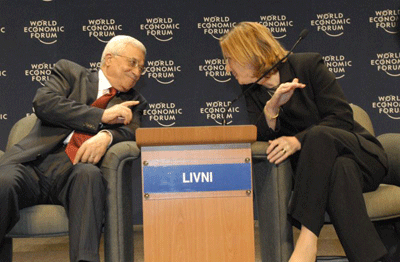
Mahmoud Abbas and Tzipi Livni, 2006

Tzipi Livni is Israel’s Barack Obama

By Neri Livneh, Haaretz Correspondent, September 18, 2008

If, as John Lennon and Yoko Ono said, “Woman is the N—-r of the World,” then Tzipi Livni is Israel’s Barack Obama.

Unlike Hillary Clinton, Livni did not exploit the fact that she was a woman in order to get elected. She is also not married to one of the most beloved individuals in the world.

Instead, Livni won the Kadima primary despite being a woman, and despite being married to a private man who prefers to steer clear from the limelight. (Israeli comics – all of them men, of course – are now busy thinking up new puns on the old “Mr. Tzipi Livni and Mrs. President.”)

And all this while Livni is zealously trying to protect the privacy of her family, and is probably the last person anyone would turn to for a Rosh Hashanah cake recipe. Continue reading Tzipi Livni is Israel’s Barack Obama →

Bomb Attack on U.S. Embassy in Yemen


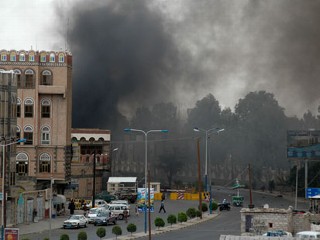
Smoke is seen billowing outside the U.S. embassy in Sanaa September 17, 2008. A car bomb set off a series of explosions outside the heavily fortified embassy in Yemen on Wednesday and a Yemeni security source said at least 16 people, including six attackers, were killed. Collapse
(Yemen News Agency, via Reuters)

U.S. Embassy in Yemen Attacked

By Ellen Knickmeyer, Washington Post Foreign Service, Wednesday, September 17, 2008

SANAA, Yemen, Sept. 17 — Attackers exploded a vehicle bomb outside the main gate of the U.S. Embassy in Yemen on Wednesday in what appeared to be a well-coordinated assault that triggered more explosions and heavy gunfire around the compound.

Yemen’s official Saba news agency said 16 people died in the incident, including six Yemeni soldiers, four civilians and six attackers. One of the civilians was an Indian woman at the embassy on business.

There were no immediate reports of American casualties. The embassy is located in the center of Sanaa, Yemen’s capital, but the building is set far back from an outer security wall.

There was no immediate claim of responsibility. Continue reading Bomb Attack on U.S. Embassy in Yemen →

The Mecca Railway


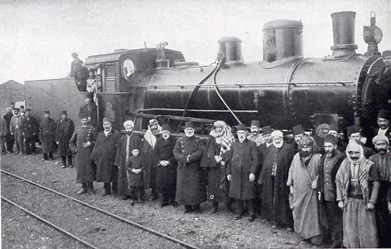
Engine “Abdul Hamid” on the Mecca Railroad; Source: National Geographic Magazine XX(2):158, 1909

[A few years before World War I, when the Ottoman empire was still an empire, the Sultan Abdul Hamid sponsored a railway link between Damascus and Mecca for the pilgrim route. Although the Hijaz Railway is little known today, it has already merited a Wikipedia article. The following is from a report published a century ago on the opening of the railway. Webshaykh.]

The gauge of the line is the somewhat curious one of 1.05 meter (3 feet 5 1/4 inches), which was necessary, when the line was first commenced, to correspond with the gauge of the Beirut-Damascus line, over which the rolling stock had to be brought. The branch to the Mediterranean, at Haifa, was constructed subsequently. The rolling stock has been obtained principally from Belgium, with the exception of the engines, which are made by a German firm. The rails were supplied by the American Steel Trust, but a French firm domiciled in Russia, and by the firm of Cockerill, in Belgium.

The engineers in charge of sections were also of various nationalities — French, Poles, Hungarians, etc. — while the guiding spirit in the construction has been Meissner Pasha, a very able German engineer. Continue reading The Mecca Railway →

Cholera outbreak spreads in Iraq


The victims include seven children and two women.

Reported in Al-Jazeera, Thursday, September 11, 2008

Babel, a central Iraqi province, is on alert after Iraqi authorities declared it a disaster zone marking the country’s latest cholera outbreak.

At least five people died on Thursday while 90 new cases had been reported, local and national health officials said.

Babel’s provincial council, said: “The laboratory reports from Babel health department indicate there are 200 cases of suspected cholera, vomiting and diarrhea in the province”.

At least 20 people, including seven children and two women, have died from cholera in the past three days, a local official said. Continue reading Cholera outbreak spreads in Iraq →