Category Archives: Countries

Lebanon …Without A Daily Star Until Further Notice

Lebanon …Without A Daily Star Until Further Notice

By Thair Abbas, Asharq Alawsat, 30/01/2009

Beirut.
The Lebanese English-language newspaper The Daily Star has been temporarily shut down since the middle of January due to a financial lawsuit between the newspaper and Standard Charter Bank. The newspaper was the only source of internal Lebanese news for many of the Lebanese “orphans” living abroad and for foreigners living in Lebanon, who would use it to follow the news of Lebanon which is rife with contradictions, events, and crises.

This is not the first time that The Daily Star has been “temporarily” shut down, indeed the newspaper has been closed down three times since its foundation, but it returned to print each time as a result of the market’s need for a publication to fill this niche. Continue reading Lebanon …Without A Daily Star Until Further Notice
Picturing the Exodus

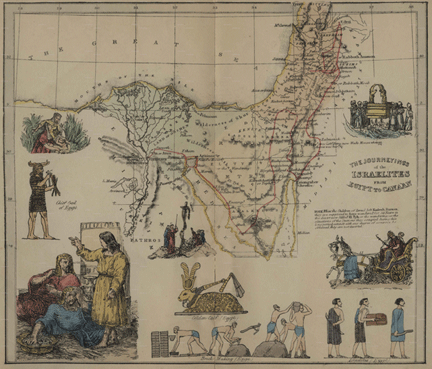
The ubiquity of GPS threatens to leave the old printed map out of the picture. This is a pity, for there is much to be learned from the way maps frame the world. As J. Z. Smith once remarked, map is not territory. True enough, but maps are the way we imagine not only territory but our place in it. When Edward Said wrote his critique of Orientalism in 1978, he cited novelists, travelers, poets and academics, but no mapmakers. But in a way Holy Land maps are what put the Holy Land on the map. Maps not only illustrated what was thought to be the lay of the land, but what people imagined was there.

A splendid example of this is an 1856 pictorial Bible map of the Journey of the Israelites from Egypt to Canaan. I reproduce the image above, but if you
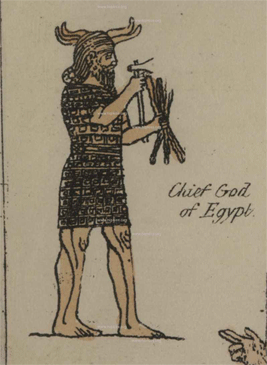
click here you can get a greatly enlarged view to see the details. Mind you, this was 1856, when few of the archeological discoveries in Bible territory had come to light. This is evident in the depiction of the “Chief God of Egypt,” (left side of map) who looks like a cross between an Assyrian and a Viking.

Continue reading Picturing the Exodus

Disproportional suffering


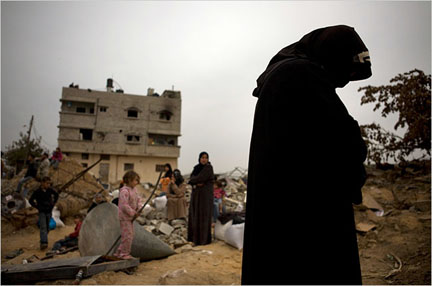
Residents returned to their homes around Gaza City on Friday. Tyler Hicks/The New York Times

Gaza is not history, nor is it likely to be soon. The bombs may have ceased on both sides, but the human toll presages a bleak future. Both sides have grievances, but the grief from death, maiming and sheer destruction of property and homes is incredibly disproportional. Even Independent observers must acknowlege this:

Up to 10 times as many Palestinians were killed as Israelis. The Palestinian Ministry of Health says 1,314 Palestinians were killed, of whom 412 were children or teenagers under 18, and 110 were women. On the Israeli side, there were 13 deaths between 27 December and 17 January, of whom three were civilians killed by rockets fired from Gaza. Of the 10 soldiers killed, four were lost to “friendly fire”.

Even if the Palestinian figure is disputed, it is clear that the death toll was massively higher for Palestinians than Israelis. Proportionality is not simply a matter of numbers, however. Continue reading Disproportional suffering

“Best interests of the state”


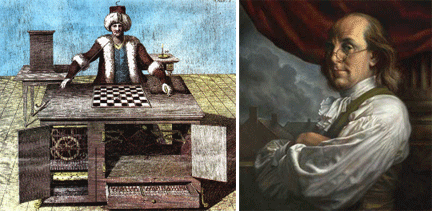
[Note: the following parody, written in critique of proslavery arguments in congress, was one of the last articles penned by Benjamin Franklin. Were Franklin almanacking today, what would Poor Richard have to say about the current state of political stalemate in the Middle East? And what would he think of today’s inaugural?]

To the Editor of the Federal Gazette
by Historicus (Benjamin Franklin)
March 23, 1790

Sir,

Reading last night in your excellent paper the speech of Mr. Jackson in Congress, against meddling with the affair of slavery, or attempting to mend the condition of slaves, it put me in mind of a similar one made about one hundred years since, by Sidi Mehemet Ibrahim, a member of the Divan of Algiers, which may be seen in Martin’s account of his consulship, anno 1687. It was against granting the petition of the Sect called Erika or Purists, who prayed for the abolition of piracy and slavery, as being unjust. Mr. Jackson does not quote it; perhaps he has not seen it. If therefore some of its reasonings are to be found in his eloquent speech, it may only show that men’s interests and intellects operate and are operated on with surprising similarity in all countries and climates, whenever they are under similar circumstances. The African’s speech, as translated, is as follows:

“Allah Bismillah, &c. God is great, and Mahomet is his Prophet.

“Have these Erika considered the consequences of granting their petition? Continue reading “Best interests of the state”

Another War, Another Defeat


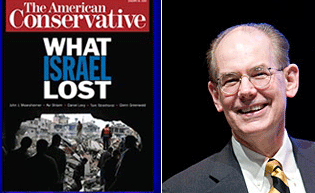
Professor John Mearsheimer

Another War, Another Defeat

The Gaza offensive has succeeded in punishing the Palestinians but not in making Israel more secure.

By John J. Mearsheimer, The American Conservative, January 26, 2009

Israelis and their American supporters claim that Israel learned its lessons well from the disastrous 2006 Lebanon war and has devised a winning strategy for the present war against Hamas. Of course, when a ceasefire comes, Israel will declare victory. Don’t believe it. Israel has foolishly started another war it cannot win.

The campaign in Gaza is said to have two objectives: 1) to put an end to the rockets and mortars that Palestinians have been firing into southern Israel since it withdrew from Gaza in August 2005; 2) to restore Israel’s deterrent, which was said to be diminished by the Lebanon fiasco, by Israel’s withdrawal from Gaza, and by its inability to halt Iran’s nuclear program.

But these are not the real goals of Operation Cast Lead. The actual purpose is connected to Israel’s long-term vision of how it intends to live with millions of Palestinians in its midst. It is part of a broader strategic goal: the creation of a “Greater Israel.” Specifically, Israel’s leaders remain determined to control all of what used to be known as Mandate Palestine, which includes Gaza and the West Bank. The Palestinians would have limited autonomy in a handful of disconnected and economically crippled enclaves, one of which is Gaza. Israel would control the borders around them, movement between them, the air above and the water below them. Continue reading Another War, Another Defeat

Entitled to consideration and respect


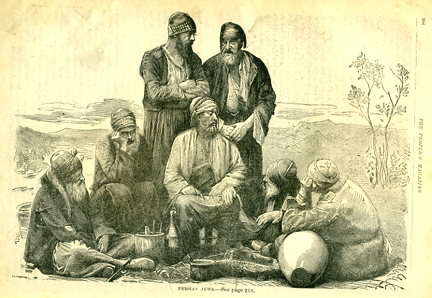
Illustration of “Persian Jews” from the People’s Magazine, 1879

The current fighting in Gaza is a tragedy of Greek dramatic proportions. On the one hand a highly sophisticated military machine wielded at present with Hawkish intent, on the other a ragtag guerilla group bent on lobbing barbs at the Hawk’s fortified lair. And in the middle frightened civilians in a humanitarian nightmare of medieval mindset. The problem is that neither side is really willing to treat the other with consideration and respect. In this unethical tie, of course, the onus must be on the stronger to recognize the limited options of the weaker.

The tragedy does not end with the present loss of life, limb and hope for Gazans. Unfortunately, it overshadows a historical trajectory that created the rise of Zionism as a political ideal in Europe. There is no excuse for the present punishing policies of Israel towards the residents of Gaza. Indeed, it is all the sadder given the sordid history of anti-Semitism in both the Christian-dominated West and Islamic-dominated Near East. Recently I picked up an old magazine from 1879, published exactly 140 years ago. On one page I was struck by the extraordinary pathos of an image of “Persian Jews.” Continue reading Entitled to consideration and respect

History of Frankincense


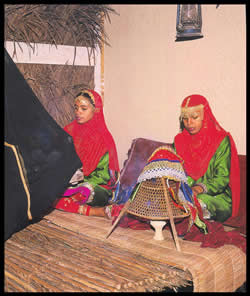
Omani women refreshing clothing with frankincense smoke

The website of the Sultan Qaboos Cultural Center has a number of interesting online pages. One of these is a pictorial history of frankincense and myrrh. Here are some of the tidbits about both of these important trade items:

• Almost all frankincense comes from western Oman, where it is used for everything from deodorant and toothpaste to food and drink flavoring.
• Frankincense and myrrh were so expensive in Europe that southern Arabia became known as Arabia Felix, “Arabia the Blessed.” Continue reading History of Frankincense

Stoves for Darfur


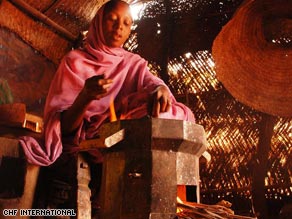
The $30 stoves help keep Darfur’s women safe
by reducing their time away from the refugee camps
.

Stoves help keep Darfur’s women out of harm’s way
Larry Lazo, CNN

In Sudan’s Darfur region, where violence and genocide are rampant, women risk their lives every day performing tasks as seemingly mundane as seeking out firewood.

But, from his suburban home, one Maryland teen has dedicated himself to making life a little safer for those women. Continue reading Stoves for Darfur