Category Archives: Countries

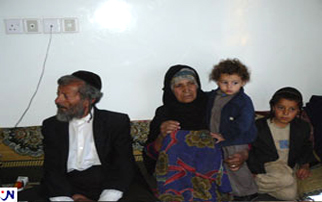
Blood money for Killing Yemeni Jew


Yemeni Jews: source: Yemen Observer

by Nasser Arrabyee, Yemen Observer, March 3, 2009

A Yemeni primary court in Amran, north of the country, ruled on Monday a payment to be made of 5.5 million YR (US$ 27,500) in blood money for the murder of a Jewish man by Yemeni, Abdul Azeez al-Abdi, last December.

The court, chaired by Judge Abdul Bari Aqaba, also ordered that the convict should be placed in a psychotic sanatorium. The father of the Jew refused the sentence and asked for an appeal to be made to demand the death penalty against the convict.

“As long as there is no justice for us, then (they should) deport us to Israel, it’s better for us.” Continue reading Blood money for Killing Yemeni Jew →
Democracy, Islam, and Secularism: Turkey

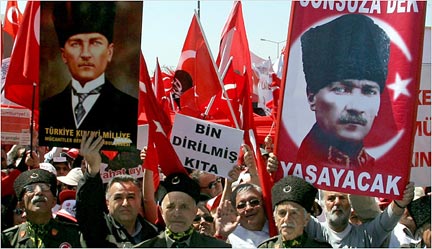
Conference: “Democracy, Islam, and Secularism: Turkey in Comparative
Perspective”

Date: March 6-7, 2009
Location: International Affairs Building 1501, Columbia University

Turkey, as a Muslim-majority country, is the only member of NATO and only
candidate member of the European Union. Assertive secularism, multiparty
democracy, and military interventions are other puzzling aspects of Turkish
politics. With its rising activism in the Middle East, Caucasus, and Central
Asia, Turkey has also become an influential actor in world politics. This
conference aims to present an integrated picture of Turkey by bringing
together comparative perspectives on its past, present, and future, and
delving into such issues as the legacy of the Ottoman Empire, secularism,
religion, democracy, civil-military relations, and the European Union
membership. Continue reading Democracy, Islam, and Secularism: Turkey →

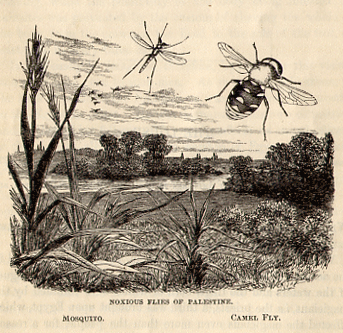
Lithographica Arabica 6: Rev. Wood’s Bible Animals, 3

This is the third in a series on the illustrations in Rev. John George Wood’s Story of the Bible Animals. What do you get if you strain at a gnat? Read on…

Gnats

It has already been stated that only one species of fly is mentioned by name in the Scriptures. this is the Gnat, the name of which occurs in the familiar passage, “Ye blind guides, which strain at a ghat and swallow a camel” (Matt. xxiii. 24).

I may again mention here that the words “strain at” ought to have been printed “strain out,” the substitution of one for the other being only a typographical error. The allusion is made to a certain custom which is explained by reference to the preceding article on the fly. In order to avoid taking flies and other insects into the mouth, while drinking, a piece of thin linen stuff was placed over the cup, so that if any insects, as was usually the case, had got into the liquid, they would be “strained out” by the linen. Continue reading Lithographica Arabica 6: Rev. Wood’s Bible Animals, 3 →

Suspects detained in Cairo blast

Suspects detained in Cairo blast
BBC News, February 23, 2009

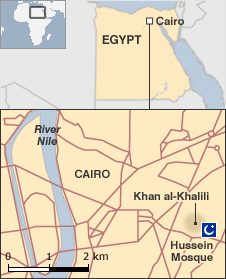
Egyptian police are questioning three suspects over the bombing of a Cairo market that killed one person and injured 20 others, officials say.

They were detained near the market shortly after the blast, police said.

It happened at an open-air hotel cafe packed with tourists in the Khan al-Khalili area – a major attraction and home to a prominent mosque.

French President Nicolas Sarkozy has expressed “deep sorrow” at the death of a French teenager in the blast.

Police said they thought the device had been thrown from a balcony. It is not yet known who was responsible. Continue reading Suspects detained in Cairo blast →

Iranian Authorities Destroy Sufi Holy Site In Isfahan

By Golnaz Esfandiari, Radio Liberty Website, February 18, 2009

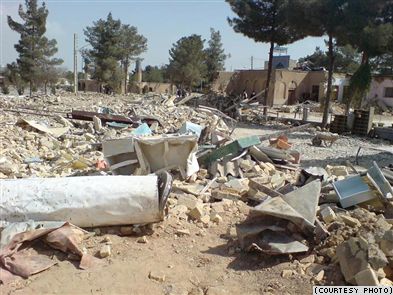
A house of worship of the Gonabadi dervishes in Isfahan has reportedly been destroyed by the Iranian authorities.

The reason for the destruction — which reportedly took place shortly after midnight on February 18 — is not clear, but it comes amid growing pressure on dervishes, who practice the Sufi tradition of Islam, and other religious minorities in Iran.

The dervish house of worship, or hosseinieh, was located next to the tomb of the great poet and dervish Naser Ali at the historical Takht-e Foulad cemetery, where a number of respected Iranian figures are buried. Continue reading Iranian Authorities Destroy Sufi Holy Site In Isfahan →

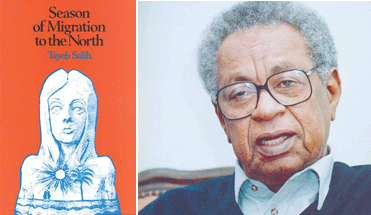
Acclaimed Sudanese novelist Al-Tayeb Saleh dies

Acclaimed Sudanese novelist Al-Tayeb Saleh dies
The Associated Press, February 18, 2009

KHARTOUM, Sudan: Al-Tayeb Saleh, one of the Arab world’s top novelists who excelled at portraying characters torn between East and West, died Wednesday in London, Sudan’s official news agency said. He was 80.

Saleh was born in 1929 in the northern Sudanese town of Marawi to a poor family and was educated first in Islamic schools and then later British institutions. He left Sudan to pursue graduate studies in the U.K. and went on to live in various European and Arab capitals, rarely returning home.

His works reflected the Arab and African quest for identity, especially in the period of 1960s, which were marked by the end of colonialism and the rise of nationalism across the region.

His 1966 masterpiece, The Season of Migration to the North, can be described as one of the earlier writings about the idea of a clash of civilizations. Continue reading Acclaimed Sudanese novelist Al-Tayeb Saleh dies →

Interflow: The Art of Emna Zghal

INTERFLOW
organized by
The Museum for African Art
Thursday Feb 19th, 2009
5-7pm on the 15th Floor of Ogilvy New York
Worldwide Plaza 309 West 49th St.
RSVP to ogilvyrsvp@gmail.com

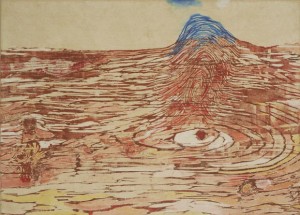
Interflow presents recent painting and mixed media works on paper by New York-based artist Emna Zghal. Color and line continually search for boundaries they never find. Forms emerge to take on shapes that feel simultaneously familiar and foreign. Though the canvas fights to act as a boundary, poetic lines overflow into infinite space. Each mark acts in unison with the next to challenge the seemingly simple nature of line itself. Emna Zghal’s artwork elicits a never-ending network of nerves pulsing with colorful abstractions and an energy that suggests organic patterns in a continual search for form. Continue reading Interflow: The Art of Emna Zghal →