Category Archives: Countries

Interrogating Interrogation in Iraq


Interrogation Results Prompt Scrutiny Of Methods

by Dina Temple-Raston, NPR, Morning Edition, April 30, 2009

This is a story about two interrogation programs — one run by the U.S. military, the other run by the CIA. The military program was focused on getting important al-Qaida suspects in Iraq to talk. The CIA operation zeroed in on important al-Qaida suspects from around the world. Both programs had similar goals, but they operated under very difficult rules.

Earlier this month, former CIA Director Michael Hayden was on Fox News defending the CIA’s enhanced interrogation program.

“The use of these techniques against these terrorists made us safer,” he said emphatically. “It really did work.” As Hayden and others see it, the U.S. had to use tough techniques — some called it torture — to battle al-Qaida.

Matthew Alexander is an advocate of a different kind of interrogation — one that builds rapport, like the kind of technique you see on television cop shows. Alexander was a military interrogator in Iraq and doesn’t see the need for rough questioning. Continue reading Interrogating Interrogation in Iraq
10 Conceptual Sins

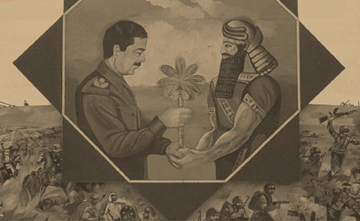
“10 Conceptual Sins” in Analyzing Middle East Politics

by Eric Davis, from The New Middle East, January 28, 2009. For an Arabic translation of this post, click here.

Sin # 1: “Presentism.” Unfortunately, many of those who analyze Middle East politics, whether journalists, policy analysts, or academics, do not take history seriously. That is, they fail to situate Middle East politics in a historical context. If they did, they would gain many more insights into the political dynamics of the region.

Analysts would have realized why, for example, Iraqis showed little enthusiasm when American troops toppled Saddam Husayn’s regime in April 2003. This response did not indicate that Iraqis were ungrateful as the vast majority were relieved to see the end of Saddam’s regime. Rather, many Iraqis, who did have a historical consciousness, knew that the US had supported Saddam Husayn during the Iran Iraq War. Iraqis also remembered that, when President George Bush senior called upon them to rise up against Saddam Husayn in 1990, many took him at his word. However, not only did the US not intervene to help the rebels during the February-March 1991 uprising (Intifada), it gave permission for Iraqi helicopter gun ships to enter the fray which turned out to be critical in suppressing it. Continue reading 10 Conceptual Sins

An Ottoman Baghdad Portrait

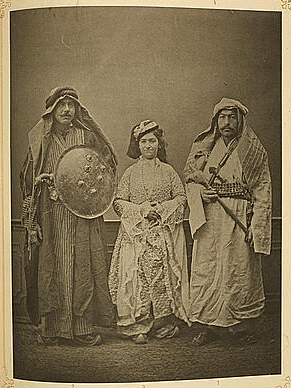
The Library of Congress has archived thousands of illustrations and photographs online. In browsing through some of the collections, I came across the above image taken in Baghdad in 1872, when the city was under Ottoman control. The photographer was Pascal Sébah. According to the description, the three individuals shown are: (1): Arab of the Chammar (Shammar) tribe; (2): Arab of the Zobeid tribe; and (3): married Muslim woman of Baghdad.

The Walled City of Sanaa

The Walled City of Sanaa
by Ronald Lewcock

[Note: This is an excerpt from Ronald Lewcock;s 1986 UNESCO book. The book is available online in its entirety in pdf format at http://www.worditude.com/ebooks/unescopdf/sana_eng.pdf.]

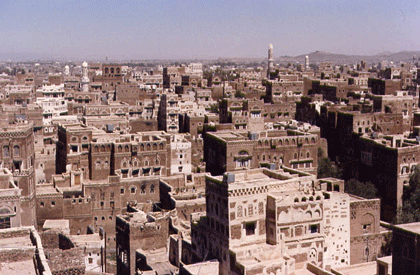
Viewing the old walled city of San‘a for the first time creates an unforgettable impression. And this vision of a childhood dream world of fantasy castles is not dispelled even on closer acquaintance. In the farmlands outside the city, on either side of the roads leading to it, buildings of all shapes – circular, rectangular, square – rise out of the flat highland plain to seemingly impossible heights constructed of apparently weak materials. Not merely does the stonework of the lower levels consist of rough rubble with loose mortar, but for most of their height the buildings are made of mud – layered mud, mud bricks of all sizes – and of mud-straw plaster, infinitely eroded by the monsoon rains until deep indentations mark the channels down which the autumnal torrents find their passage to the earth. Continue reading The Walled City of Sanaa

Iraq Study Day at Hofstra

The Middle Eastern and Central Asian Studies (MECA) Program at Hofstra University is hosting a day-long “Iraq Study Day” on Monday, April 27, 2009. The purpose of the program is to bring several distinguished scholars to campus to speak to the Hofstra community and general public about the making of modern Iraq and the ongoing occupation by American military forces. Although information on the current crisis is widely available in the media, students, faculty and the general public need to understand the historical context for the making of modern Iraq in the 20th century.

A general forum for the public will be held on the theme “Iraq: How the Past Shapes the Future” on Monday, April 27, 3-4:30 p.m., in the Monroe Lecture Center Theater, California Avenue, South Campus of Hofstra University. Directions to Hofstra are available here.

The participants in the panel are:

• Nida al-Ahmad, Political Science, New School for Social Research: “State Power in Ba’thist Iraq”
• Dr. Magnus Bernhardsson, History, Williams College (author of “Reclaiming a Plundered Past: Archaeology and Nation Building in Modern Iraq,” 2006)
• Dr. Eric Davis, Political Science, Rutgers University (author of “Memories of State: Politics, History and Collective Identity in Modern Iraq,” 2005)
• Dr. Reeva Simon, History, Yeshiva University (author of “The Creation of Iraq, 1914-1921,” 2004
• Dr. Bassam Yousif, Economics, Indiana State University (author of “The Paradox of Development under Dictatorship: Iraq 1950-2003,” 2006)

Continue reading Iraq Study Day at Hofstra

Visit the Topkapi for free

Given the economy, you may not be planning any trips this summer or anytime soon. But who would not like to take a tour of the Topkapi Palace in Istanbul? No problem, you can do it for free. Just go to this website (http://www.3dmekanlar.com/topkapi_palace.htm), download and start clicking away. And when you exhaust that, check out a number of major Islamic sites that are yours for digital pleasure.

Yemen’s Alabaster Windows

Moonglow from Underground

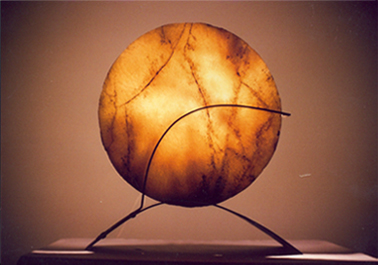
Alabaster, one of the rarest and most ancient of lighting materials, has now been reinterpreted in a contemporary idiom.

Used to illuminate Arabian palaces and tower-houses since 2,000 years ago, the subtle glow of alabaster – ‘moonlight stone’ – has been brought to light again by Abdulwahhab al-Sayrafi, master alabaster craftsman. His unique, hand-made range of alabaster windows, lamps and candleholders are perfect for today’s architecture and today’s interiors. Continue reading Yemen’s Alabaster Windows