Category Archives: Countries

Gender and Justice in Palestine


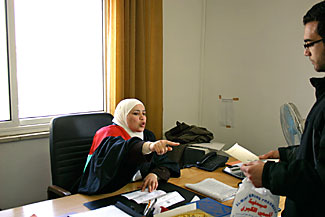
Khouloud el-Faqeeh argues a legal point in her West Bank office. In March, she became one of the two first female Islamic judges in the Middle East.

New female judge transforms Islamic court

Khouloud el-Faqeeh is part Judge Judy, part Sunday School teacher.
By Ilene R. Prusher,The Christian Science Monitor, May 10, 2009

Ramallah, West Bank:

Khouloud el-Faqeeh has shattered the glass ceiling of Islamic jurisprudence.

After years of pushing to break into the all-male ranks of sharia judges in the Palestinian territories, she finally secured a post after scoring among the best – along with another woman – in a recent test for new jurists. They are widely considered to be the first female sharia judges in the Middle East.

Now, Ms. Faqeeh is setting a new tone in her Ramallah courtroom, where defendants are often shocked to see a woman on the bench. With a style that’s part Judge Judy, part Sunday School teacher, she’s on a mission to change her society, case by case. But sometimes, even the most progressive intentions won’t overcome powerful social forces, such as those driving Miryam Abed-Nabi, a newlywed who came to court recently to finalize a divorce. Her husband – Fahmi Awadullah, a man twice her age – took her as a second wife just a few months ago. But the marriage infuriated his adult sons, who worried about their portion of his inheritance. Continue reading Gender and Justice in Palestine
Tarim, Islamic cultural capital for 2010


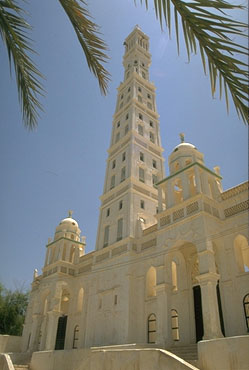
Al-Midhar mosque, Tarim, Hadramawt, Yemen

by Abdulaziz Oudhah, Yemen Observer, May 7, 2009

The Islamic Educational Scientific and Cultural Organization (ISESCO) chose Tarim as an Islamic cultural Capital for 2010, after an agreement was reached during a meeting of Islamic Cultural Ministers in Algiers in 2004. A number of Islamic, Arab, Asian, and African towns were nominated in the process to choose three towns each year to be recognized as Islamic culture capitals.

ISESCO General Manger Abdulaziz al-Tawijri, said that the Islamic capitals program aims to promote the spread of Islamic culture, renew its content, perpetuate its message, and revive the cities’ glorious culture and civilization. The capitals are chosen according to specific standards, which consider the role that they have played in serving Islamic culture, art, science, and knowledge throughout their history. The legacy of these cultural capitals is important to the construction of present and future memory, which is inspired by Islamic civilization. Continue reading Tarim, Islamic cultural capital for 2010

Emirati Youth in a Rapidly Changing Society

by el-Sayed el-Aswad, United Arab Emirates University

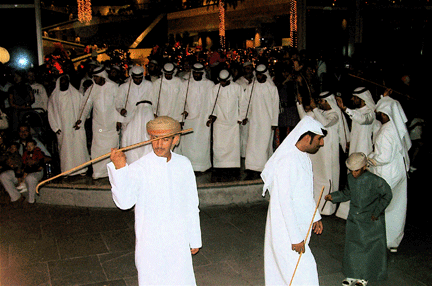
The UAE has developed amenable ways of synchronizing localism with globalism. It is hard to erase specificities that create a misleading portrait of a single global culture. However, Emirati local culture transforms and appropriates aspects of the global into a unique system of local social meaning. The young generations of the Emirates, for instance, have succeeded in assimilating outside influences without deserting their heritage. They have expressed their pride generated by their ability to combine both local culture and modern, global ways of life. They speak Arabic with Emirati dialects, eat indigenous food, use incense and wear traditional costumes (including veils for women) so as to symbolically identify themselves with their traditional society, but, at the same time, they speak English and employ symbols signifying western ‘global’ modernity, such as using computers, eating Western fast food, consuming expensive perfumes, and driving extravagant four wheel-drive cars. However, it can be argued that symbols of modernity do not fundamentally alter people’s beliefs, values, or culture. Continue reading Emirati Youth in a Rapidly Changing Society

God, the Devil and Pakistan


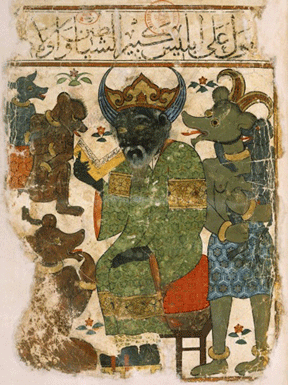
Iblis (the Devil) from The Book of Nativities (Kitâb al-Mawalid) by Abû Ma’shar, 15th Century.

by Suroosh Irfani, Daily Times (Pakistan), May 7, 2009

Jewish denial during the war is perilously instructive for Pakistan today: a country where the founding spirit of justice and democracy is blighted by falsehood and fear. Small wonder that last month, Prime Minister Gilani virtually ignored the seditious speech of Sufi Muhammad.

Noted Saudi novelist Turki al Hamad’s novel, Kharadib, has sold over 20,000 copies in the Arab world since publication in 1999. Al Hamad continues to live in the Saudi capital Riyadh, despite fatwas of Saudi clerics against him, and Al Qaeda branding him an apostate.

The reason? Hamad’s teenaged protagonist in the controversial novel dares to ponder the question of God and the devil.

King Abdullah, then the Crown Prince, reportedly offered Hamad bodyguards for his protection, while reputed Saudi scholar Sheikh Ali al Khudair, who initially censured Hamad, withdrew his fatwa in 2003.

The retraction suggests that the musings of Hamad’s protagonist on “religion, sex and politics, the three taboos in Saudi society” had triggered a rethink on an issue that Muslim luminaries like Jalaluddin Rumi (d.1273) had addressed, long before German writer Goethe cast the devil in new light in his epic poem Faust in the 19th century.

However, it remained for Allama Iqbal’s genius to bring together Goethe and Rumi in a discourse on the devil, burnishing wisdom of the past with his own insights on evil. The upshot of it all is a realisation that “evil is not mere darkness that vanishes when light arrives. This darkness has as positive an existence as light,” as Javed Iqbal, former Chief Justice of Lahore High Court, notes in “Devil in the triangle of Rumi, Iqbal and Goethe” in Iqbal Review. Continue reading God, the Devil and Pakistan

Guns and Bibles


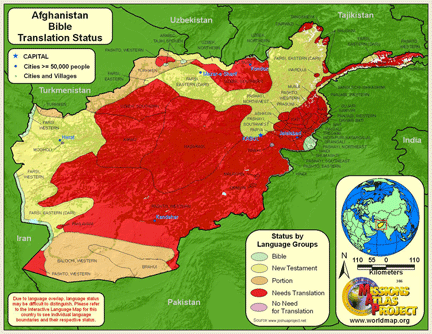
Bible Translation map for Afghanistan from Mission Atlas Project

So much for the secular state. When the founding fathers envisioned the transformation of the thirteen original colonies into the United States of America, the explosive baggage of a state religion was wisely foregone. Contemporary Fundamentalist preachers may bemoan the historical fact, but we do not live in a “Christian” nation. Other states have chosen to maintain a formal religious identity, with varying levels of tolerance for those who are not in the majority. Take Afghanistan, for example. Indeed, the Bush administration did just that, or at least did so partially. Although the Taliban were sent packing into the hills, much to the dismay of Pakistanis who value sovereignty in Swat, Afghanistan is still a solidly Muslim country. The American military is present in Afghanistan in order to ensure security and protect the development agenda. Obviously this takes guns. But the latest addition to the peace-on-earth-keeping mission arsenal appears to be Biblical.

A report on al-Jazeera reveals that an American military chaplain is exhorting evangelical men in the ranks to tote more than their rifles. “The Special Forces guys, they hunt men. Basically, we do the same things as Christians. We hunt people for Jesus. We do, we hunt them down. Get the hound of heaven after them, so we get them into the Kingdom. That’s what we do, that’s our business,” he said. Continue reading Guns and Bibles

Portrait of a Bahraini Anthropologist


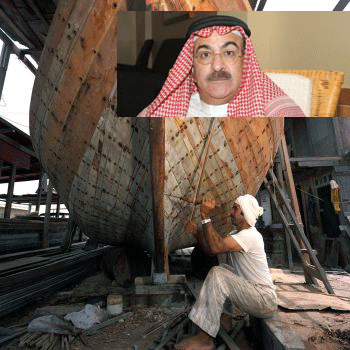
Bahraini dhow builder, photo by Abdulla Al Khan; insert shows Dr. Abdullah Yateem

A modern culture specialist
By Paul Balles, Bahrain This Month

What makes Dr. Abdullah Yateem a modern culture specialist? He’s an anthropologist who has taken a modern approach to studying cultures.

Many people don’t know what anthropology is or what anthropologists do unless they happen to have attended university and learned that they could take courses in the subject.

If they listened to British television critic Nancy Banks-Smith, they might have heard her say, “Anthropology is the science which tells us that people are the same the whole world over — except when they are different.”

Cultural anthropologist Ruth Benedict, with tongue in cheek, put it another way, “The purpose of anthropology is to make the world safe for human differences.”

From these comments, one might safely assume that anthropologists study almost anything related to the similarities and differences between cultures.

Anthropologists like Dr. Abdullah Yateem address questions such as: how can people who look different, talk differently and come from different cultures get along together in today’s world? (paraphrasing Clyde Kluckhohn). Dr. Yateem is not only an anthropologist who studies cultures. Currently, he’s Assistant Undersecretary for Press and Publications in the Ministry of Information. Continue reading Portrait of a Bahraini Anthropologist

Why hedonistic polygyny is against Islam


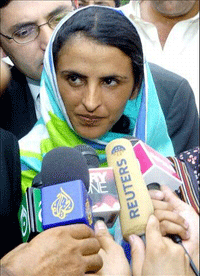
Mukhtaran Mai

Why hedonistic polygyny is against Islam

by A. Faizur Rahman

The marriage, under pressure, of Mukhtaran Mai, the courageous woman who stood up to the atavistic tribal laws of Pakistan after being honour-raped by a gang of human beasts, has brought into focus the enormity of the gender bias prevailing in Muslim societies, particularly through the misuse of the law of polygyny. Without doubt, Ms. Mai is a victim of both emotional and physical blackmail. That she is also a victim of medieval indoctrination can be deduced from her unqualified statement (“A controversial marriage in Pakistan,” The  Hindu, March 30, 2009) that taking a second wife is permitted in Islam. Therefore, it could be said with some conviction that it was the belief that her marriage was not un-Islamic (rather than the fear of jeopardising the marriages of three other women) that prompted her into marrying an already married man. For it is unbelievable that a woman of the mental strength of Ms. Mai could have succumbed to the threats of a cowardly blackmailer. Continue reading Why hedonistic polygyny is against Islam

Kill the Pigs

“Kill the pigs.” After all, they are a bunch of swine. Were this the rallying cry of a terrorist group or the mantra of war-torn propaganda, such a phrase would not be a surprise. But beyond the barricades in the pigpen, there is a new strain in the refrain. It’s bad enough that the pig has been a symbolic target for censure by the orthodox in Judaism and Islam (Christians were saved by St. Peter’s dream), but now it is subject to literal swinocide. That is what is happening in Egypt, a country where pig bones are as much a part of the rich archaeological record as mummies. Here is the AP story, written by Maamoun Youssef:

CAIRO – Egypt began slaughtering the roughly 300,000 pigs in the country Wednesday as a precaution against swine flu even though no cases have been reported here, infuriating farmers who blocked streets and stoned vehicles of Health Ministry workers who came to carry out the government’s order. Continue reading Kill the Pigs