Category Archives: Countries

Rocking The Vote Not Easy For Iranian-Americans


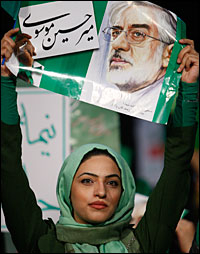
A supporter of the leading reformist Iranian presidential candidate, Mir Hossein Mousavi, holds his poster during a campaign in Tehran, Iran. Photo by Vahid Salemi, AP.

Rocking The Vote Not Easy For Iranian-Americans

by Melody Moezzi, NPR, June 11, 2009

On the eve of the Iranian presidential elections, people are pouring into the streets of Tehran in support of the reformist opposition candidate Mir Hossein Mousavi. Mousavi is the leading candidate opposing incumbent Mahmoud Ahmadinejad, and this election promises to be a close one. Should Mousavi win, it would be the first time in the history of the Islamic Republic that an incumbent failed to win a second term. But people are comparing this election to a revolution, and the enthusiasm around Mousavi has extended far beyond Iran’s borders. Even Iranian-Americans are trying to get in on the action. That is, we’re trying to vote. Continue reading Rocking The Vote Not Easy For Iranian-Americans
Final Solution

Is there a ‘Final Solution’ to the Muslim Question?

by Tareq Fatah, The Muslim Question, Wednesday, May 20, 2009

On the weekend I came across an article by Hugh Fitzgerald of Jihad Watch in which he mocked Senators John Kerry and Richard Lugar for daring to suggest that Pakistanis “are like us.”

This mild exhibition of empathy towards Pakistanis so riled up the good Mr. Fitzgerald that he blasted not just the two senators for having the the temerity to equate Americans and Pakistanis, he suggested we not trust any Muslim until he or she renounces Islam.

The fact that Americans and Pakistanis are both human beings governed by democratically elected governments who seek to wipe out the scourge of Jihadi terrorism, and that both admit to having played a role in creating these monsters, was lost on Fitzgerald. The fact that two countries have been allies–militarily and politically–for two generations, mattered little to the writer. The fact that nearly a million Americans have Pakistani ancestry did not matter either. For him, since Pakistanis are Muslim therefore they cannot be “like us”. Continue reading Final Solution

Re-Writing Muslim Political History

Based in New Delhi, Maulana Waris Mazhari is a leading Indian Deobandi scholar. He is a graduate of the Dar ul-Uloom at Deoband, and is the editor of Tarjuman Dar ul-Uloom, the official organ of the Deoband Madrasa’s Graduates’ Association.

In this interview with Yoginder Sikand, Maulana Mazhari talks about his views on Islam, historiography and politics.

Q: Muslim history has generally been written in the form of a series of battles and a succession of rulers and military generals. This, in turn, has had a deep impact on the way Muslims imagine their past and their identity and on the way they relate to people of other faiths. What do you feel about this way of presenting Muslim history?

A: I have major problems with the traditional approach, including the traditional way of presenting the sirat, the history of the Prophet Muhammad, who Muslims consider as the model for all humankind. Typically, sirat-writing has taken the form of a narration of events that focus mainly on the maghazis or military confrontations and victories of the Prophet. This tradition goes back to early times. In fact, one of the first available sirat texts that we have, by Ibn Ishaq, is also known as Maghazi Ibn Ishaq. This is a reflection of how Ibn Ishaq portrayed the Prophet’s life. Ibn Ishaq was by no means an isolated case. In fact, many other sirat writers followed in that mode, and still continue to do so. Continue reading Re-Writing Muslim Political History

Postcards from Beirut

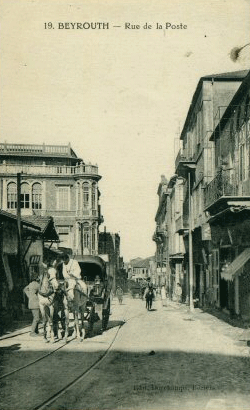
Since I am currently in Beirut and I am not sure what my internet access will be on a regular basis, here are some old postcard views of Beirut, starting with the image above of the Beirut Post Office from about a century ago.

Islam and Contemporary Issues

By Asghar Ali Engineer, April, 2009

A few days ago I was invited to speak in a Prophet Day’s function. There were other speakers as well. As usual the speakers before me indulged in rhetoric ‘Islam is the solution’ and also said the world economy has failed and slowed down as it is based on gambling and interest. Another person said Islam declared human rights 14 hundred years ago whereas UNO declared it only sixty years ago. Yet another speaker said Islam has given equal rights to women and made it obligatory for them to seek education. Also it was emphasized that Islam is religion of peace.

All this provoked me to say all this is true and I can add much more to it but have we ever seriously reflected why Islamic world is in such turmoil today. Why Muslims have totally failed to adopt these teachings in practice. I said if one caste a critical glance at Islamic world today one finds exactly opposite of what Qur’an teaches. If Qur’an lays great emphasis on knowledge, Islamic world from Indonesia to Algeria has more illiterates than any other community. Continue reading Islam and Contemporary Issues

Flipping through Yemen a Millennium Ago


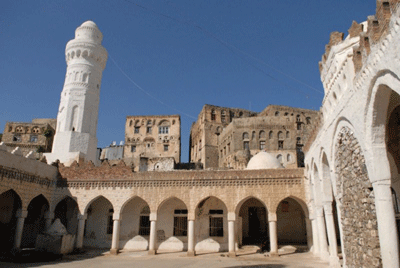
Mosque in Jiblah, Yemen

There was a time when books were hard to come by. Either they cost too much or were inaccessible in a private or exclusive university library. Whatever else the world wide web has done (and that is a mouthful), it now functions as an archive. More and more, the rare and out-of-print books I used to be forced to read in a library reading room are becoming available online. Mr. Gutenberg might roll over in his Grab at the very thought of a pdf file, but print has taken a new and universal turn. I especially enjoy the “flipbook”, which simulates turning the pages of images of the original. For an enjoyable read on the early history of Yemen, there is the flipbook version of Henry Cassels Kay’s translation called YAMAN, ITS EARLY MEDIAEVAL HISTORY, published in London in 1892. This has excerpts (not always trustworthy in their translation) from Umarah ibn Ali al-Hakami (1120/21-1174), Ibn Khaldun (1332-1406); Muhammad ibn Yaqub al-Janadi (d. 1332?).

The sad thing is that well over a century ago, Kay lamented that there was virtually nothing available on the history of Yemen, which had become of strategic interest to the British empire. Continue reading Flipping through Yemen a Millennium Ago

Bashing the academic Left

by David Newman, The Jerusalem Post, April 14, 2009

For the past two years I represented Israel’s universities in the UK in the debate surrounding the proposed academic boycott. There were many who could not accept the fact that a professor with left-of-center views should fill this role. The Department of Politics at Ben-Gurion University where I work has been described by its detractors as being the most left-wing academic department in Israel. After all, they would argue, people like myself are part of the problem, not the cause, and as proof of their argument they would roll out the same two or three names of Israeli academics (most notably Ilan Pappe) who had taken the unprecedented step of actually supporting the boycott. The proposed boycott proved to be a great opportunity for some left-wing bashing rather than focusing on the real problem – the growth of anti-Israel sentiment among specific groups within the UK university faculty union.

The last few years have been “in season” for attacking the academic left, a form of academic McCarthyism that is hard to recollect going back 10 or 20 years. Most pernicious and consistent is the self-styled Campus Watch, created by the neo-con critic of the Israeli left, Daniel Pipes. It uses students and faculty to spy on those teaching courses on Israel and the Middle East. Anyone who so faintly utters a word of criticism is immediately labeled as such, including some of the best critical scholars of Israel today. Continue reading Bashing the academic Left