Category Archives: Countries

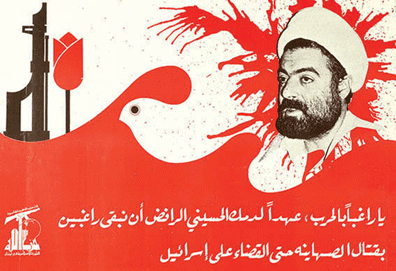
Poster Martyrs


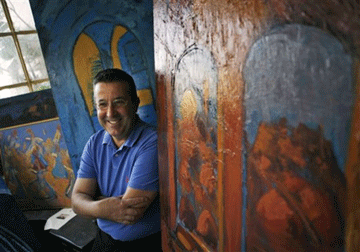
A poster commemorating the second anniversary of the assassination of Sheikh Ragheb Harb, by Merhi Merhi, 1986 (Hizballah Media Office)

by Hicham Safieddine, The Electronic Intifada, July 6

Author Christopher Hitchens might have saved himself a beating had he read Zeina Maasri’s book Off the Wall: Political Posters of the Lebanese Civil War. Hitchens, a self-proclaimed expert on all matters theological and Middle Eastern, was attacked in the streets of Beirut last February after defacing a political poster. The power of posters apparently touched Hitchens himself, who felt compelled to express his vindictiveness by attacking an image. But in a war-ravaged place like Lebanon, images can be a lot more than mere symbols. As Fawwaz Traboulsi explains in Off the Wall’s forward, they can serve as weapons, and Hitchens’ attackers must have understood that quite well.

The power of posters, as not merely symbolic weapons but also sites of hegemonic struggle during Lebanon’s civil war, is a central theme of Maasri’s book. A mix of text and image, the book is a rich and visually engaging work that tackles a dimension of war long-neglected by Lebanese historians. A sample of 150 posters (out of 700 the author has examined) in full color and printed on laminated paper occupies the center of the book and it is hard to begin reading before going through them: portraits of “heroic” leaders of all factions, clenched fists facing enemy guns, silhouettes of martyrs and landscapes of religious and nationalist symbols overlooked by dominant war figures, many marked with slogans that range from the racist to the revolutionary. But the book is a lot more than a slideshow of images summing up defining moments of the war or a straightforward critical review of the posters. Maasri delves into questions of theory, representation and meaning that shaped and defined the art of poster-making and the politics of their interpretation during times of conflict.

For the rest of this article, click here
.

Transhumance in Tarkumia

Transhumance in Tarkumia: An Exploration of Aspects of Palestinian Summer Identity This Week in Palestine

“Exploration is not so much a covering of surface distance as a study in depth: a fleeting episode, a fragment of landscape or a remark overheard may provide the only means of understanding and interpreting areas which would otherwise remain barren of meaning.” Claude Levi-Strauss, Tristes Tropiques (1955)

The three-month summer vacation from schools liberates Palestinian families from the constraint of the temporal rhythm of school and from the constriction of space. The students are free, but the parents are equally liberated. This temporal space provides ample opportunities for exploration of self, of other, of place, and of time by means of travel. Travel is usually thought of as a displacement in space. This is an inadequate conception. A journey occurs simultaneously in space, in time, and in the social hierarchy. Each impression can be defined only by being jointly related to these three axes, and since space is itself three-dimensional, five axes are necessary if we are to have an adequate representation of any journey.

Travel is a form of exploration, a spark to the imagination, a quest, commerce, escape, and a means of self-discovery. Continue reading Transhumance in Tarkumia

Tracing the History of Qat


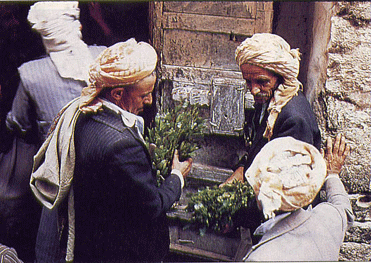
Selling qât in Yemen. Photo by Pascal Maréchaux

Much has been written, pro and con, about the chewing of qât leaves in Yemen. In addition to the economic and social problems over qat, there is a historical puzzle. When and how did the plant Catha edulis come from Ethiopia, its botanical origin, to Yemen? Yemeni legend and folkore suggest that the stimulant qualities of qat leaves were first discovered by a goatherd who noticed the effect on goats who browsed on the plant. A variant of this goat legend, told to me in 1979 by a poet from Husn al-‘Arus, suggests that an Ethiopian came along to explain to the goatherd what was happening. The goat is one of the few animals that can be seen occasionally eating qât leaves, but the story is surely apocryphal. Sometimes it is told for the origin of coffee, another stimulant brought from East Africa. Continue reading Tracing the History of Qat

The Fortress of Saone and Salah al-Din, 1


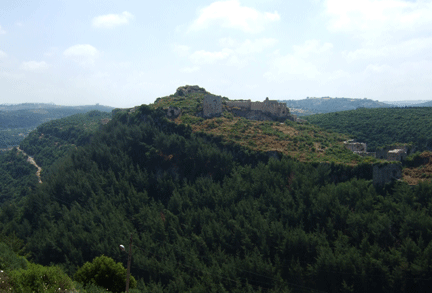
Figure 1: Looking northeast at the western town and central fortification of Qal‘at Salah al-Din

On my recent visit to Lattakiya, Syria, I was given a guided tour of a most extraordinary castle/fortress with visible Crusader and Mamluk ruins. This is the crusader castle named for Robert of Saone, who was given control of it by Roger, Prince of Antioch in 1119 CE. Located almost 30 km from Lattakiya, it was obviously a strategic asset for the Crusaders. But it appears Robert of Saone chose a bad architect for his expansion of the existing fortress. Instead of building up the Byzantine fortress at the high point, he built along the walls, so there was not a second site of defense once the walls were breached. He also failed to consider the range of mangolins, which Salah al-Din used effectively from the nearby ravines to breach the castle walls.

It is no wonder why this impressive location also appealed to defenders from the Phoenician period on. It is recorded that Alexander the Great conquered it, but only with the divine help of Hercules’ club, in 334 BCE. In the 10th century CE the Byzantine Emperor John I Tzimisces gained control and built up the walls, which were expanded by the crusaders. The crusaders did not even last a century, despite the seemingly impregnable aspect of the castle. The walls were breached by the armies of Salah ed-Din in July 1188. In 1957 the official name of the remains was fixed by the Syrian government as the castle (qal‘a) of Salah al-Din, proving once again that to the victor go the spoils and history’s nod. Continue reading The Fortress of Saone and Salah al-Din, 1

Islamic Civilization in Peril

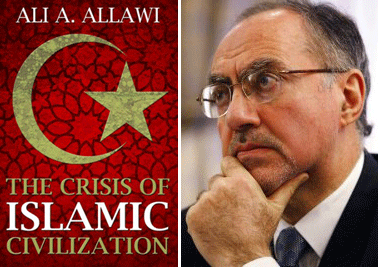
By Ali A. Allawi, The Chronicle Review, June 29

I was born into a mildly observant Muslim family in Iraq. At that time, the 1950s, secularism was ascendant among the political, cultural, and intellectual elites of the Middle East. It appeared to be only a matter of time before Islam would lose whatever hold it still had on the Muslim world. Even that term — “Muslim world” — was unusual, as Muslims were more likely to identify themselves by their national, ethnic, or ideological affinities than by their religion.

To an impressionable child, it was clear that society was decoupling from Islam. Though religion was a mandatory course in school, nobody taught us the rules of prayer or expected us to fast during Ramadan. We memorized the shorter verses of the Koran, but the holy book itself was kept on the shelf or in drawers, mostly unread. The elderly still made the pilgrimage to Mecca to atone for their transgressions in preparation for death — more an insurance policy than an act of piety. I don’t recall ever coming across the word “jihad” in a contemporary context. The political rhetoric of the day focused on Arab destiny and anti-imperialism. Continue reading Islamic Civilization in Peril

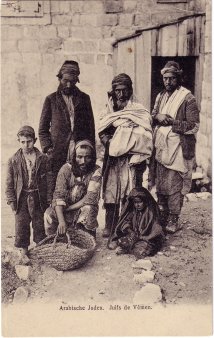
Jews of Yemen prefer to stay


Group of Yemenite Jews, postcard c. 1910

by Salma Ismail, The Yemen Times, June 28

SANA’A, June 28 The death sentence passed on Abdulaziz Al-Abdi, charged with killing Yemeni Jewish and father of nine Masha Al-Nahari last December, heeds mixed reactions among the Jewish community in Yemen.

Despite growing US and Israeli pressure to bring them out of Yemen and settle them in other destinations, the majority of Yemen’s Jews prefer to stay in their ancestral homeland, as long as the government ensures their safety.

Last Sunday’s ruling overturned a previous March sentence that deemed the defendant, a retired pilot in the Yemeni air force, “mentally unstable” and ordered him to pay a “blood fine” of YR 50.5 million, about USD 25,000. Continue reading Jews of Yemen prefer to stay

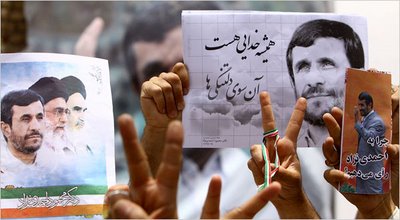
Media fantasies in Iran

by Abbas Barzegar, The Guardian, Friday June 26, 2009

It’s not about the election, Ahmadinejad, or the even the protesters. The world has been captivated by the events in Iran because for many, Iran is to Islamism what the Soviet Union was to communism and presumably today we are somewhere near the fall of the Berlin Wall.

Indeed as the media has been telling us, all the right ingredients are here: a charismatic leader, fractions in the political hierarchy, and a critical mass of protesters. The opposition has begun shouting “Allahu Akbar” from the rooftops and wearing black to commemorate their martyrs just like they did 30 years ago. Iran’s diaspora pundits and dissidents have come out in droves to tell us about the unwillingness of the police to use force on the protesters … just like they did 30 years ago. There are even dissident clerics in the fight, and better yet the protesters now have Twitter and Facebook to help.

I don’t know whose cruel joke this is, but these protests have never been about a revolution nor have any of the opposition leaders ever suggested that. Continue reading Media fantasies in Iran