Category Archives: Countries

Rape and Shariah Law

HOW SHARIA LAW PUNISHES RAPED WOMEN

by Hasan Mahmud, Mudugnet.com, November 20, 2008.

On October 30, 2008, the United Nations condemned the stoning to death of Aisha Duhulow, a 13-year-old girl who had been gang-raped and then sentenced to death by a Sharia court for fornication (Zina). She was screaming and begging for mercy, but when some family members attempted to intervene, shots were fired by the Islamic militia and a baby was killed.

Local Sharia courts in Bangladesh regularly punish raped minor girls and women by flogging and beating them with shoes.[1] Similar cases of punishing raped women are Mina v. the State, Bibi v. the State and Bahadur v. the State.[2] Sharia courts in Pakistan have punished thousands of raped women by long term imprisonment.[3]

You might think that such horrific barbarity cannot be the real Sharia law; that it is a misapplication of the law by ignorant clergy. Sadly, neither is true. Continue reading Rape and Shariah Law
Monkeying Around in Old Aden

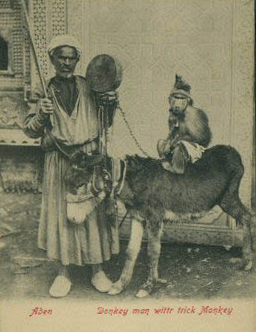
Here is an old photograph entitled “Donkey Man with Trick Monkey,” taken in Aden during the days of the British protectorate. It is not just any kind of “monkey,” of course. Sitting on the donkey is Papio hamadryas, the baboon, usually called rubâh in Yemen. It appears, in deference to the British colonial presence, that the monk is wearing britches.

Saudi- Iranian War fought in Sa’ada


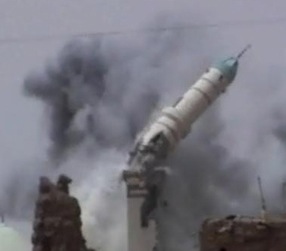
Destruction of a minaret in the recent fighting at Sa’da, Yemen

by Hakim Almasmari, Yemen Post, August 31, 2009

With every day that passes, we come close to believe that the war in Sa’ada is a Saudi-Iranian war, not a Yemeni one.
Both foreign countries are desperate for more regional power while both are also worried of losing greatly. Saudi Arabia does not want Houthis controlling northern parts of Yemen for one main reason; southern Saudi has a large number of Shiite’s which could make them turn against their country as well. Saudi also fears that Shiite’s already have a militant group in the north of Arabia (Hezbollah), and are now looking for one in the south of Arabia (Houthis). Saudi Arabia paid billions of dollars to keep Hezbollah out of rule in Lebanon and somewhat came out victorious for the meantime, and is doing the same in Yemen. Continue reading Saudi- Iranian War fought in Sa’ada

Where else would you find an Arab?

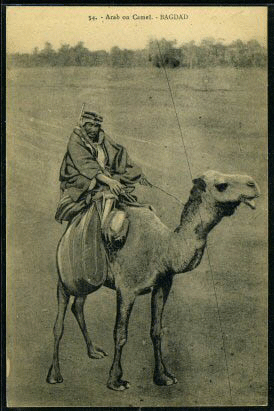
Here is a postcard from a century ago entitled “Arab on Camel … BAGDAD.” I guess for the postcard title writer, a camel rider outside the city of Baghdad might as well be down town. But one wonders why the title was even needed. Where else would the person receiving the postcard at the time have imagined an “Arab” would be?

Walk a Mile for a Chocolate Bar?

World’s First Camel-Milk Chocolates Going Global

Asharq Alawsat, July 22, 2009

DUBAI (Reuters) – Dubai’s Al Nassma, the world’s first brand of chocolate made with camels’ milk, is in talks to expand into new Arab markets, Europe, Japan and the United States, its general manager said Tuesday.

Martin Van Almsick said the United Arab Emirates company planned to enter Saudi Arabia first, followed by Bahrain, Qatar, Kuwait and the United States within the next few months.

Al Nassma is also in talks with British department store Harrods and San Francisco’s Chocolate Covered to sell its products.

Founded and owned by Dubai’s ruler Sheikh Mohammed bin Rashid al-Maktoum, Al Nassma was formally established in October last year and aims to produce 100 tons of premium camels’ milk chocolate a year. Continue reading Walk a Mile for a Chocolate Bar?

Syrian Cuisine, Two Centuries Ago

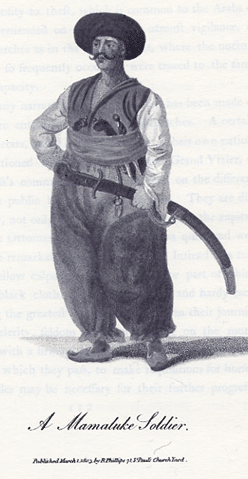
[Note: The following account is by the English traveler William Wittman, who commented on the foods and crops he saw while passing through the Levant in what was then Syria. The spelling is that of the original, from a time when proof reading was a distant concern and spelling was a democratic venture. The picture above is from the original 1803 edition.

Wherever the land is susceptible of cultivation, and has not been neglected, it affords abundant crops of wheat, barley, Indian corn (dourra), tobacco, cotton, and other productions. Fruits and vegetables are in equal abundance. Among the former are pomegranates, figs, oranges, lemons, citrons of an uncommonly large size, melons, grapes, and olives. The melons are large, and have a delicious flavour; as have also the grapes. of which we partook so late as the month of December, when we found they still retained their exquisite flavour. I have already adverted to the uncommon size of the water-melons, many of which weight from twenty to thirty pounds. they are a great and valuable resource to the inhabitants, who are so passionately fond of them, that, during the summer months, they form a great part of their subsistence. Notwithstanding they are as cooling and refreshing, as grateful to the taste, I was surprised to see the natives eat them in such immoderate quantities, without experiencing any unpleasant consequences. Continue reading Syrian Cuisine, Two Centuries Ago

Burns on Afghanistan


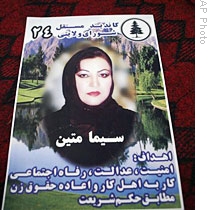
An election poster in Kapisa province for Sima Matin, a female candidate in a provincial council election, 28 Jul 2009

John Burns Answers Your Questions on Afghanistan

By John F. Burns, The New York Times, August 19, 2009

After more than 30 years as a Times foreign correspondent, I’ve grown used to looking out of the aircraft or jeep or train on arrival in unfamiliar and often inhibiting terrain, and wondering with a mixture of anticipation and anxiety how quickly, and capably, I’ll get my professional bearings — and justify the editors’ faith in assigning me. The boundary I’ll be crossing with this new venture for “At War,” our new and expanded blog on the conflicts of the post-9/11 era, is a different kind of challenge — but just as daunting, in its way, as those old forays into unknown lands.

In the first 48 hours after our Web editors invited readers to send in their questions, more than 220 of you responded, a degree of interest that is encouraging for what it suggests about the potential for us at the Times of this kind of interactive journalism. Just as much, the flow of questions, and the sophisticated commentaries woven into many of them, have been a reminder of how much many of our readers already know about the complex challenges America confronts abroad. Continue reading Burns on Afghanistan