Category Archives: Countries

God is my co-sniper

Not since Tammy Faye Baker embroidered Bible verses on her underwear has there been as eye-opening a scriptural scandal as the recent revelation that an American manufacturer routinely engraves Bible verses on U.S. military gun sights. As reported earlier this week, the Michigan-based corporation Trijicon has supplied the gun sights used by American marines to aim at and shoot the Taliban and their sympathizers in Afghanistan. The company may now be in quite a few critics’ sights given the new publicity. The Wikipedia entry already details the controversy. But the main company website has nothing to say. In the detailed descriptions of the gun sights on the website the biblical abbreviations are nowhere in sight. But it does say that “Trijicon self-luminous night sights are proven to give shooters five times greater night fire accuracy- with the same speed as instinctive shooting.” Five times, got it? Try MARK 6:38 (do look this up) and don’t forget the fishes. It may very well be that the procurement officers never noticed the addition of gospel acronyms after the serial numbers, but the company is not shy about its Christian views: “We believe that America is great when its people are good. This goodness has been based on biblical standards throughout our history and we will strive to follow those morals.”

The actual verses are not inscribed, only the chapter and verse in code. It appears that all of the verses are from the New Testament, so at least it cannot be claimed to be a Zionist plot (or perhaps it could be said to be a very clever Zionist plot…). I have no idea how many verses have appeared on the 800,000 units contracted for $660 million by the U.S. Marine Corps. I suspect that MATT 5:44 (do look it up) is not one of them. Perhaps the Sermon on the Mount is not part of what the company defines as “biblical standards.” Continue reading God is my co-sniper
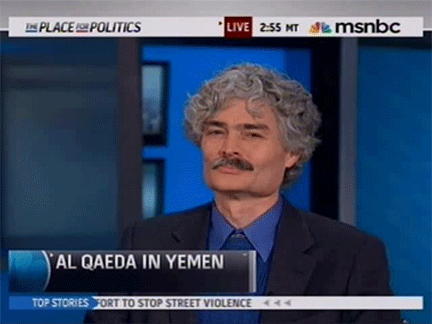
Greg Johnsen on al-Qaeda in Yemen

Welcome to Qaedastan
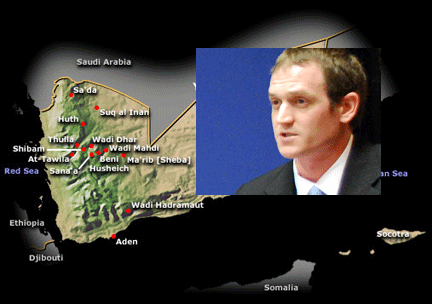
by Gregory D. Johnsen, , Foreign Policy, January/February, 2010

In 2010, Yemen will celebrate the 20th anniversary of national unification. But it won’t be much of a party: This could well be the year Yemen comes apart.

Even the brutal 1994 civil war failed to threaten the structural integrity of this country chronically teetering on the verge of disintegration as much as the current crises, all of which may be coming to a head in 2010.

Yemen has so many dire problems that it’s easy to be overwhelmed. Al Qaeda is growing in prominence, a Shiite rebellion is expanding in the north, and the threat of secession is renewed in the south. There’s a brewing fight over what comes after President Ali Abdullah Saleh, age 67, who has ruled Yemen for 31 years; the country’s elites are locked in a closed-door struggle to take power once he departs. Finally, and perhaps most intractably, Yemen is an environmental and resource catastrophe in the making. The country’s water table is nearly depleted from years of agricultural malpractice, and its oil reserves are rapidly dwindling. This comes just when unemployment is soaring and an explosive birthrate promises only more young, jobless citizens in the coming years. Continue reading Greg Johnsen on al-Qaeda in Yemen

On Yemen (and some a bit off)


Varisco interviewed about Yemen on MSNBC, January 16

For the past week or so, just before the terrible human tragedy in Haiti, Yemen was once again a front page news story in the Western media. This time it was not about qât, nor about the rhino horn used in Yemeni dagger hilts, but the issue was exotic nevertheless. Yemen is newsworthy because of the recent attempted suicide mission of a Nigerian who met with members of the relatively recently reframed Al-Qaeda in the Arabian Peninsula. At first, the political talking heads were eager to brand Yemen as a lawless tribal haven for the next stop of our continuing war on terror. Joe Lieberman added Yemen to his own version of the axis of evil, which I have previously commented upon. But then late last week Yemeni officials announced that six al-Qaeda figures had been killed in an airstrike, and on Saturday three more had been arrested near the Saudi border.

On Saturday, on my return from delivering two lectures in Toronto, I went straight from the airport to MSNBC, where I was interviewed (if that term works for about two minutes of air time) about the recent strikes on al-Qaeda in Yemen. Earlier in the week, I sat down for an extended interview on the current situation in Yemen with Karla Schuster of Hofstra University, an interview which can be seen on Youtube. Continue reading On Yemen (and some a bit off)

Following Seward’s Folly: #3 Confederates in Cairo


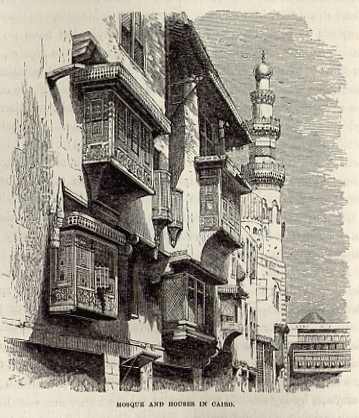
Illustration of Cairo from Seward’s Travels (1873)

William H. Seward, the American Secretary of State who is forever linked with the “folly” of acquiring Alaska from the Russians, spent a year traveling around the world near the end of his life. In two previous posts I posted the comments he and his daughter made about India and Aden, but their trip continued up the Red Sea to Egypt. While in Cairo, Mr. Seward received the esteemed protocol of a traveling diplomat, but in Cairo there came a most civil surprise:

The Americans in Egypt are a mixed though interesting family. The Khédive is reorganizing his army on the Western system of evolution and tactics. Continue reading Following Seward’s Folly: #3 Confederates in Cairo

The Art of Frederick Goodall


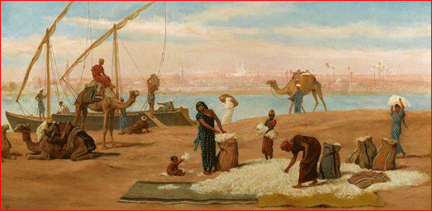
Unloading Cotton on the Nile, painting by Frederick Goodall, mid 19th century

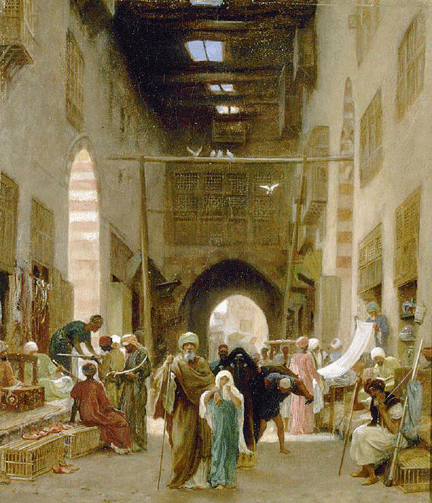
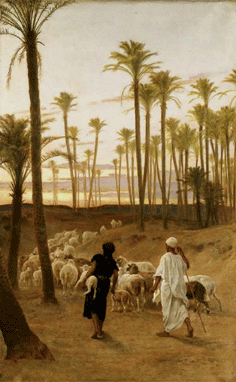
Attention to Orientalist paintings often ignores the lesser artists, some of whom provided valuable descriptive renderings of people and scenes. One of these is the Englishman Frederick Goodall (1822-1904), who moved to the Coptic quarter of Cairo in 1858, sharing space with Carl Haag, a drawing master for Queen Victoria. They spent much time in Bedouin camps, as well as busy suqs, where they were often treated with suspicion. After seven months in Egypt, Goodall had produced 130 oil paintings. He returned to Egypt in 1870 to make more paintings, this time with his two sons. They stayed at the house of the Egyptian archaeologist Mariette-Bey, near Sakkara. To blend in with the context Goodall grew a beard and at times dressed in white with a red fez. His work provides a meticulous “ethnographic” view of Egypt at the time.


Cairo Bazaar, 1891


The Palm Grove, 1894

Karim Ben Khelifa in Yemen


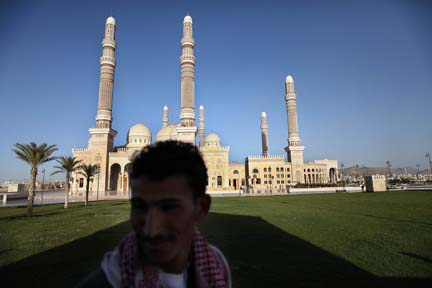
The newly built presidential mosque, which cost an estimated $60 million; photography by Karim Ben Khelifa

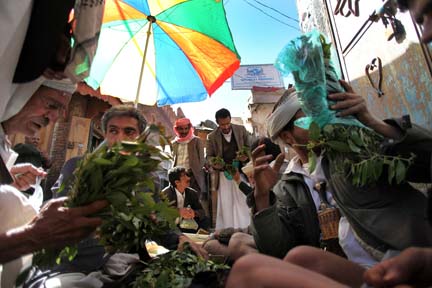
Much of the reporting on recent events in Yemen is pathetic. A rare exception is the work of photojournalist Karim Ben Khelifa, who is currently on assignment in Yemen. Thus far he has posted two sets of photographs, one on the Wall Street Journal, and the other for the New York Times. Check out these websites for superb photographs, two of which I reprint here with the permission of the photographer.


Qât market in Sanaa, Yemen; photography by Karim Ben Khelifa

Following Seward’s Folly: #2 Hopeless Arabia


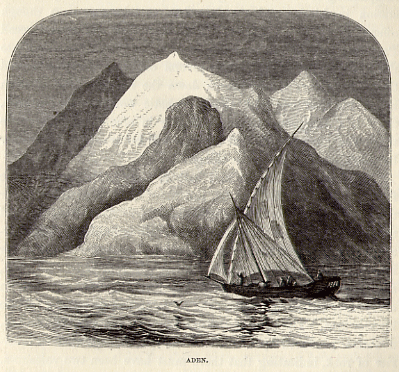
Illustration from Seward’s Travels (1873)

William H. Seward, the American Secretary of State who is forever linked with the “folly” of acquiring Alaska from the Russians, spent a year traveling around the world near the end of his life. In a previous post I recorded his comments on the British rule in India, as reported by his daughter. On April 27, 1871 the Seward party neared the Yemeni port (and British fueling station) of Aden. Here is how the approach is recorded by Ms. Seward:

April 27th. – After eight months travel in the incomprehensible East, with its stagnant civilization, we are now passing into another region still more incomprehensible and hopeless.

On the right hand is Yemen, once ‘Arabia the happy,’ and still known in poetry as a land of light and beauty, but now the dwelling of Arab hordes, who are sinking every day deeper into barbarism. On the left, wee are passing Somali, that part of Africa which stretches from Mozambique to Abyssinia. Continue reading Following Seward’s Folly: #2 Hopeless Arabia

IBLA tragedy

Institut des Belles Lettres Arabes (IBLA) in Tunis caught fire on January 5 and Father Gian-Battista Maffi was killed by the flames. Here is the information posted on the mission website:

Yesterday afternoon, Tuesday the 5th January, about 14.30, there was an explosion in the library of the Institut des Belles Lettres Arabes (IBLA), Tunis. Following the blast, a fire broke out and in spite of the rapid intervention of the city’s Fire Brigade, our confrere Gian-Battista Maffi, 54 years, who was in the library, could not be rescued. He was burnt to death, his body charred.

Police from the forensic laboratory are at work to try to determine the causes of the explosion and the fire.

We join in the sorrow and grief of Gian-Battista’s mother, family and friends. Let us pray for our deceased confrere, for all his confreres in Tunisia and Italy, and for the members of the Pre-Capitular Assembly preparing to begin its work tomorrow the 7th January at Tunis.

José Cantal, Provincial of the Maghreb, is on the spot. He is in the process of organising the funeral at a date yet to be fixed.