Category Archives: Countries

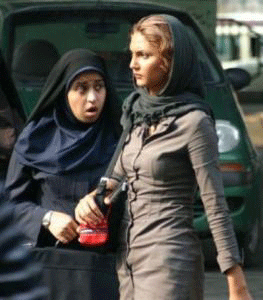
Understanding Islamic Feminism: Interview with Ziba Mir-Hosseini

Understanding Islamic Feminism: Interview with Ziba Mir-Hosseini

Yoginder Sikand, Madrasa Reforms in India, February 7, 2010

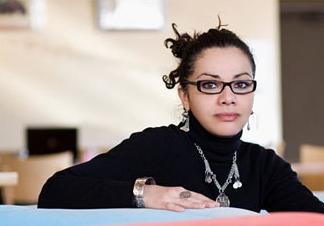
Born in Iran and now based in London, Ziba Mir Hosseini, an anthropologist by training, is one of the most well-known scholars of Islamic Feminism. She is the author of numerous books on the subject, including Marriage on Trial: A Study of Family Law in Iran and Morrocco (l.B.Tauris, 1993) and Islam and Gender, the Religious Debate in Contemporary Islam (Princeton, 1999). She is presently associated with the Centre for Islamic and Middle Eastern Law at the School of Oriental and African Studies, London.

In this interview with Yoginder Sikand she talks about the origins and prospects of Islamic feminism as an emancipatory project for Muslim women and as a new, contextually-relevant way of understanding Islam.

Q: In recent years, a number of Muslim women’s groups have emerged across the world, struggling for gender equality and justice using Islamic arguments. Most of them are led by women who come from elitist or, at least middle class, backgrounds. Many of them seem to lack a strong popular base. How do you account for this?

A: I think the majority of the women who are writing and publishing about what is popularly called ‘Islamic feminism’ are definitely from the elite or the middle class. But then, globally speaking, feminism has always had to do with the middle class, at least in terms of its key articulators and leaders. I believe that Islamic feminism is, in a sense, the unwanted child of ‘political Islam’. It was ‘political Islam’ that actually politicized the whole issue of gender and Muslim women’s rights. The slogan ‘back to the shariah’ so forcefully pressed by advocates of ‘political Islam’ in practice meant seeking to return to the classical texts on fiqh or Muslim jurisprudence and doing away with various laws advantageous to women that had no sanction in the Islamists’ literalist understanding of Islam. Translated into practice, law and public policy, this meant going back to pre-modern interpretations of shariah, with all their restrictive laws about and for women. It was this that led, as a reaction, to the emergence of Islamic feminism, critiquing the Islamists for conflating Islam and the shariah with undistilled patriarchy and for claiming that patriarchal rule was divinely mandated. These Muslim women were confronted with horrific laws that Islamists sought to impose in the name of Islam, and so began asking where in all of this was the justice and equality that their own understanding of the Quran led them to believe was central to Islam. These gender activists, using Islamic arguments to critique and challenge the Islamists, brought classical fiqh and tafsir texts to public scrutiny and made them a subject of public debate and discussion, articulating alternative, gender-friendly understandings, indeed visions, of Islam. That marked the broadening, in terms of class, of the fledgling Islamic feminist movement. Continue reading Understanding Islamic Feminism: Interview with Ziba Mir-Hosseini

Reforming the Arab League

Yemen proposal to reform Arab League
SABA, Yemen News Agency, February 6, 2010

CAIRO. Feb. 06 (Saba) – Yemen has put forward a proposal for the establishment of an Arab Union as a replacement for the Arab League that would be discussed by Arab Foreign Ministers in an early March meeting as a prelude to sending it to the Arab Leaders’ Summit in late March.

The proposal was drafted in an initiative form to reform the Arab League.

In the initiative, Yemen suggested a draft constitution for the union that should contain 37 articles based on principles such as respecting sovereignty and regional borders of countries, respecting the unity of a member state’s national soil, the right of a country to choose its ruling system, dis-recognizing taking office through
force, and establishing an Arab security system to protect the member states and contribute to boosting international peace and security, the Egyptian Al-Shorouk newspaper quoted an official at the Arab League as saying. Continue reading Reforming the Arab League

Why does this land make me quiver?

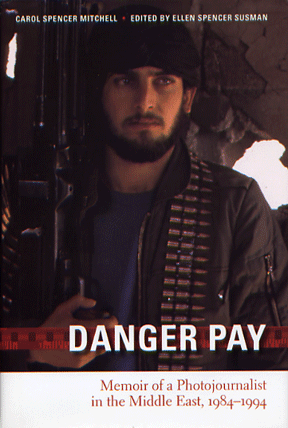
[Webshaykh’s note: Carol Spencer Miller (1954-2004) worked as a photojournalist in the Middle East, covering the crises there for some of the major American and european journals and newspapers. She had access to the elites, including King Hussein and Yassir Arafat, as well as ordinary people. Although she died before publishing her reflections on this experience, her book has been edited by her sister as Danger Pay: Memoir of a Photojournalist in the Middle East, 1984-1994 and is now available as an intriguing first-person memoir of events that seem to recycle more than disappear from the news cycle. I provide here an excerpt about her feeling of disorientation reporting on the Israeli/Palestinian issue.]

It grows increasingly unclear to me why people call this a “Westernized” country. the phones don’t work, the press is censored, there are guns everywhere. I am perpetually uneasy. How, I wonder, can anyone relax when wherever you look, there is someone toting or pointing a machine gun? they casually rest across shoulders, carried by anybody who wants to. Will I get used to the sight of civilians wearing sandals, shorts, T-shirts, and Uzis. in movie theaters, at the supermarket, at shopping malls, and at bars? They aren’t frightening as much as disconcerting.

This is a difficult country to get accustomed to. There are bomb shelters in homes and children’s playgrounds, security at every store, the ever-present notion of “security reasons,” the way people dress, as if they don’t give two hoots about appearance (they don’t). Restaurants and movies open on Fridays are stoned by the ultra-Orthodox Haredim. Continue reading Why does this land make me quiver?

Following Seward’s Folly: #4 The Dome of the Rock


Illustration of Cairo from Seward’s Travels (1873)

William H. Seward, the American Secretary of State who is forever linked with the “folly” of acquiring Alaska from the Russians, spent a year traveling around the world near the end of his life. In three previous posts I posted the comments he and his daughter made about India and Aden, and Egypt. The journey continued to Palestine and the city of Jerusalem:

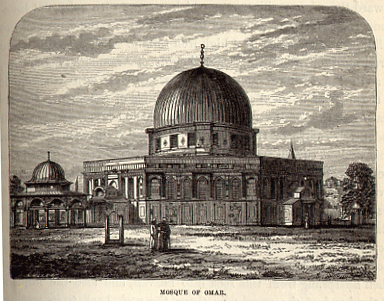
Yussef Effendi, with the brother and secretary of the pacha, attended us to the Mosque of Omar. It is only within the last five years that this mosque, scarcely less sacred in the eyes of Mussulmans than the Church of the Holy Sepulchre is in ours, has been opened to Christian travelers. Even now a careful, though somewhat disguised surveillance, is practiced over them. The mosque stands in an area enclosed with a high, parapeted wall, overlooking the vally of Jehoshaphat, and confronting the Mount of Olives. This occupies one-sixth of the land of the entire city. On the eastern side of this wall is a gate-way, built of marble, called by the Mussulmans the “Golden Gate,” which they are fond of representing as the “gate of the temple called Beautiful,” but its modern architecture does not support that claim. It is only interesting from the tradition that it was closed with the Roman conquest, and has never been reopened. The so-called Mosque of Omar is not single. It consists of two distinct mosques, placed at some distance from each other – the one here named Kubbet-es-Sukhrah, or “the Dome of the Rock,” commonly called the Mosque of Omar, and the Mosque-el-Aqsa. Though differing entirely from the Church of the Holy Sepulchre, the Mosque of Omar is not less unique and peculiar in its sacred antiquities. Twelve hundred years ago, on the surrender of the Greek Patriach, the Caliph Omar demanded to be shownt he site of the Jewish temple. He was taken to the sacred rock, he knelt and prayed over it, and he built over it a mosque, which, with subsequent repairs, is the present “Dome of the Rock,” or Mosque of Omar. In architectural design and execution it rivals the finest in Cairo and Constantinople. Continue reading Following Seward’s Folly: #4 The Dome of the Rock

On the loss of his grandfather


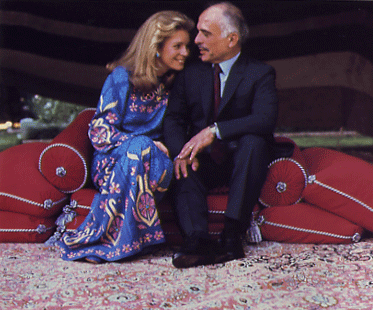
King Hussein with Queen Noor, 1985; Photograph by Carol Spencer Mitchell

[Webshaykh’s note: Carol Spencer Miller (1954-2004) worked as a photojournalist in the Middle East, covering the crises there for some of the major American and european journals and newspapers. She had access to the elites, including King Hussein and Yassir Arafat, as well as ordinary people. Although she died before publishing her reflections on this experience, her book has been edited by her sister as Danger Pay: Memoir of a Photojournalist in the Middle East, 1984-1994 and is now available as an intriguing first-person memoir of events that seem to recycle more than disappear from the news cycle. I provide here a second excerpt about her interview with King Hussein about the murder of his grandfather in which he himself was almost killed.]

On the Loss of His Grandfather

CS: What do you remember about the day your grandfather was assassinated?

KH: (He is silent for a moment,) You want me to go through the whole experience? I remember it very vividly … very vividly. (He is silent again.)

My grandfather was everything to me – a father, an example – who a few days before had asked me a strange question, which I’ve tried to live up to ever since. He asked me to ensure that his work was no lost and that I would continue to serve the Arab nation and this country as he had done. That particular day, I went with him to the city of Nablus because people insisted that we spend the day with them. We had the intention to go pray at the Al-Aqsa Mosque. I remember being in the uniform that he insisted I wear that morning. It was the only one that I had. I remember the meeting that he had in Jerusalem with certain Palestinians that fateful Friday. I remember him speaking about his relations with some of them. The fact that his differences with people were not always of a personal nature, but were matters of policy and approach. I remember him speaking of death and that he wished he would go while he was still in possession of his faculties and the best way in his view would be from a bullet from an unknown assailant. Continue reading On the loss of his grandfather

IUAES Conference in Turkey

The 2010 IUAES Inter-Congress Antalya, Turkey

The Ahi Evran University Department of Anthropology is proud to announce to you the 2010 IUAES (International Union of Anthropological and Ethnological Sciences) Inter-Congress to be held October 3-6 2010 in Antalya, Turkey.

Since our approval to host the congress, preparations and arrangements have been conducted in collaboration with various anthropology departments, professors, and graduate students across Turkey. Our collaborative efforts promise to bring a diverse, exciting, and informative Inter-Congress.

Turkey’s location at a point where three continents of the old world are closest to each other and where Asia and Europe meet has served as a crossroads that is one of the few areas that has been continuously inhabited since the dawn of mankind. The archeological richness is a telling measure of the human history of cultural interaction, conflict, and integration that shape the region. Since the founding of the Turkish Republic in 1925 anthropology as a discipline has assumed an important role in understanding and theorizing cultural exchanges between ethnically, linguistically, and religiously diverse Anatolian peoples and their neighbors; we are honored to strengthen this legacy with IUAES. Continue reading IUAES Conference in Turkey