Category Archives: Countries

Picturing Yemen’s History


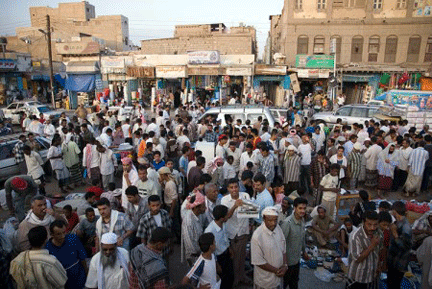
View of a busy marketplace in Aden. Staggering unemployment rate of around 35% hampers serious socio-economic development of the nation. People finishing high school and possessing university degrees are affected the most and according to a government survey published in 2008, 54% of graduates are unemployed/under employed. (Photo: Swiatoslaw Wojtkowiak)

There is an interesting historical study of Yemen through photographs on the Foreign Policy Journal website. Click here to see the full article and pictures. Here is the opening explanation:

Recent events in Yemen have brought the country into limelight again. While Houthi rebels in the north and northeast of the country have an on-off political agreement with the government in Sanaa, al-Qaeda affiliated groups are flexing their muscles by attacking the authorities across the country. Political forces in southern Yemen are also unhappy with the economic development the region has seen since its union with the north two decades ago and talk of secession is ripe.

Though strategically located at the junction of the world’s most important waterways, the Red Sea and Gulf of Aden, the channel that connects world’s western shipping lines to the east, Yemen has failed to capitalise on its potential and emerge as a regional powerhouse. Instead, the country is at the brink of political mayhem and stands at #18 in the Failed States Index 2009 [1].

This photo story sheds light on Yemen’s ancient as well as recent history and discovers the factors that have hampered the country’s economic and socio-political development and brought it to the brink of disintegration.

If your name is Khan…


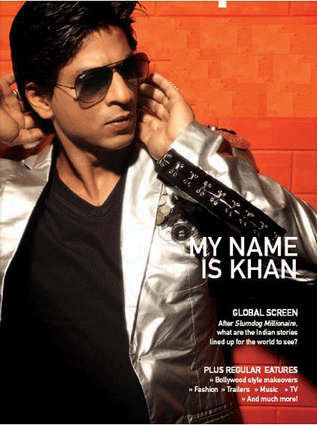
Kajol Devgan and Shah Rukh Khan

On Sunday I finally saw the new Bollywood film with Shah Rukh Khan, “My Name is Khan.” It is well worth seeing, although the minimalist dancing and singing in the film make it more Hollywood (not Fred Astaire’s) than Bollywood. Add to this the fact that many parts of the film were made in San Francisco and California and the Bollywood connection is even more estranged. The plot of the film has gaping holes, but it is not meant as a documentary. I walked away feeling good about two aspects of the film. First, it is a stirring educational lesson in Asperger’s Syndrome. One of Bollywood’s most glamorous male stars provides a moving performance of this disability, disabling those critics who dismiss the victims of the syndrome as dumb or retarded (neither of which they are).

Second, given all the Islamophobic films out there, where jihad is the only plot associated with Islam, it is refreshing to see the tables turned. While most Americans did not use 9/11 as an excuse to go out and beat up Muslims (or Sikhs or anyone who was not “white” enough), a number of prejudicial people did. The hate was real and most Muslims have felt it, even if only the cold stare. Finally here is a fantasy that goes the other way, while making Muslims heroes and lovers of peace. Continue reading If your name is Khan…

Pakistaniaat: New Journal


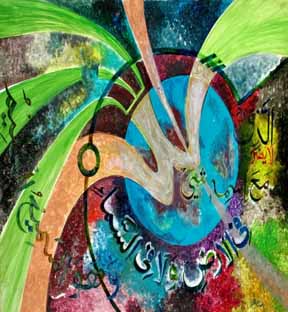
Current cover illustration by Amar Raza, “A Prayer for Protection”

There is a new online journal for anyone interested in Pakistan studies. The first issue of the second volume is now available. Here is the journal description of focus:

Pakistaniaat is a refereed, multidisciplinary, open-access academic journal offering a forum for a serious scholarly and creative engagement with various aspects of Pakistani history, culture, literature, and politics.

Though several existing journals do pay a fair degree of attention to the issues of South Asia and Postcoloniality, we feel that under the current climate of high capital and war on terror, Pakistan, often subsumed under the larger registers of South Asia or Postcolonial Studies, needs a particular space of its own in our academic and creative undertakings. Thus, Pakistaniaat aims to provide a public space on the Internet to introduce and discuss hitherto neglected aspects of Pakistani cultural and literary production and to make this knowledge available to a worldwide audience. Continue reading Pakistaniaat: New Journal

Mocha Musings #2: Egypt

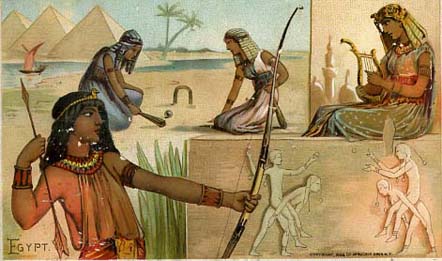
previous post I began a series on coffee advertising cards with Middle Eastern themes. One of the most colorful collections is that provided by the Arbuckle Coffee Company. In my great, great aunt’s album there is a card depicting ancient Egypt, which is shown above.

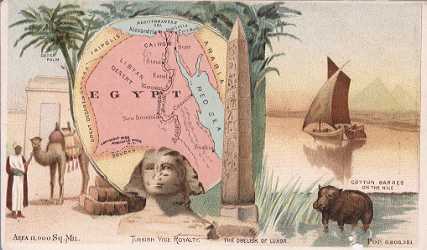
In the 1889 series depicting the nations of the world, Egypt also appears:


Area: 11,000 sq. mi
Population: 6,806,381
Government: Turkish Vice Royalty
Scenes: Date Palm; The Obelisk of Luxor; Cotton Barges on the Nile

Islamic Folk Astronomy #4


Modern photograph of the Pleiades

The Pleiades in Arab Folklore

The most famous star in Islamic folklore is undoubtedly the Pleiades. Commentators regard the reference in surah al-Najm (#53) of the Quran as the Pleiades; in fact the Arabs often referred to the Pleiades simply as al-najm (the star par excellence), a usage parallel to that in Sumero-Akkadian (Hartner 1965:8). In a well-known tradition, Muhammad links the early summer heliacal rising of the Pleiades with the beginning of the heat, crop pests and illnesses. In another tradition, more political than weather-related, Muhammad is supposed to have told his uncle Abbas (for whom the Abbasid caliphate was later named) that kings would come from his descendants equal to twice the number of stars in the Pleiades. This would imply that Muhammad thought there were 13 stars in the asterism, since the Abbasid caliphs numbered twenty-six (Ibn Mâjid in Tibbetts 1981:84). Continue reading Islamic Folk Astronomy #4

My name is Khan

Anyone who is interested in issues of Islam in America must certainly go see the new Shahrukh Khan film My Name is Khan. Despite all of its Bollywood silliness and melodrama, the film is surprisingly discerning on the experiences of Muslims in American society. Though it is set almost entirely in the U.S. (beginning in San Francisco and ending in Georgia), this film will go down as one of the most important Bollywood movies Shahrukh Khan has ever done.

Most obviously of course, the film reminds audiences all around the world that Bollywood’s biggest star ever is in fact a non-violent Muslim (the film’s most repetitive line is “My name is Khan, and I am not a terrorist”). But it also does a number of other absolutely fascinating things, such as performing a reinterpretation of the Qur’anic Abraham-Ishmael story, and in a surprising turn, it spotlights the U.S.’s government abandonment of poor African-American communities. Continue reading My name is Khan

Exercises in Struggling with Loneliness


Shaqi Shafiq, Adeni poet

Exercises in Struggling with Loneliness

by Shawqi Shafiq, Translated by Sinan Antoon, Banipal

Rub the heart’s ring

rub it well

to erase the dust of depression

Rub it again carefully

so that the wall of forgetfulness shines

or

draw a circle/put a dove, or two, inside it/watch the wings move (that is if there are any)

You will ask: What if the circle crumbles?

What if the dove flies away

or if I am bothered by the wings’ noise

I will say to you: erase the circle

for all the traces to disappear

or put a fresh woman

instead of the dove

to seek revenge

for the aridity of an apartment

devouring your mouth

Trouble in Turkey

Anyone following the news the past couple of days may have noticed that the current government of Turkey has arrested a number of former military offices and accused them of plotting a coup. Consider this report on the al-Jazeera website today:

The action over the alleged plot, known as Operation Sledgehammer, has seen Turkey’s largest-ever crackdown on the military.

Recep Tayyip Erdogan, Turkey’s prime minister, said on Friday that no one should consider themselves “above the law”, in what was seen as a warning to the army.

“Those who make plans behind closed doors to crush the people’s will must see that from now on they will face justice,” he told a gathering of his Justice and Development Party (AKP).

“No one is above law, no one has impunity,” he said.

At a time when Turkey is trying to show that it’s Asiatic geography and Islamic polity overlay do not block entry in the EU, this may be a political move to show that democracy has trumped the long history of secular military hegemony. Why Turkey would still want to join the EU, given the debt crisis in neighboring Greece, is another issue. But I can think of several reasons why Turkey should be given top priority for entry into the regional entity that the Ottomans never fully conquered. There but for a successful capture of Vienna goes a different history, as even Martin Luther knew at the time. I think the best rationale is that modern Turkey is just as crazy and mixed up as the diverse nations currently allied in the EU. If you want proof, I suggest you look no further than Youtube. Check out the final scenes of the Turkish made-over version of Star Wars here on Youtube. But first check out the trailer. Eat your heart out, Flash Gordon fans…

Luke R. E. Publican