Category Archives: Countries

Blame it on Lady Gaga

Why is the “Muslim world” angry with America, asks columnist Bret Stephens in the Wall Street Journal? Well here are your two choices:

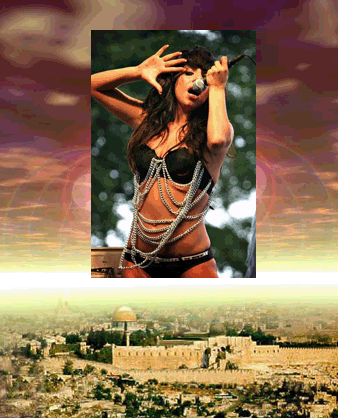
Pop quiz—What does more to galvanize radical anti-American sentiment in the Muslim world: (a) Israeli settlements on the West Bank; or (b) a Lady Gaga music video?

If your answer is (b) it means you probably have a grasp of the historical roots of modern jihadism. If, however, you answered (a), then congratulations: You are perfectly in synch with the new Beltway conventional wisdom, now jointly defined by Pat Buchanan and his strange bedfellows within the Obama administration.

Of course, how could it be Israeli policy. It must be the loose women and jazz singers that really upset Muslims, because that is what Sayyid Qutb said way back in 1951 after visiting Colorado (if only they had shut down those speak-easys in Boulder, who knows!). Yes, here is what Qutb, the “intellectual godfather of al Qaeda,” said:

“The American girl,” he noted, “knows seductiveness lies in the round breasts, the full buttocks, and in the shapely thighs, sleek legs and she shows all this and does not hide it.” Nor did he approve of Jazz—”this music the savage bushmen created to satisfy their primitive desires”—or of American films, or clothes, or haircuts, or food. It was all, in his eyes, equally wretched.

Qutb, notes the columnist, was also anti-Semitic, and blamed the Jews for being at war against Islam. And, to seal the argument for Stephens, here is the real beef (or cheesecake or kosher wine) because: Continue reading Blame it on Lady Gaga

Mocha Musings #4: Morocco to Afghanistan


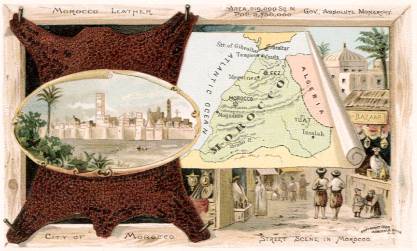
Area: 219,000 sq. mi
Population: 2,750,000
Government: Absolute Monarchy
Scenes: Morocco Leather; City of Morocco; Street Scene in Morocc
o

previous post I began a series on coffee advertising cards with Middle Eastern themes. One of the most colorful collections is that provided by the Arbuckle Coffee Company. In my great, great aunt’s album there were several Middle Eastern and North African nations represented, but she did not have all the cards. Here is a final potpourri from Arbuckle’s 1889 series, starting with Morocco above. Continue reading Mocha Musings #4: Morocco to Afghanistan

Human Rights Report on Yemen released

On March 11, 2010 the Bureau of Democracy, Human Rights, and Labor in the U.S. Department of State released its 2009 Country Report on Human Rights Practices for Yemen. The full report can be accessed online here, but I include below the preliminary paragraphs:

Yemen, with a population of approximately 23 million, is a republic whose law provides for presidential election by popular vote from among at least two candidates endorsed by parliament. In 2006 citizens reelected President Ali Abdullah Saleh to another seven-year term in a generally open and competitive election, characterized by multiple problems with the voting process and the use of state resources on behalf of the ruling party. Saleh has led the country since 1978. The president appoints the prime minister, who is the head of government. The prime minister, in consultation with the president, selects the council of ministers. Although there are a number of parties, President Saleh’s General People’s Congress (GPC) party dominated the government. Civilian authorities generally maintained effective control of the security forces, although there were instances in which security forces acted independently of government authority. Continue reading Human Rights Report on Yemen released

Veiled Voices

Veiled Voices

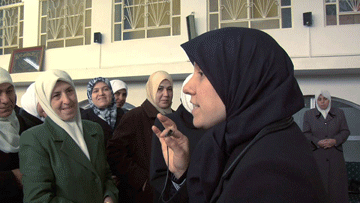
Women across the Arab world are redefining their role as leaders in Islam. Veiled Voices investigates the world of Muslim women religious leaders through the eyes of three women in Lebanon, Syria and Egypt. Filmed over the course of two years, Veiled Voices reveals a world rarely documented, exploring both the public and private worlds of these women. The stories featured in the film give insight into how Muslim women are now increasingly willing to challenge the status quo from within their religion, promoting Islam as a powerful force for positive transformation in the world. Each triumphs over difficult challenges as they carve out a space to lead—both in Islam and in their communities.

For air dates, click here.

The Petraeus briefing

The Petraeus briefing: Biden’s embarrassment is not the whole story

by Mark Perry, Foreign Policy, March 13, 2010

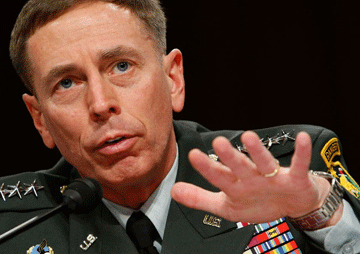
On Jan. 16, two days after a killer earthquake hit Haiti, a team of senior military officers from the U.S. Central Command (responsible for overseeing American security interests in the Middle East), arrived at the Pentagon to brief Joint Chiefs of Staff Chairman Adm. Michael Mullen on the Israeli-Palestinian conflict. The team had been dispatched by CENTCOM commander Gen. David Petraeus to underline his growing worries at the lack of progress in resolving the issue. The 33-slide, 45-minute PowerPoint briefing stunned Mullen. The briefers reported that there was a growing perception among Arab leaders that the U.S. was incapable of standing up to Israel, that CENTCOM’s mostly Arab constituency was losing faith in American promises, that Israeli intransigence on the Israeli-Palestinian conflict was jeopardizing U.S. standing in the region, and that Mitchell himself was (as a senior Pentagon officer later bluntly described it) “too old, too slow … and too late.” Continue reading The Petraeus briefing

Sinan Antoon on Poetry

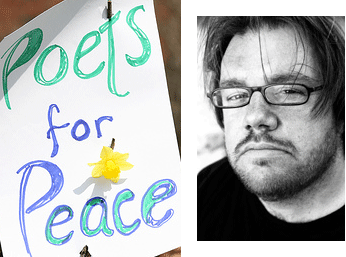
The Iraqi poet Sinan Antoon, attending the Split This Rock Poetry Festival in Washington, D.C. last weekend, was interviewed along with two other poets on NPR on March 10. Here is a brief excerpt, but there is more at the website.

CONAN: Careful listeners can hear another person there in the studio with you at the Radio Foundation in New York City. That is Sinan Antoon, a poet and novelist originally from Iraq, and it’s good of you to be with us today, too.

Mr. SINAN ANTOON (Poet; Novelist; Assistant Professor, New York University): Thank you for having me.

CONAN: And in your tradition, we just heard about that “Poet’s Millions” program broadcast in the Gulf area. Poetry is revered in the Arab world.

Mr. ANTOON: Yes, it is. I should say about this “Million’s Poets” program, it’s not necessarily the best phenomenon we have nowadays because it supports and promotes a certain kind of populist poetry, which is important, and it has its audience. But yes, the tradition of poetry in the Arab world is 14 centuries old, and it’s been integral for the collective identity of people.

But in the modern, contemporary period, it was a very important forum for the anti-colonial struggle, for liberation and for a lot of people in expressing their resistance against dictatorships. So being a poet in the Arab world and saying what poets should say and defending the public and truth meant that, you know, poets are taken to court and are put in prison and are exiled, so… Continue reading Sinan Antoon on Poetry

Mocha Musings #3: Turkey and Persia


Area: 63,800 sq. mi
Population: 4,490,000
Government: Absolute Despotism
Scenes: Merchants Buying Carpets

previous post I began a series on coffee advertising cards with Middle Eastern themes. One of the most colorful collections is that provided by the Arbuckle Coffee Company. In my great, great aunt’s album there were several Middle Eastern and North African nations represented, but from a different series than in the Arbuckle’s 1889 series. The 1889 version of Turkey is shown above, but my aunt’s version of Turkey is decidedly more imaginative:

Continue reading Mocha Musings #3: Turkey and Persia

Gallup on Taliban Popularity

Taliban Increasingly Unpopular in Pakistan
Four percent say Taliban’s presence is positive influence

by Julie Ray and Rajesh Srinivasan, gallup.com, March 12, 2010

This article is the first of a two-part series that looks at Pakistanis’ and Afghans’ views of the Taliban’s influence and their respective countries’ efforts to combat terrorism.

WASHINGTON, D.C. — The Taliban’s presence on either side of the Afghanistan-Pakistan border is largely unwelcome, but increasingly so in Pakistan, where Gallup surveys show they have lost much of the little appeal they had. Four percent of Pakistanis in a November-December 2009 poll, conducted prior to Pakistan’s current push to rout the Taliban within its borders, said the Taliban’s presence in some areas of the country has a positive influence, down from 15% in June. Continue reading Gallup on Taliban Popularity