Category Archives: Countries

Damn the Vuvuzelas


For those of us watching the World Cup in South Africa the din of the vuvuzelas is muted by the voices of the announcers. I can only imagine the deafening roar experienced by those attending the games in what has to be the noisiest World Cup ever. Now, courtesy of a fatwa from the United Arab Emirates, Muslims no longer need to put up with the noise. In Fatwa #11625 of July 6, the verdict is in. All this noise really is haram. The fatwa quotes Imam Malik as saying he disapproved of a festivity with loud horns, a handy precedent for the current noise pollution in the sporting world. Of course, Imam Malik did not measure decibels, but we sure can today.

For those who are interested, here is the argument: Continue reading Damn the Vuvuzelas

Payback for No Pay


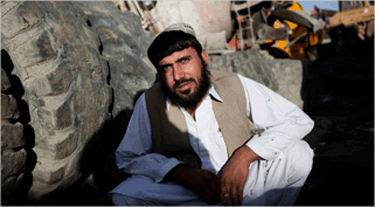
Haji Layeq says an American company failed to pay a construction company he has ties to; photo by Adam Ferguson for The New York Times

Much of the world, despite what many Americans think, does not trust the United States intentions in either Afghanistan or Iraq. Both countries have seen corruption and favoritism at the highest levels. In theory “America” stands for citizens’ rights and equal treatment under the law, but in practice such principles may conveniently be ignored in war zones. Such a case was reported on yesterday in The New York Times by Carlotta Gall. She writes:

The failure of American companies to pay for contracted work has left hundreds of Afghan workers unpaid in southern Afghanistan, and dozens of factories and small businesses so deep in debt that Afghan and foreign officials fear the fallout will undermine the United States-led counterinsurgency effort to win the support of the Afghan people.

Continue reading Payback for No Pay

Divorcing fundamentalism


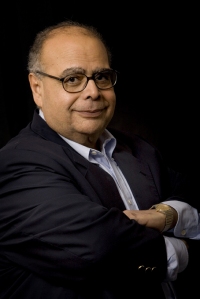
Nasr Abu Zaid was a brave and honest scholar disgracefully persecuted for his attempts to read the Quran historically

by Brian Whitaker, The Guardian, July 6

The divorce case was what made him famous, though it wasn’t the usual kind of celebrity divorce and Nasr Abu Zayd was still in love with his wife.

Abu Zayd, the liberal Muslim thinker who died yesterday, first came to the attention of Islamists while teaching Arabic literature at Cairo university in the early 1990s. They decided that his research contained “clear affronts to the Islamic faith” and accused him of apostasy.

That in turn inspired a group of Islamist lawyers to file a third-party (“hesba”) case, seeking to divorce him from his wife on the grounds that a Muslim woman cannot be married to an apostate – and after a series of court hearings his marriage was declared null and void.

Such was the controversy after the verdict that Cairo university was “turned into a military fortress” to protect him the next time he made an appearance there. Realising that it was impractical to continue teaching under those conditions, and after one of his guards was heard describing him as “the infidel”, Abu Zayd and his “ex-wife” left Egypt and settled in the Netherlands. Continue reading Divorcing fundamentalism

Al-Qaeda in the Arabian Peninsula


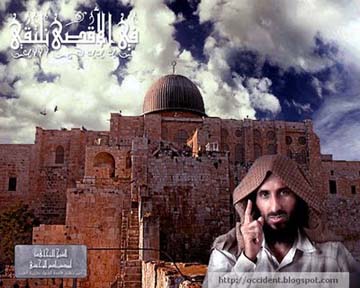
The Amir [leader] of al-Qa’ida in the Arabian Peninsula, Abu Basir Nasir al-Wuhayshi (also transliterated, “Abu Baseer Nasir al-Wahayshi”), in front of a photograph of the al-Aqsa mosque, one of Islam’s holiest shrines, in Jerusalem. The text reads, “At al-Aqsa We Meet.”

Exploiting Grievances: Al-Qaeda in the Arabian Peninsula

Executive Summary
THE PAPER IN A NUTSHELL

• Al-Qaeda in the Arabian Peninsula (AQAP) has been remarkably adept at exploiting the grievances of ordinary Yemenis. The group’s rhetoric, however, only goes so far and has not yet translated into a widespread base of support. In order to prevent AQAP from becoming more deeply entrenched, the Yemeni government must move swiftly to increase governmental visibility and improve the delivery of services at the local level. Failure to do so risks a growing al-Qaeda presence on the Arabian Peninsula with grave consequences for regional and international security.

VITAL STATISTICS
• Al-Qaeda in the Arabian Peninsula (AQAP) is the product of a merger between al-Qaeda’s Saudi and Yemeni branches.
• Estimates of the size of AQAP in Yemen vary from 300 to several thousand. The lower figure likely represents the number of active militants within the organization, while the larger figure includes supporters not actively involved in the group’s day-to-day operations.
• AQAP employs targeted messaging that is consistent with the core tenets of al-Qaeda’s ideology but infused with themes that resonate locally within Yemen.
• According to AQAP, Muslims are suffering at the hands of foreign powers that prop up illegitimate and corrupt local regimes that have failed to provide for their citizens. Continue reading Al-Qaeda in the Arabian Peninsula

July 4, 1187


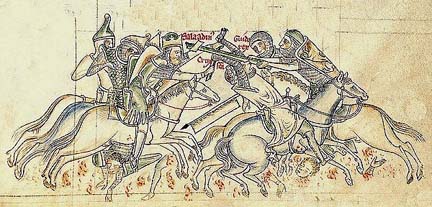
Guy de Lusignan and Saladin in Battle / Mathew Paris, c.1250

[Webshaykh’s Note: July 4 is famous for more than one reason, although firecracker bedlam covers both the annual American celebration as well as a devastating crusader defeat of the Knights Templar almost a millennium ago. The following account is from TemplarHistory.com.]

The Fourth of July, a time for Americans to celebrate their War of Independence from the English in 1776, had an entirely different meaning to medieval Europe. For the Fourth of July, 1187 was to be one of the bloodiest battles of the crusades, the Battle of the Horns of Hattin.

The area is called the Horns of Hattin for the two rocky peaks that rise over the brush covered slopes behind Tiberius on the Sea of Galilee. It was here that Saladin aligned 12,000 of his knights plus an army carrying regular provisions at Tiberius. An army as well mounted and armed as anything that could be assembled by the combined forces of the Templar and Hospitaller orders. On the other side of the battlefield were the crusading forces comprised of 20,000 foot soldiers but only about 1,000 knights. This force, small by comparison, was assembled by depleting the forces of many surrounding cities thus leaving the unarmed cities open to attack.

The Christian army had set out for Tiberius in the early morning hours of July 3rd, leaving in their wake their well-watered camp for the dust and dryness of the desert air. They carried with them that Holy relic so many would die for in coming battles, the True Cross, discovered in 326 CE by the mother of Constantine the Great.

As they made the trek in the hot desert sun they found no water to aid their thirst and in the heavy armor must have been near exhaustion. By evening of July 3rd, the crusading army arrived at a plateau below the Horns of Hattin, which jutted into the air 100 feet above them. Even at this resting spot the Templars and other crusading warriors found no water, as the well was dry and the only stream was blocked. Continue reading July 4, 1187

Faulkner in Iraq


Videoconferencing Faulkner in Iraq

By Jennifer Howard, The Chronicle Online, June 24

Thanks to videoconferencing, literary criticism is playing a small part in the rebuilding of Iraq.

At the end of last year, Steve Wilson, a professor of English at Texas State University at San Marcos, got an email from a U.S. official working on provincial reconstruction in Iraq. Through contacts at Iraqi universities, the official had met some professors of English who wanted to find a way to talk to their U.S. counterparts about literature. So he went looking on the Internet for American professors who had experience that might be relevant and found Mr. Wilson, who had taught in a largely Muslim country, Malaysia. Continue reading Faulkner in Iraq

Ibn Abī Bakr al-Azraq on Massage Oils: #1


The Arab physician Ibrāhīm ibn ‘Abd al-Rahman ibn Abī Bakr al-Azraq, wrote an important medical text near the end of the 9th century A.H./fifteenth century C.E. This is his Tashhīl al-manāfi‘ fī al-ṭibb wa-al-ḥikma, which was published in Cairo in the late 19th century and has been republished many times since then. One of his chapters deals with adhān, that is oils and lotions that were rubbed on the body either in the hot bath or just for general health. Here is my translation of his account on oils.

Section on the Benefit and Influence of Oils (adhān)

The Prophet, may Allah bless him and grant him salvation, said: “Eat olive oil (zayt) and rub it on the body.” It is a remedy for seventy illnesses, one of these being leprosy (judhām). He said: “For forty nights, Satan will not come near anyone who has olive oil applied.” Zayt is the extraction of the olive, according to al-Dīwān. Cold and wet, but said to be hot. It softens (yadbughu) the stomach, strengthens the body, energizes movement, and there is benefit for one in old age in applying it to the eyes against dimming of vision. According to Ibn ‘Amr the Prophet, may Allah bless him and grant him salvation, said: “Use it to season bread and rub it on the body, because it comes out of the blessed tree (al-shajara al-mubāraka). Continue reading Ibn Abī Bakr al-Azraq on Massage Oils: #1

Habibi Rasak Kharban


Habibi Rasak Kharban (Darling, Something’s Wrong with Your Head) is a dramatic feature that tells the story of a forbidden love in Gaza. The film is a modern re-telling of the famous ancient Sufi parable Majnun Layla and is the first full-length narrative set in Gaza in over 15 years.

Susan Youssef is the writer and director. This is her first feature film. Her five shorts have screened at venues such as Sundance Film Festival and Museum of Modern Art (NY), and have been acquired for distribution by Video Data Bank, Third World Newsreel, and Canadian Filmmakers Distribution Centre. For information on her past films, click here.