Category Archives: Countries

Manly manoeuvres


By Nadeem F. Paracha. Smoker’s Corner, Dawn.com, July 4, 2010

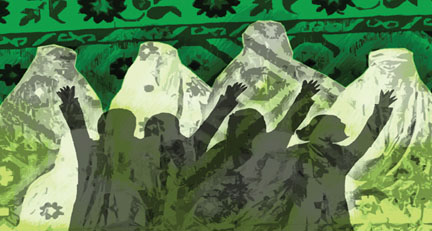
It is rather startling to note how the powerful ‘Women’s Lib’ movement in the 1970s was manhandled by certain sections of society in the West. They scrapped the intellectual aspects of the concept and used the fruits of the movement by simply exhibiting it as a way to justify nudity.

The above was what most frontline women activists of the movement bemoaned, alluding that their movement’s many positive social outcomes had been misused. In fact, such is also the view of a majority of conservative Muslim thinkers — especially those who have been at the forefront of encouraging the usage of veil among Muslim women.

Interestingly, a lot of young Muslim women who adorn the hijab/burqa suggest that veiling demonstrates their liberation from becoming an object of the pitfalls of the Women’s Lib movement. But just as one is correct to point out that these pitfalls involve emancipated women who shroud their obvious objectification by describing it as liberation, one isn’t too far off the mark to also question the other side of the divide. Continue reading Manly manoeuvres

Economisstep


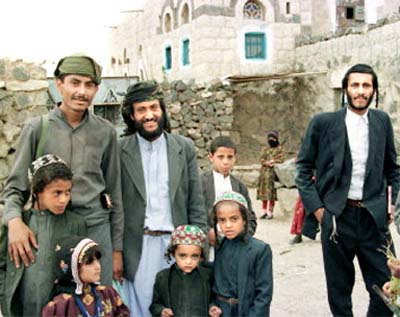
The Economist is generally considered one of the better journalistic bright spots for periodical subscribers. The editors lean to the conservative side, but usually provide articles with the background and rationale to make informative reading. However, a short article released in the latest issue is misinformed and borders on propaganda. There is no byline, at least in the online edition I read, but the writer is poorly informed about Yemen. It is true that Yemenite Jews have suffered because of the political actions of Israel. Like most Arab nations, Yemeni Arabs tend to side with the plight of the Palestinians. Yes, they are exposed to a steady stream of anti-Zionist news, but the government itself has protected the Jewish community. Most Yemenis do not swallow the government propaganda whole and there is still a great deal of respect for the Yemenite Jewish tradition in Yemen. The distinction between “Jew” and “Zionist” does exist.

Even if the author visited Sanaa and Jibla, he has totally missed the amount of unrest among the population. To state “Yemenis rarely protest publicly against their own miserable circumstances at home” is quite naive. Continue reading Economisstep

Yemen: not on the verge of collapse

by Steven C. Caton, The Middle East Channel, August 11, 2010

The Republic of Yemen is often spoken of in the press and in policy circles as a society on the verge of collapse (last year it was “another Somalia”), based largely on two claims, the first being the supposed weakness of its state, the other the supposed lawlessness of its tribal population that makes up the majority ethnic group (about seventy-five percent are settled agriculturalists in the mountains and another five per cent, nomadic Bedouin in the eastern desert). And supposedly being on the verge of collapse, Yemen is seen as vulnerable to take-over by terrorist organizations such as al-Qaeda that threaten America’s and the region’s security. Let us consider how tribe and state, law and conflict operate in Yemen that few analysts seem to grasp when they make these pronouncements.

History may provide some perspective. There has been a state or dawlah in Yemen for thousands of years, whether the Sabaean state that built Marib Dam and was the reputed homeland of the Queen of Sheba, or the Islamic state created shortly after the advent of Islam which lasted for a thousand years, or the republican state that came into being in 1962 and has lasted until the present day, despite two bitter civil wars. To be sure, the state has waxed and waned in power and contracted or expanded in territory during this history, and it has faced formidable outside opponents, beginning with the Romans and most recently with al-Qaeda, but it has never fully collapsed or disappeared from the scene. It is unlikely to do so in the present in spite of arguments that the current regime is at a tipping point and about to fall apart because of an unprecedented number of seemingly intractable problems facing it (an ever weakening economy, unsustainable water consumption, projected diminished oil reserves, conflicts between the state and certain regional populations, rampant corruption, and let us not forget al-Qaeda). Continue reading Yemen: not on the verge of collapse

Go ye into all the war zones


How American Right-Wing Christians Are Waging ‘Spiritual Warfare’ in Northern Iraq
By Michael Reynolds, AlterNet
Posted on July 12, 2010, Printed on July 28, 2010

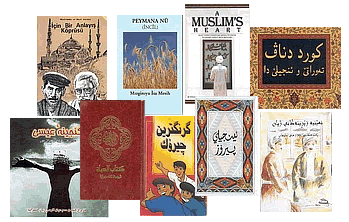
On a barren hillside outside Sulaymaniyah in southeast Iraqi Kurdistan sits a small compound of buildings clustered behind battered gray and ochre walls. Atop one wall is a large white sign glittering with gold and azure lettering that reads in English and Arabic: Classical School of the Medes. It is one of three new private schools in the region that teach a “Christian worldview,” the handiwork of American evangelicals from Tennessee.

Since the US occupation took hold, American evangelicals have established not only schools, but printing presses, radio stations, women’s centers, bookstores, medical and dental clinics, and churches in northern Iraq, all with the blessings and assistance of the Kurdistan government. Many of these efforts were funded in part by US taxpayer dollars, channeled through Department of Defense construction contracts and State Department grants.

In September 2003, just four months after US forces took down Saddam Hussein’s regime, 350 evangelical pastors and church leaders assembled in Kirkuk, where they were warmly welcomed by Massoud Barzani, president of the Kurdistan Regional Government. At that gathering, George Grant, a leader of Servant Group International, the evangelical organization in Nashville that set up the chain of Christian schools, declared that “Jesus Christ is Lord over all things; He is Lord over every Mullah, every Ayatollah, every Imam, and every Mahdi pretender; He is Lord over the whole of the earth, even Iraq!” Continue reading Go ye into all the war zones

Imams as schoolboys

Educating Imams in Germany: the Battle for a European Islam

By Paul Hockenos, The Chronicle Review, July 18, 2010

Berlin

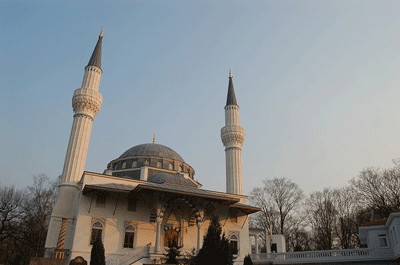
In the snow-swept courtyard of the white-marble Sehitlik Mosque, Berlin’s largest Islamic prayer house, the resident imam greets the faithful with handshakes and embraces. A slightly built, cordial man wearing an open parka, Mustafa Aydin is a Turkish civil servant on a four-year posting abroad, as are many of the Islamic preachers in Germany, where the Muslim community is overwhelmingly of Turkish heritage. Aydin understands basic German, which he’s been learning, but he communicates with me through a Turkish-to-German interpreter. The services’ prayers are in Arabic, he says, but his sermons and chats with congregants—including those born and schooled in Germany—are in the language of their parents’ Turkish homeland, and that, he assures me, is perfectly adequate for his parish’s needs. “We don’t have any problems with Turkish,” he says.

In a Germany struggling to come to grips with its burgeoning, four-million-strong Muslim population (about 5 percent of the populace), the use of imams sent from Turkey and other foreign countries, including Saudi Arabia, has come under sustained fire from integration-minded critics. After all, argue some intellectuals, politicos, and other citizens across Germany’s political spectrum, including the more moderate currents in the Muslim community, how can the foreign clergy advise believers—many of whom grapple with profound disadvantage in Germany—without mastering the lingua franca and knowing the world they live in? The imams have, in part, been held responsible for Muslims’ ghettoization, as well as fundamentalism in some pockets of the country. Continue reading Imams as schoolboys

Tariq Aziz: ‘Britain and the US killed Iraq. I wish I was martyred’


Tariq Aziz with Saddam Hussein before the fall

by Martin Chulov in Baghdad , The Guardian, August 5, 2010

Tariq Aziz is slumped on a tattered brown sofa seat cradling his walking stick and cigarettes, his gaunt face topped, incongruously for a practising Christian, by a Muslim prayer cap. It is perhaps only the familiar black-ringed spectacles that signal to the visitor that this was Iraq’s former face to the world – Saddam Hussein’s right-hand man, his most powerful deputy.

Apart from his captors and lawyers, Aziz, says he has not seen or spoken to a foreigner since the fall of Baghdad. But after years rotating between solitary confinement and a witness box in court, he is now more than ready to speak.

“It’s been seven years and four months that I have been in prison,” he told the Guardian. “But did I commit a crime against any civilian, military or religious man? The answer is no.”

Iraq has been through hell since Aziz was last seen in public, days before Baghdad fell in April 2003, toppling Hussein and the totalitarian Ba’athist regime that Aziz had helped lead for 30 years. Continue reading Tariq Aziz: ‘Britain and the US killed Iraq. I wish I was martyred’