Category Archives: Countries

Leaves from an old Bible Atlas #3


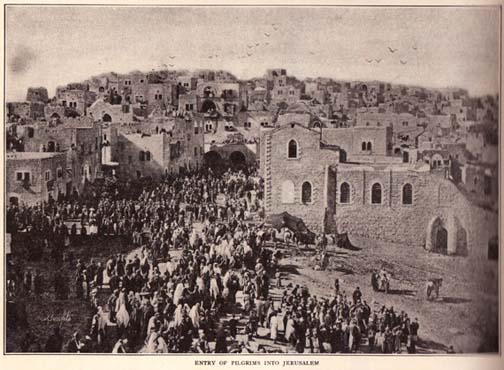
Entry of pilgrims into Jerusalem, Hurlbutt’s Atlas, p. 150

The Christian fascination with the Holy Land as a window into interpretation of the Bible has a long and indeed fascinating history of its own. Here I continue the thread on Jesse Lyman Hurlbutt’s A Bible Atlas (New York: Rand McNally & company, 1947, first published in 1882). The photograph above is actually the last in the atlas, just before a colorful foldout chart of Bible History.

The edition I am using includes an Introduction by Bishop John H. Vincent, whose memories of a visit to Palestine are quite typical of this Holy-Landaphilia. The following is a good example of the preacher’s rhetoric:

At one time I was permitted to spend forty days and forty nights in Palestine. I saw Abraham at his tent door; Rebekah veiling herself at the approach of the stranger; the long caravan of camels and Midianites on their way toward the south. I saw the wailing mourners at the house of death; the roof that might easily have been broken up; the wedding procession; the grass on the housetops; the sparrow making a nest for her young in the synagogues of Jerusalem. I saw the elders in the gates; David the shepherd, with his sheep, on the hillside; the Jewish mother, teacher Timothy, the words of the old Book in the old city on the hill. Verily, it is the old land; it is the old life; it is the memorial presentation in concrete form of what the Book says was true there thousands of years ago.

To be continued …

The Meaning of Democracy

The Meaning of Democracy

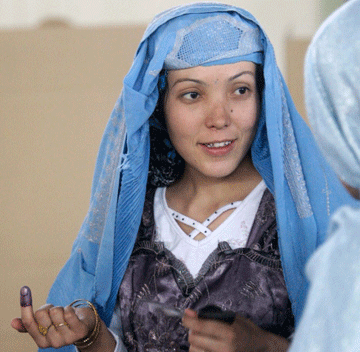
by Roya, Afghan Womens’ Writing Project

After the Taliban‘s black regime, when houses were cages for women and only the wild Taliban ideology was law, when the burqa was accepted as a symbol of freedom and the real Islamic hijab disappeared unknown—after all this, Afghan women recognized the word for Democracy.

But Democracy is a very young word for the people of our country, very new in our cultural dictionary, and the question is: Do women understand this word? Do they welcome it, or hide under their burqa?

I think Democracy knocked on the doors of only some women in Kabul, Mazar, Herat, only a few of Afghanistan’s 34 provinces. In most areas, Afghans still don’t know this word. Many think it is a word used only by politicians who travel all over the world, live in the tallest buildings and own the latest car models. Democracy, easiest explanation, is government of the people, for the people. But in our country, people think whatever your heart wants, do it, and that is the meaning of democracy. Continue reading The Meaning of Democracy

Leaves from an old Bible Atlas #2


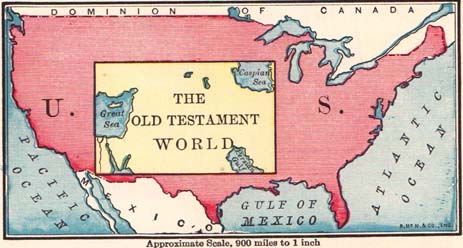
Comparative view of the United States and Old Testament world, approximate scale, 900 miles to 1 inch (in the original map which is only 3 3/4 inches across)

The Christian fascination with the Holy Land as a window into interpretation of the Bible has a long and indeed fascinating history of its own. Here I continue the thread on Jesse Lyman Hurlbutt’s A Bible Atlas (New York: Rand McNally & company, 1947, first published in 1882). I love the irony of the map above. Long before the political map devolved into Blue States vs. Red States, here is the Old Testament squarely in an expanded Bible Belt.

Here is Hurlbutt’s summary of the physical space defined as the Old Testament world:

The Old Testament world embraces the seas and lands between 30° and 54° east longitude, or from the mouth of the Nile to the head of the Persian Gulf; and between 27° and 40° north latitude, from the parallel south of Mt. Sinai to the north of Mount Ararat. The total extent of territory is about 1,400 miles from east to west and 900 miles from north to south, aggregating 1,260,000 square miles. If the space occupied by the Mediterranean Sea and other large bodies of water is deducted from this, the land will include about 1,110,000 square miles, or one-third of the extent of the United States, excluding Alaska. Unlike the United States, however, nearly two-thirds of this area is a vast and uninhabitable desert, so that the portion actually occupied by man is less than an eighth of that included int he American Union.

I wonder what Sarah Palin would think about Hurlbutt excluding Alaska, but at least it was not a state yet and some still referred to it as Seward’s folly.

To be continued …

Pictures at a Yemeni exhibition


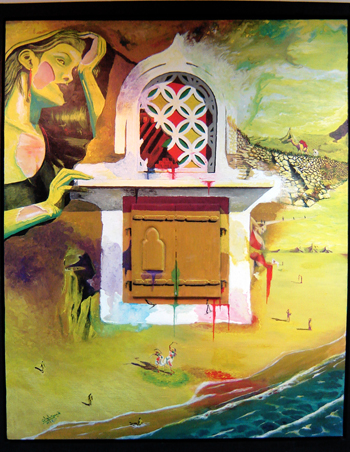
Painting by Qais Saleh Ahmed Aluan, founding member and vice-director of the Bait al-Fann (House of Art) in Yarim (Ibb Governorate)

The media focus on Muslim grievances over images of the Prophet Muhammad obscures the fact that there is a vibrant artistic tradition throughout the Islamic world. Take Yemen, for example. There are art centers in various parts of the country. Here is a Youtube trip through Bayt al-Fann (The House of Art) in Hodeidah. I only wish they had used music by Mussorgsky…

Dance Workshop & Discussion: Leila of Cairo and Anthropologist Najwa Adra


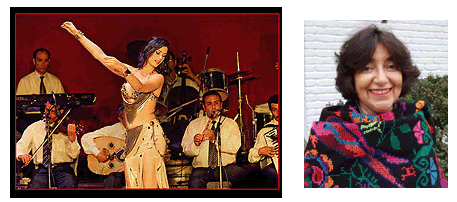
Leila, left; Dr. Najwa Adra, right

Dance Workshop & Discussion: Leila of Cairo and Anthropologist Najwa Adra
Wednesday, September 1, 2010 6:00 pm at Alwan for the Arts

Workshop: 6:00-8:30 pm
Discussion: 8:30-10:00 pm

This evening of dance and discussion provides an opportunity much needed in the bellydance scene: to both embody the feeling of Egyptian raqs sharqi through movement and music, and also to speak to the controversial issues surrounding the dance through dialogue with experts. Alwan welcomes acclaimed dancer Leila of Cairo, and esteemed scholar Najwa Adra, to kick off its 2010-2011 season of culturally contextualized, quality dance and performance.

Dance Workshop with Leila of Cairo

Understanding Classical Egyptian Music for Dance

6:00-8:30 pm

The historic songs of Oum Kalthoum, Abdel Halim Hafez and Warda can be intimidating for dancers of all levels. Join Leila as she navigates through the musical structure of these complex compositions. Explore Egyptian versus Western interpretation of these songs, and utilize Egyptian technique to express the music and ultimately, yourself, within the dance.

Take advantage this rare opportunity to learn with Cairo-based, American-born Leila, who has won over Egyptian audiences with her dance, film and stage appearances.

Discussion with Najwa Adra PhD and Leila

Raqs, What’s the Point? Diverging Bellydance Traditions in Egypt and the U.S.

8:30-10:00 pm

This discussion focuses on differences of perception, meaning, context and technique of the dance known simply as raqs or raqs sharqi in the Arab world, and as bellydance in the US. Leila draws upon her experiences as a US-born dancer who has an exceptionally successful career as a performing artist in Eygpt, while Najwa highlights related issues from her fieldwork research, writings and lifetime of participating in social dance traditions of the Arab world. The talk-back will touch upon notions of authenticity, cultural appropriation and orientalization in the dance. Come with questions and comments! Continue reading Dance Workshop & Discussion: Leila of Cairo and Anthropologist Najwa Adra

Leaves from an old Bible Atlas #1

Perhaps there is a geographical inclination gene in my ancestry, since I have always loved Bible atlases. Many years ago my father was given a copy of Jesse Lyman Hurlbut’s A Bible Atlas, first published in 1910; his volume was a 1947 revision. But for the most part I assume the photographs were taken around the turn of the 20th century, give or take a decade. The author lived from 1843–1930 and as early as 1882 had published a Manual of Biblical Geography, the perecursor to this atlas. The 1910 version is archived online. There is also a website devoted to maps from his 1904 Story of the Bible.

So here I begin a thread of photographs of the Holy Land from at least a century ago. Let’s begin in Tiberias … Continue reading Leaves from an old Bible Atlas #1

A shift in Arab views of Iran


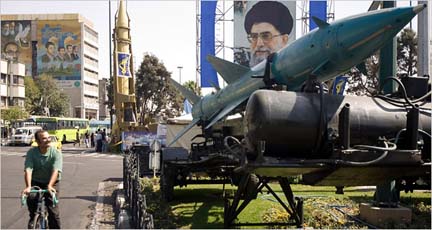
Photograph by Morteza Nikoubazl for Reuters

Anger over the Israeli-Palestinian conflict and U.S. policy is tilting public opinion in favor of Tehran and against Washington.

by Shibley Telhami, The Los Angeles Times, August 14, 2010

President Obama may have scored a diplomatic win by securing international support for biting sanctions against Iran, but Arab public opinion is moving in a different direction. Polling conducted last month by Zogby and the University of Maryland in Egypt, Saudi Arabia, Jordan, Morocco, Lebanon and the United Arab Emirates suggests that views in the region are shifting toward a positive perception of Iran’s nuclear program.

These views present problems for Washington, which has counted on Arabs seeing Iran as a threat — maybe even a bigger one than Israel. So why is Arab public opinion toward Iran shifting? Continue reading A shift in Arab views of Iran

Ottoman Haifa


William Henry Bartlett, Mount Carmel Looking towards the Sea, engraving,
collection of Dr. Y. Rimon, Haifa

The Haifa City Museum in Israel is sponsoring a special exhibition entitled “Ottoman Haifa: Aspects of the City, 1516-1918” from August 29, 2009 – October 2, 2010. The curator is Ron Hillel. Details are provided at the exhibition website, with the description copied below.

During the Ottoman period, many marked changes occurred in Haifa and its environs. The foundations of today’s city were laid, economic, social, and religious. Even though Ottoman rule ended less than 100 years ago, the general sense is that all this happened in the remote past. This exhibition is intended to revive that heroic era, to make it tangible.

The exhibition follows Haifa’s development during the Ottoman period. The city’s growth is linked by indissoluble bonds to its technological and economic progress. Its development is documented in geographic illustrations and maps and with the invention Continue reading Ottoman Haifa