Category Archives: Countries

Mohammed Reza Shajarian: Protest Through Poetry


by Steve Inskeep, NPR Morning Edition, September 27, 2010

[NPR this morning has a 7 minute segment on this famous Iranian singer; click on the website for samples of his music.]

Mohammed Reza Shajarian may be the most famous singer in all of Iran.

He’s also Iran’s most famous protest singer — even though, strictly speaking, his music doesn’t directly protest the government at all.

Just before they end their fast each day during the Muslim holy month of Ramadan, many Iranians or people of Iranian descent around the world listen to a prayer sung by Shajarian.

“It has such power, and the power of it has virtually nothing to do with the words,” says Iranian-American scholar Abbas Milani. When Milani hears Shajarian’s recording of the prayer, it transports him back to his youth in Iran.

“When I still hear it, I get a chill to my bone and think that this is not the voice of a mere mortal — this is the gods speaking to us.”

Iranians heard Shajarian’s voice on the radio for decades — and then, suddenly, the music stopped. Shajarian, protesting a crackdown on voters after last year’s disputed election, asked that the government cease broadcasting his songs. Continue reading Mohammed Reza Shajarian: Protest Through Poetry

and where is the city of the future?


Take a look at the picture above. This is the recently operationalized city of Masdar, one that seems to come right off the drawing boards of 2001: A Space Odyssey or at least Star Wars. Imagine a city with zero carbon emissions. Imagine a perfectly planned city from top to bottom, fueled by solar power and clean as the pure desert sand. This one happens to have been built on the desert sand, only a short commute by a carbon-emitting vehicle from the city of Abu Dhabi. Forget the Seven Wonders of the Ancient World; here is Futurama out of the Arabian Nights.

Today’s New York Times has a lengthy article about the architectural feat, designed by Foster & Partners. All it takes is money (lots of money) and visionary architects. In this Disney on Sand there are even battery-powered pod vehicles, which operate underground out of sight and take people from place to place without drivers. The author of the article, Nicolai Ouroussouf, mixes praise with a dose of populist realism and rightly so: Continue reading and where is the city of the future?

On Professor Mohammed Arkoun


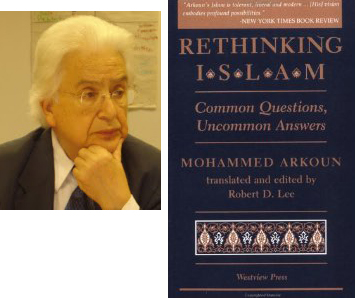
Professor Mohammed Arkoun: A Courageous Intellectual Who Advocated A Tolerant, Liberal and Modern Islam

Simerg, September 18, 2010

Algerian born scholar Mohammed Arkoun (February 1, 1928 – September 14, 2010) was a Senior Research Fellow at the Institute of Ismaili Studies and also a member of its Board of Governors, which is chaired by His Highness the Aga Khan

In a tribute to the Algerian Islamic scholar Mohammed Arkoun, who died at the age of 82 in Paris, France, on Tuesday, September 14, 2010, Algeria’s Minister of Culture, Khalida Toumi, said that Professor Arkoun “believed in dialogue between cultures and civilizations of which he was an ardent activist” and “his sincerity and dedication to bringing people and religions together have made him a true messenger of peace and harmony between different societies.” In her condolence message she also stated that he was “the author of books in the field of critical thinking who taught in the most prestigious universities of the East and the West.”

Amongst his peers around the world, Professor Arkoun was regarded as one of the most influential scholars in Islamic studies contributing to contemporary Islamic reform. Continue reading On Professor Mohammed Arkoun

What if Obama’s Yemen policy works?


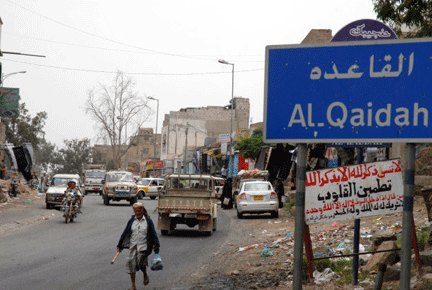
The town (long before Osama Bin Laden) of al-Qaida in Yemen

by Aaron Zelin, Foreignpolicy.com, September 22, 2010

In the past month, Yemen has returned to the spotlight. The CIA now believes that the Yemen-based al Qaeda in the Arabian Peninsula (AQAP) is a larger security threat to the United States than al Qaeda Central in Pakistan. Since then, press accounts have stated that the United States government plans to carry out drone attacks in Yemen, and reported that U.S. Central Command plans to give $1.2 billion in aid to Yemen’s military over a five-year period. But such policies, no matter how well-intentioned, are unlikely to solve the very real challenges posed by al Qaeda’s presence in Yemen and may well make the situation worse.

It originally appeared that there was widespread consensus in the government on providing such military aid to Yemen. But a recent article in the New York Times highlights that there is a vigorous debate within the Obama administration about the efficacy of such aid. The Obama administration has been debating the legality of droning an American citizen (i.e. Anwar al-Awlaki). Before rushing into a major new program, it’s worth recalling the reasons why past U.S.-backed efforts aimed at eliminating al Qaeda’s presence in Yemen have failed. Continue reading What if Obama’s Yemen policy works?

A Citizen of Baghdad

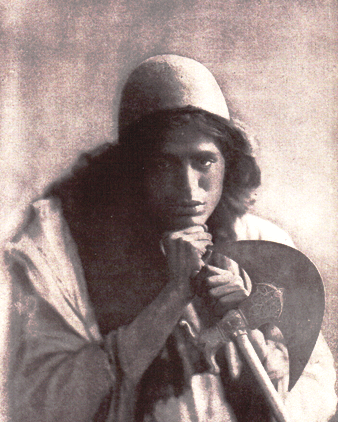
One of my prize collections, inherited in part from my grandparents, is an almost complete run of National Geographic Magazine from 1907 to the present. Periodically I pull an issue off the shelf at random and browse. I recently opened up the February, 1917 issue and noticed that near the end advertising (as interesting as the articles in many cases) there were several pictures of the Middle East, but not tied to a specific article in the issue. It may be that the publisher needed to add a few pages or else these were pictures that somehow did not make it into an earlier issue. The one that struck me the most is the above portrait on p. 199. It is simply entitled “A Citizen of Baghdad” and no photographer is indicated. It looks to me like there is a scabbard in view, but the man is also holding on to something I cannot make out. I wonder if anyone has any ideas on what the man is wearing and if that is a clue as to his background.

Message to Muslims: I’m Sorry


Message to Muslims: I’m Sorry
By NICHOLAS D. KRISTOF, The New York Times, September 18, 2010

Many Americans have suggested that more moderate Muslims should stand up to extremists, speak out for tolerance, and apologize for sins committed by their brethren.

That’s reasonable advice, and as a moderate myself, I’m going to take it. (Throat clearing.) I hereby apologize to Muslims for the wave of bigotry and simple nuttiness that has lately been directed at you. The venom on the airwaves, equating Muslims with terrorists, should embarrass us more than you. Muslims are one of the last minorities in the United States that it is still possible to demean openly, and I apologize for the slurs.

I’m inspired by another journalistic apology. The Portland Press Herald in Maine published an innocuous front-page article and photo a week ago about 3,000 local Muslims praying together to mark the end of Ramadan. Readers were upset, because publication coincided with the ninth anniversary of 9/11, and they deluged the paper with protests. Continue reading Message to Muslims: I’m Sorry

Sikand on Qaradawi


[Webshaykh’s note: The following is a book review by Yoginder Sikand, who maintains the blog Madrasa Reforms in India.]
 
Review of Global Mufti—The Phenomenon of Yusuf al-Qaradawi.
Edited by Jakob Skaovgaard-Peterson & Bettina Graf (Hurst & Co, London, 2009,
ISBN: 978-1-85065-939-6

Reviewed by: Yoginder Sikand
 
 
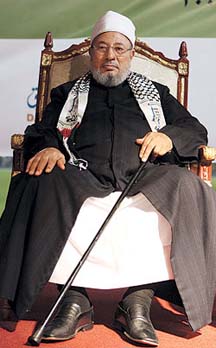
The Qatar-based Egyptian Yusuf al-Qaradawi is among the most well-known Islamic scholars on the contemporary global scene. It might be something of an exaggeration to label him as a ‘phenomenon’ and as the ‘global mufti’—which is what the very title of this book hails him as—but that he exercises an enormous influence in numerous Islamic scholarly and activist circles is undeniable.
 
This book is a collection of essays on diverse aspects of Qaradawi’s life, achievements and writings. In their introductory essay, the editors of the volume provide a broad overview of his life, against which they situate his scholarly and activist accomplishments. Born in a poor family in a village in Egypt in 1926, Qaradawi studied at Cairo’s Al-Azhar, then the largest seat of traditional Islamic learning, after which he shifted to Qatar as emissary of his alma mater. It was there, we are told, that Qaradawi established himself as a noted scholar and activist, traveling widely across the world and establishing a number of Islamic institutions. The editors provide a pen-portrait of a passionate, dedicated scholar-activist, seeking to revive the rapidly disappearing tradition of socially-engaged ulema, who Qaradawi believes, should lead Muslims in the twenty-first century. Continue reading Sikand on Qaradawi

Leaves from an old Bible Atlas #4


Hurlbutt’s Atlas, p. 17


Hurlbutt’s Atlas, p. 17

The Christian fascination with the Holy Land as a window into interpretation of the Bible has a long and indeed fascinating history of its own. Here I continue the thread on Jesse Lyman Hurlbutt’s A Bible Atlas (New York: Rand McNally & Company, 1947, first published in 1882). After describing the physical geography, Hurlbutt proceeds directly the “The Journeys of the Patriarchs.” He writes (p. 17):

The journeys of Abraham extend over nearly all the lands of the Old Testament from Chaldea to Egypt. They represent the separation of a Semitic clan from the great body of the race, which was then ruled by an Elamite dynasty; and they bring to our notice the political relations of the world about two thousand years before Christ, in the early Chaldean period of the East.

Continue reading Leaves from an old Bible Atlas #4