Category Archives: Countries

Tribal Mediation in Yemen


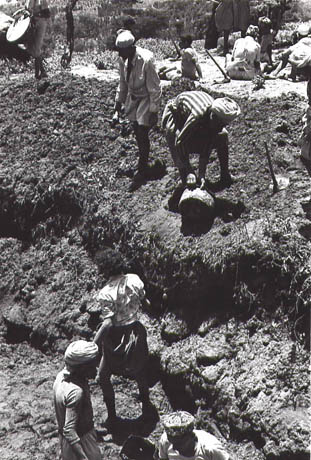
Community cleaning of cistern in al-Ahjur, 1979; photograph by Daniel Varisco

TRIBAL MEDIATION IN YEMEN AND ITS IMPLICATIONS TO DEVELOPMENT

by NAJWA ADRA, AAS WORKING PAPERS IN SOCIAL ANTHROPOLOGY
2010, Volume 19: 1–17.

Introduction

An international phenomenon that has captured the interest of scholars and international development organizations is a continued tendency to resolve conflict through indigenous methods rather than in state courts (Chirayath et al.; Corrin Care 2000; Syria-News.com; UNDP). In Yemen, as in countries as diverse as Kenya and the Solomon Islands, traditional justice is often perceived as familiar, transparent, and participatory. Its focus is reconciliation rather than punishment (Dempsey and Coburn 2010; Dimitrijevic 2006). Specifically in Yemen there is considerable flexibility and adaptability in indigenous tribal procedures and decisions, more so than one usually finds in state justice systems, and decisions are restitutive rather than coercive. Furthermore, indigenous dispute mediation, where fi nes are shared by the entire community, is less costly than the formal legal system. On the other hand, there are concerns that traditional justice may perpetuate social hierarchies by favoring the powerful or discriminating against women (Corrin Care 2000; Kameri-Mbote 2005; Kollapen 2005; Tripp n.d.). In Yemen, as elsewhere, “local strongmen” may co-opt traditional mechanisms by using force in ways that would not have been permitted historically (Dempsey and Coburn 2010). Political scientists worry that resort to traditional justice may undermine state sovereignty.

In this article, I explore these issues as they apply to self-identified tribal communities in Yemen’s Central Highlands through case studies of mediation that I collected during extensive fieldwork between 1978 and 2005 in al-Ahjur. Continue reading Tribal Mediation in Yemen

Dreams in Egypt


[The following is an excerpt from a recent article published by contributor el-Sayed el-Aswad, entitled “Symbolic Transformations of the Seen and the Unseen in the Egyptian Imagination” in ANTHROPOS, 105:441–453, 2010.]

The study has shown that the world is constructed by Egyptian worldview and imagination as a place of seen and unseen dimensions. These dimensions necessitate two kinds of knowledge. One is related to the knowledge of everyday observation, the other to the knowledge of hidden reality, religious or otherwise. Taken in their totality, as far as they indicate psychological, social, and spiritual realities, dreams necessitate the two kinds of knowledge. Dream visions or dreams belong to the unknown or unseen sphere and assert the effectiveness of that sphere in the reconstruction of people’s everyday reality. Dreams serve as lenses through which individuals see or glimpse the hidden or unseen aspects of the world.

Put differently, dream experiences are open to possible interpretations generating possible worlds. Dream phenomena and related notions of spirituality and unseen realities are not dealt with here within the oppositions between tradition versus modernity, common sense reality versus dream reality, or belief versus science because such oppositions do not exist in Egyptian multidimensional worldviews, visible and invisible, in which there is always intermediate realm or barzakh connecting them. Continue reading Dreams in Egypt

Winners and Losers in a Post-Mubarak Arab World

By Yousef Munayyer, Palestine Center, The Jerusalem Fund, February 14, 2011

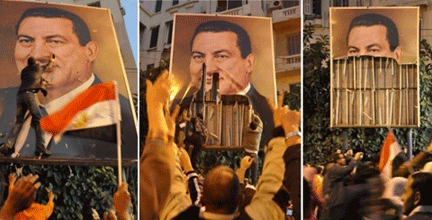
Thirty years ago the Soviet Union was at the beginning of a long campaign in Afghanistan, the average person was lucky to have an advanced recording technology called a “VHS tape,” and Mohammad Hosni Mubarak took control of Egypt, the most populous nation in the Arab Middle East. This week, the last of these beginnings came to an end when millions of Egyptian protestors succeeded in toppling one of the longest standing rulers in the 5,000-year history of Egypt.

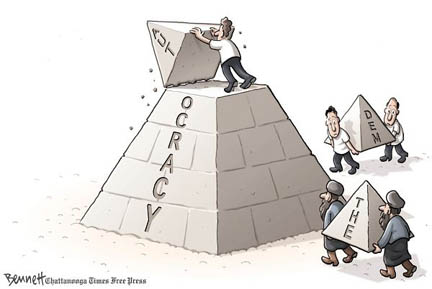
But as with all eras, Hosni Mubarak’s established norms, some national and others regional, which have now irreversibly changed. What type of government may take form in Egypt in the coming weeks and months is yet to be seen, however, it is highly unlikely that any new government can afford to repeat the mistakes of the previous regime which eliminated pluralistic political participation in the formulation of both domestic and foreign policy.

Many different global players had an investment in the outcome of the drama that finally concluded in Egypt with Mubarak’s departure. So after this transformational moment, who are the winners and who are the losers?

The Winners

1. The People of Egypt – After only 18 days, the people of Egypt succeeded in removing a ruler who had governed Egypt for three decades. But the victory for the people of Egypt is far greater than the removal of one person like Mubarak or his family. Continue reading Winners and Losers in a Post-Mubarak Arab World

Ottoman Palestine


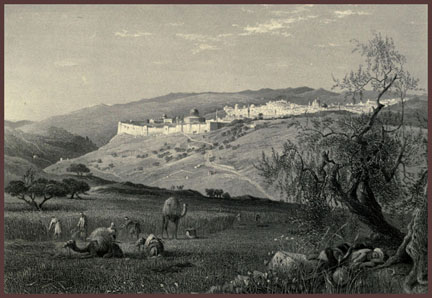
A friend recently brought my attention to an Arabic website with a fascinating collection of illustrations and photographs about Palestine under Ottoman rule. I also came across another site with illustrations of Jerusalem in the Ottoman era. I attach two examples here from the latter website, although the site does not specify the source or date of the images. Continue reading Ottoman Palestine

Breadom


by el-Sayed el-Aswad, United Arab Emirates University

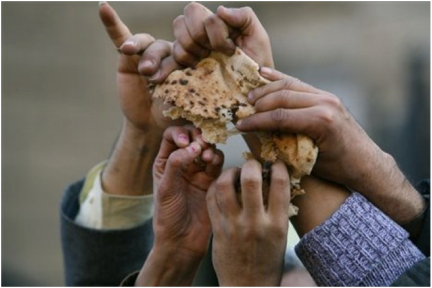
The word “Breadom” is not a spelling mistake; rather it is a combination of the words “bread” and “freedom” indicating, respectively, the “body” and “soul” of the Mother of the World (umm ad-duniya, Egypt), which is currently being affected by a novel form of revolt. In the bread uprising of January 18-19, 1977, falsely depicted by Sadat as “the uprising of thieves” (intifada haramiyya), Egyptians, especially the poor, were interested in securing the ‘bread of their livelihood’ (luqmat al-‘aysh), while in the revolt beginning on January 25th, 2011, they showed profound interest in both bread and freedom. The Arabic word “‘aysh” means both “bread” and “life or living.” These two inseparable meanings have made the phrase “‘aysh al-huriyya” (life of freedom) the best iconic gift crafted, engraved and offered, through victorious young Egyptians of victorious Cairo (al-Qahira), in the Freedom Square (Tahrir Square) opening a new chapter of Egyptian (Arab) history.

It is not surprising to hear people in Tahrir Square, directing their chanting to the government and its businessmen, shout forcefully, “thieves, thieves, thieves” (haramiyya). Also, there was a phrase written in huge letters on the ground of Tahrir Square that says “catch a thief” (imsik haramy). Such phrases resonate and reverberate in the Egyptian folk saying, “its guard is its thief”, (hamiha haramiha), with reference to a plundering and deceitful governor. Continue reading Breadom

The Music of Rebellion


The revolution in Egypt never would have happened as fast and as ultimately peacefully as it did without the new digital age in full bloom. Now that Mubarak has resigned, the protesters are attempting to go back to life with an air of freedom conquering the stale odor of fear. Last night was one of jubilation as Egyptians of all stripes danced in the streets. The withdrawal of Mubarak was music in the ears. And, indeed, music was part of the process. Here is a hip-hop protest on Youtube with a range of video and still photographs by the Egyptian rap group known as Arabian Knightz. Other rap groups also found the recen protests worthy of Youtube. For yet another early video on the protests, click here. And here is a collage from the rapper Marcel Cartier.