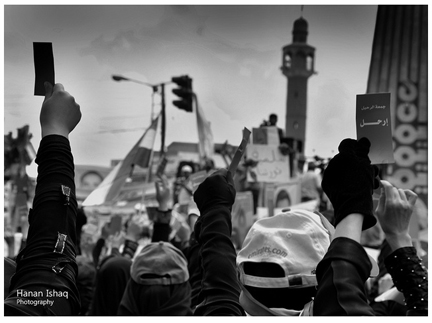
The current protests in Yemen have not gone unnoticed. Among the Yemeni photographers chronicling the current unrest is Hanan Ishaq, a young Yemeni artist whose work is featured on Flickr.
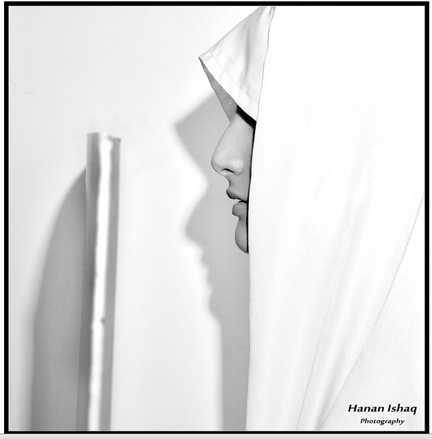
The current protests in Yemen have not gone unnoticed. Among the Yemeni photographers chronicling the current unrest is Hanan Ishaq, a young Yemeni artist whose work is featured on Flickr.
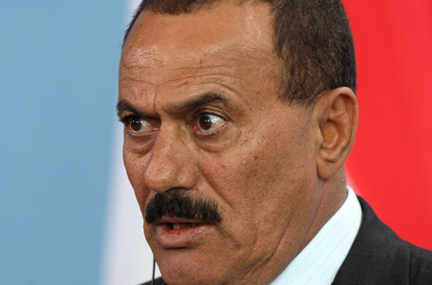
The crucible of Yemen
The two opposing forces of unity and disunity are helping to shape the future of the struggle against Saleh in Yemen.
by Larbi Sadiki, Al Jazeera, May 22, 2011
There has never been a single Yemen, and maybe there will never be one. What is nonetheless exceptional about the revolt engulfing Yemen is that it represents a united stand, a cry for freedom and dignity. Thus it echoes the cry for freedom in Tunis’ Habib Bourguiba Avenue and Cairo’s Tahrir Square.
However, Yemen presents a prominent specificity; it’s a unity-disunity pairing that shapes and re-shapes the current moment of popular empowerment, constantly stirring the politics concocted within the Yemeni crucible.
Note that Yemenis feel insulted by the brand of nepotism and dynasticism engineered by Saleh and his ilk. The fissiparous forces which Saleh controlled, kept in check or used to his own ends through cunning, money, and even violence, are today largely rallied against him.
He dropped them like hot potatoes when political expediency demanded it. Now they are returning the favour. In this, Saleh’s foes seem to be united.
The interplay of unity and disunity are responsible for both Yemen’s moment of popular empowerment and weakness, as far as democratic protest and change are concerned.
One Yemen, many Yemens
In every sense, Yemen is breathtaking. It is a quilt of colours, climes, landscapes, regions, sects, tribes, customs, ideologies, histories and identities. Anthropologists would have a field day exploring it. But not so if one approaches Yemen with a narrow political science set of lenses. The risk to miss the “Archimedean point” – wherever that might be – is greatest here. Continue reading The Crucible of Yemen
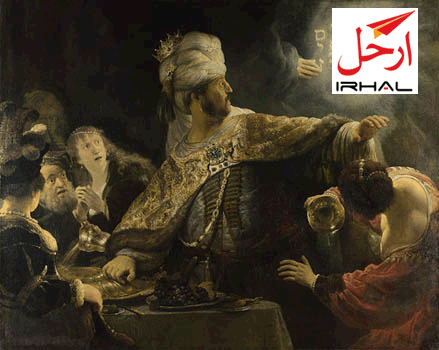
Rembrandt’s ‘Belshazzar’s Feast’ (1635)
Mene mene tekal upharsin. Some two and a half millennia ago it did not take King Belshazzar of Babylon too long to get this Aramaic message. Here is the gist, as recorded in the biblical book of Daniel (5:25-28):
And this is the writing that was written, MENE, MENE, TEKEL, UPHARSIN. This is the interpretation of the thing: MENE; God hath numbered thy kingdom, and finished it. TEKEL; Thou art weighed in the balances, and art found wanting. PERES; Thy kingdom is divided, and given to the Medes and Persians.
The ink on this populist uprising, with over 100 days of signs held aloft in Yemeni protests saying “irhal ya Ali”, has long since dried and Ali Abdullah Salih has been dilly dallying all along. The latest deal, brokered by the GCC with the U.S. and E.U. seals of approval, was signed yesterday by the opposition parties and Salih was supposed to sign today. Continue reading dilly dally, ya Ali
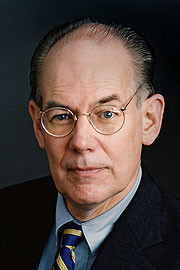
John J. Mearsheimer
by John J. Mearsheimer, Pink Tank, May 19, 2011
Barack Obama gave a major speech on the Middle East today and it is clear from the subsequent commentary that he impressed few people. The main reason is that he did not say much new or indicate that there would be any serious changes in US policy in the region. It was essentially more of the same with the some tweaking here and there. Nevertheless, he did manage to anger some people. For example, Israel’s hard-line supporters were outraged that he said, “Palestine should be based on the 1967 lines with mutually agreed swaps.†For them, the 1967 borders are “Auschwitz borders†and thus can never serve as a basis for negotiations.
Many Palestinians, on the other hand, did not like Obama’s assertion that it made little sense for them to go to the UN General Assembly this September and win recognition for a Palestinian state based on the 1967 borders. Surely they also noticed that shortly after saying that “every state has the right to self-defense, and Israel must be able to defend itself,†the president said that the Palestinians would have to be content with “a sovereign non-militarized state,†which means that they will not be able to defend themselves against Israel or any other state for that matter. Hypocrisy appears to be wired into the DNA of American foreign-policy makers. Continue reading Doomed to Disappoint
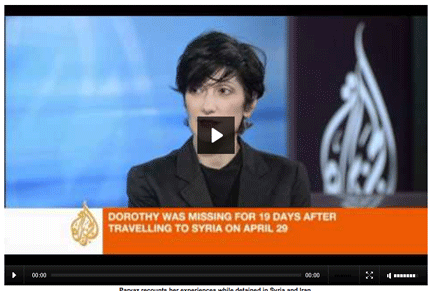
[Webshaykh’s Note: There is a definite frost on the Arab Spring in Syria. Read the chilling report by reporter Dorothy Parviz, who was detained and describes the horrors of those held in detention and beaten.]
Inside Syria’s secret prisons
by Dorothy Parviz, Al Jazeera, May 18, 2011
I was standing in two fist-sized pools of smeared, sticky blood, trying to sort out why there were seven angry Syrians yelling at me. Only one of them – who I came to know as Mr Shut Up during my three days in a detention center, where so many Syrians ‘disappeared’ are being kept – spoke English.
Watching them searching my bags, and observing the set of handcuffs hanging from the bunk bed wedged behind the desk in the middle of the room, I guessed that I was being arrested – or, at the very least, processed for detention.
“Why are you doing this?” I asked.
“Shut up! SHUT UP!” said Mr Shut Up.
I’d arrived there moments before, dragged by a handful of hair from a car where I’d been wedged between two armed men. They’d tried to convince me that they were taking me to my hotel, but, of course, I knew that there was no way plain-clothed security personnel would be kind enough to escort me to my accommodation.
I did, however, manage to resist being forced to wear a blindfold, figuring that if they were going to shoot me, they really didn’t need a reason to do so.
After about 20 minutes, we pulled off the highway and through two checkpoints. By this point, the rather handsy security guard to my left had pulled my scarf over my eyes. Continue reading Detained in Syria
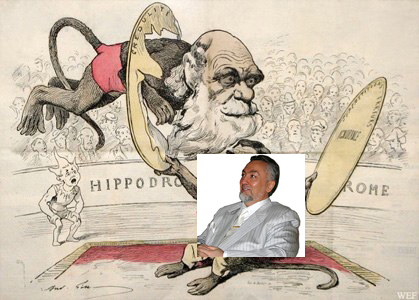
[Webshaykh’s Note: The pseudoscientific nonsense of Harun Yahya has upended the recent burqa controversy. It is one thing to cover one’s body from head to toe, and quite another to cover one’s mind from the consensus of all contemporary science. In a sense arguing that only atheists accept “evolution” is not unlike those who insist that a woman’s body must be totally taken out of view. Both do a disservice to Islam by only encouraging the negative stereotyping so prevalent against Muslims in the West.]
Muslim creationists tour France denouncing Darwin
By Tom Heneghan, Religion Editor, Reuters, May 16, 2011
AUBERVILLIERS, France (Reuters) – Four years after they first frightened France, Muslim creationists are back touring the country preaching against evolution and claiming the Koran predicted many modern scientific discoveries.
Followers of Harun Yahya, a well-financed Turkish publisher of popular Islamic books, held four conferences at Muslim centers in the Paris area at the weekend with more scheduled in six other cities.
At a Muslim junior high school in this north Paris suburb, about 100 pupils — boys seated on the right, girls on the left — listened as two Turks from Harun Yahya’s headquarters in Istanbul denounced evolution as a theory Muslims should shun.
“We didn’t descend from the apes,” lecturer Ali Sadun told the giggling youngsters. Charles Darwin’s theory of evolution, he said, was “the scientific basis to defend atheism.” Continue reading Darwinism (but not a woman’s body) exposed in France
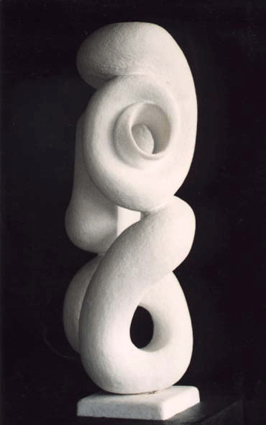
Spiritus, by Sami Rifai, Lebanon, Micheal-Angelo white Marble, 133x40x40 cmby, 1988
Ghazal 98: News From Abroad
by Hafiz, translated by A. Z. Foreman
Last night, the wind brought wind of one I love who’d gone away.
I too shall yield my heart unto the wind, now. Come what may.
At length my love has come to this: I can confide in none
but blazing lightnings every night and dawn winds every day.
Defenseless in your deep curled locks, and out of me, my heart
never once said “Let me recall the body where I lay”
Today, I see my friends were wise to counsel against lovefall.
Elate my counselors’ souls, O Lord, for all the truth they say.
Remembering you, my heart was bloodstruck every time wind blew
open the rosebud’s robe out on the grass in gentle play.
My weakened being leaked out through my fingertips till dawn,
whose wind blew hope of you, and brought the life back to my clay.
Your spirit of good will, Hafiz, will earn you what you yearn for.
When good-willed men cry out, all souls are ransomed to obey.
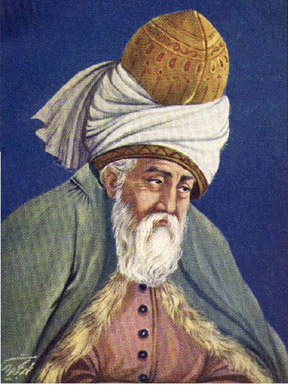
Iran’s spiritual leader isn’t a hardline Islamist, but a mystic poet
By Melody Moezzi, Christian Science Monitor, May 11, 2011
Iran’s officially recognized “spiritual leader†today may be Ayatollah Khamenei, but for hundreds of years before the current establishment of mullahs and ayatollahs, Iranians of all creeds have looked to another spiritual leader: Jalal ad-Din Rumi. While this 13th century Persian Sufi poet is known in much of the West as “Rumi,†he is referred to more affectionately in Iran as “Mowlaana,†or the master.
Among Iranians, he is a spiritual guide and guru whose words hold unmatched moral authority. Over 700 years after his death, it is nearly impossible to spend a day walking around any Iranian city, suburb, or village and not hear his echo. His words live on in everyday parlance: No matter one’s station, religion, or occupation, everyone in Iran knows at least a handful of Rumi’s poems by heart. They are taught in classrooms as an essential part of the basic curriculum, but more than that, they are learned in homes, cafes, bazaars, parks, and houses of worship. No place is beyond this poet’s influence. Continue reading Rumi over Khamenei