Category Archives: Countries

In Memory of BJ


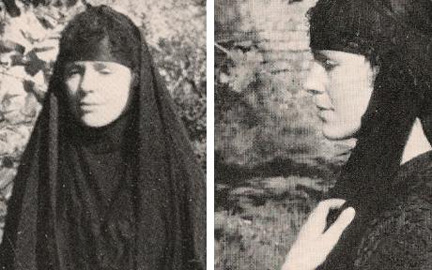
Elizabeth Warnock Fernea pictured wearing traditional tribal women’s dress of the southern Euphrates area. The headscarf with fringe is the asha, the chin scarf is the foota. These garments are worn under the abbaya or outer cloak Photo: KATHARINE RAMSAY

For many students and professors, the go-to text for Middle East ethnography for several decades has been Elizabeth Warnock Fernea’s Guests of the Sheik, still in print, about her life with anthropologist husband Bob Fernea in an Iraqi village during the 1950s. BJ, as her many friends knew her, went on to an academic career in several parts of the Middle East, producing books, articles and films of lasting value. Her passing in December, 2008 was a loss for us all. Now there is a short videography of her life available on Youtube. Check it out. And, if you have not read it in awhile or at all, get a copy of Guests of the Sheik and read it again or for the first time.

The Seduction of Simple Solutions


Over at Waq al-Waq there is an excellent commentary by Greg Johnsen on the situation in Yemen, responding to a “think tank” report from people who really do not know Yemen very well (or apparently want to know it in a certain way). Here is the start…

Late last week Frank Cilluffo and Clint Watts released a policy brief from George Washington University’s Homeland Security Policy Institute entitled “Yemen and al-Qaeda in the Arabian Peninsula: Exploiting a Window of Counterterrorism Opportunity.”

My in-box quickly filled up with helpful people sending me copies of the report, I have now had time to read it and digest and my thoughts follow below.

(Note:) I don’t know Frank Cilluffo but I do know and respect Clint and he has seen a copy of my rebuttal here prior to posting.

For those who are faithful readers of Waq al-waq it should come as no surprise that I strongly disagree with the report and its conclusions. I think this is what happens when smart people tackle a complex problem in an environment they don’t know particularly well. The report, in my opinion, is full of assumptions that make sense broadly but break down the closer one gets to Yemen.

Obviously there are parts of the report I agree with, and many other places where well-intentioned people can disagree.

(Quotes from the paper are in italics; mine are in regular caps.)

Assumption 1: AQAP suddenly stronger this month

“This week’s escape of 63 suspected al Qaeda in the Arabian Peninsula (AQAP) fighters from a Yemeni prison exemplifies how President Saleh’s departure to Saudi Arabia and Yemeni instability embolden this lethal al Qaeda affiliate.“

I’m pretty sure that AQAP was emboldened prior to Salih’s departure, the group has been incredibly active in Yemen recently and I would argue that largely as a result of US air strikes between December 2009 and May 2010, the organization is actually stronger now in terms of recruits than it was when it dispatched the so-called underwear bomber who tried to bring down the airplane over Detroit on Christmas Day 2009.

Assumption 2: Huthis and Southern Movement are responsible

“In recent weeks, the writ of government in Yemen has evaporated under the twin strains of the Houthi rebellion in northern Yemen and the Secessionist movement in southern Yemen.”

This is simply untrue – the writ of Yemen’s government has evaporated under popular protests. The Huthi rebellion has been ongoing since 2004 and the Southern movement since 2007 – neither of these are new, and neither of these are the cause of the recent collapse.

For Greg’s full commentary, click here.

Dreaming on a hot summer day


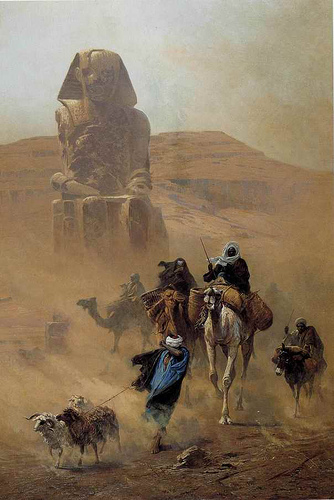
“The Simoon” by Ludwif Hans Fischer

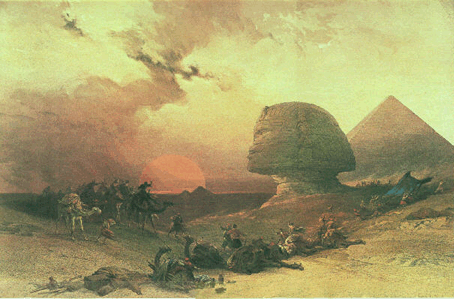
One does not have to be on a caravan in the Sahara or trying to cross the Empty Quarter in mid-summer to appreciate the beauty of a sandstorm; in fact it is probably best appreciated when one is not in it. Above is how the hot winded simoon looked to the Austrian artist Ludwig Hans Fischer (1848-1915), who painted “The Simoon” in 1878. Below is how the simoon looked approaching the Sphinx to David Roberts in the early 19th century.


“Approach of the Simoon” by David Roberts

New blog on Yemen


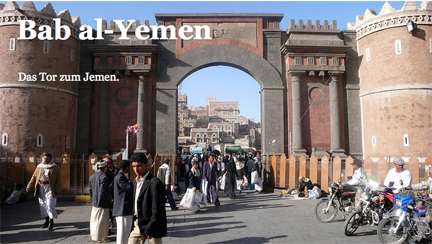
There is a new blog on Yemen: Bab al-Yemen: Das Tor zum Yemen; this is created by Marie-Christine Heinze, who is a graduate student at the Bielefeld Graduate School in History and Sociology. Marie-Christine is working on her Ph. D. about the “Social Life of Weapons in Yemen,” including the famous Yemeni jambiyya. In her new blog she has posted a review of a recent book privately published by Stephen Gracie entitled Jambiya: Daggers from the Ancient Souqs of Yemen.

French Center for Yemeni Studies threatened


Le CEFAS : un instrument indispensable de compréhension de la péninsule Arabique

by Laurent Bonnefoy (chercheur, Institut français du Proche-Orient)

En 2011, jamais la France et l’Union européenne n’ont autant eu besoin de comprendre les sociétés arabes. Jamais les chercheurs spécialistes du monde arabe contemporain n’ont autant répondu à une demande sociale venant tant des médias et des diplomates que même parfois des entreprises. A l’heure où le Yémen connaît un profond mouvement de révolte et où s’expriment des aspirations au changement, à la liberté et à la démocratie, le ministère des Affaires étrangères songe à mettre fin à l’expérience du Centre français d’archéologie et de sciences sociales de Sanaa (CEFAS).

Ce centre, créé sous le nom de Centre français d’études yéménites en 1982 sous la double tutelle du ministères des Affaires étrangères et du CNRS, a en près de trente ans permis à des centaines d’étudiants et de chercheurs de se familiariser avec les sociétés de la péninsule Arabique, d’apprendre l’arabe et de mener à bien de nombreux projets de recherche avec les partenaires locaux qu’ils soient yéménites, saoudiens, omanais ou autres. Son travail d’interface avec les institutions yéménites et du Golfe, sa bibliothèque exhaustive ont fait du CEFAS un instrument unique au monde, valorisé à l’échelle internationale. Les archéologues liés à cet institut ont été à la pointe des découvertes sur les cités antiques de l’Arabie Heureuse. Ses historiens ont pu analyser et réévaluer tant les spécificités que l’intégration ancienne de la péninsule Arabique dans le système monde. Ensemble ils ont directement contribué à valoriser, mais également à préserver, un patrimoine d’une richesse inestimable qui reste encore pour une grande part inconnu. Les chercheurs en sciences sociales ont pour leur part travaillé à rendre intelligible les sociétés et systèmes politiques de cette région du monde arabe. Le rôle de chacun, dans un Yémen et dans un Golfe arabo-persique en transformation, est dès maintenant d’appréhender et d’analyser les transformations et, à l’usage de chacun en France, en Europe et dans le monde, de fournir de nouvelles grilles de lectures indispensables. Continue reading French Center for Yemeni Studies threatened

New Orientalism at a German University?

By Andreas Neumann, Erlangen Center for Islam & Law in Europe (EZIRE)

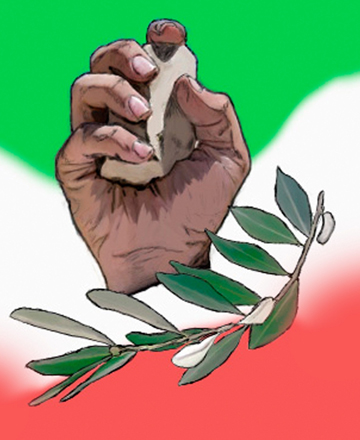
Recently, at one of the many German universities of excellence (names do not matter), students and other citizens were invited to a lecture with the title: “Stoning: a Non-Islamic tradition.” The hosts were the Seminar for Arab and Islamic Studies and the Institute of Criminal Sciences. The picture represented here is taken from the poster hanging all over the campus and also in the city. At its center, you see a huge hand on the point of casting a crude edged stone in the direction of the observer. In the foreground, there is an olive branch. The colors in the background evoke the national flag of Iran flying in wind. A short analysis might be fruitful. The picture is an example of contemporaneous stereotyped thinking and also transports a message contrary to the requirements of reason.

The hand, disambiguated by the context, symbolizes the gruesome act. It is combined with the enlarged olive branch. The olive branch was a symbol of peace in Greek and Roman antiquity, when it also was worn as an adornment by brides. Retrospectively, it was associated with Noah who sent out a dove which returned with an olive leaf in its beak (which became a branch in the Vulgate). This sign indicated that the water was receding. There might exist an older model of this image, since the association of the dove, the olive branch or even the rainbow with peace does not follow conclusively from the text. The Quran has not taken it over in its frequent references to the Genesis version of the story of the Flood (also see the account by Heinrich Speyer, Die biblischen Erzählungen im Qoran, Gräfenhainichen 1931, pp. 89-115). Nevertheless, the olive tree (by the way, in German more often called “Ölbaum”, oil tree) is cited several times in the Quran, especially in the beautiful verse of the light, Q 24:35, where the blessed olive tree in question is characterized as neither Eastern nor Western (cf. Zechariah 4:3-11). The olive branch has become an international symbol of peace and is represented on the emblem of the United Nations, where two of them symmetrically embrace a map of the world. Continue reading New Orientalism at a German University?