Category Archives: Countries

Tabsir Redux: “when I asked him what a Moslem was”

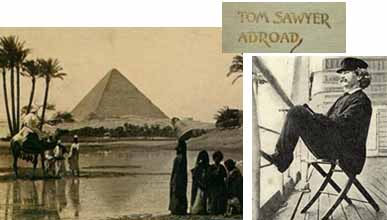
According to all three major monotheisms even God needed time to take a rest and so the sabbath was created. With the spate of mosque bombings, torture of prisoners and outright mayhem dominating the news about the Middle East these days, it might help to sit back and read what the American humorist Mark Twain wrote about his Missouri-born creation Tom Sawyer set loose in the Holy Land more than a century ago. Continue reading Tabsir Redux: “when I asked him what a Moslem was”

Ba’d kharab Tripoli


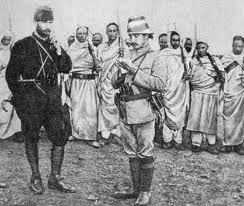
“After a short naval bombardment, Tripoli fell to 1500 Italian sailors on October 3, 1911”

Watching the media coverage of the “rebel” pick-up entry into the outskirts of Tripoli is a chilling reminder that we continue to be a culture of spectator pornography. I can imagine my ancient Roman ancestors quaffing goblets of wine as they reveled in the blood flowing from indentured swordsmen and Christian martyrs fed to the lions. How little is changed when fans break out in fights at a pre-season American football game and soccer hooliganism remains a curse on civility in Britain. On our screens we see the sanitized version of war, of course, not the sun-scorched corpses, the unrecognizable twisted body parts, the agony at the receiving end of grenade blast. The number of casualties, invariably inflated by some and deflated by others, is duly noted as though it could be the up and down daily tick of the stock market. Ah yes, the “mad dog” of Libya, ruthless dictator as he clearly has been, is about to disappear from the scene. Hooray for the good guys…

One can celebrate the overturn of a dictatorial regime, but is it ever worth celebrating individual deaths? Martyrs are always those who die on your own side; the other bodies might as well be animal dung. This was the fate of Mussolini at the end of World War II. History will be rewritten by those who assume power, but the memories of widespread destruction will continue to haunt a generation or two or three or more. The pain continues because old wounds are continually reopened and the scars never really go away. If you live through a war, that war will not die with you as an individual; often, not even with a generation.

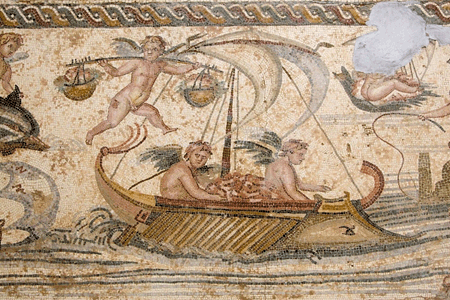
There is nothing new going on in Libya; it is the age-old toppling of one regime and ascendancy of another. The Phoenicians had their turn; then the Romans; then the barbarians that swept through Rome, the Ottomans and then again the Italians in 1911. There is always this sense that this time around it may be permanent, a road to future progress. Clearly, almost any kind of regime in Libya after Qaddafi will be better for most people, but in the broad historical perspective it may only be one pendulum swing in the sad history of humanity’s intolerance. No, the problem is not Islam, not the West, not the monetary policies of the World Bank, not even fascism, communism or any specific ideology. We have evolved as a species dependent on cooperation because we also have the propensity of a will to power over others. Those who fight for peace, often by refusing to fight in the mode of a Gandhi, only highlight the fact that peace is not the normal state of affairs for our species over the long haul. The hope that one day a Messiah, a Jesus, or any dreamed up deliverer, will come and set things straight is as old as the need for such a hope.

There is an old Arabic proverb, ba’d kharab Basra (after the destruction of Basra), one that gained new resonance during the regime of Saddam Hussein in his disastrous war with Iran and then the two Gulf Wars that eventually brought about his end. So now is it to be ba’d kharab Tripoli? Continue reading Ba’d kharab Tripoli

All eyes on Tripoli


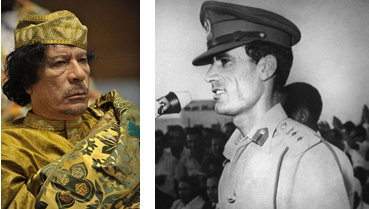
Yesterday the news out of Libya indicated a sudden reversal of fortune for the forces opposed to Qaddafi. Two of his sons are now in custody, many parts of Libya are no longer under his control and the residents of the city are finally free to join the revolution. The Arab Spring has weathered a hot summer in Libya. It seems only a matter of time before Qaddafi is captured, killed or escapes to a safe haven. The pundits are spinning away, but predicting the actions of a megalomaniac who has exercised total power for some 42 years is a difficult task.

The future of Libya is uncertain, as is the case for Yemen and Syria, where protests continue despite the reluctance of a dictatorial leader to yield power. But the fact that Qaddafi could be in power for such a long time, be so ruthless to his own people and sponsor terrorism abroad is a chilling reminder that morality as a human right inevitably takes back seat to the Machiavellian bent of politics. The irony is that the Qaddafis of this world did not rise out of a desert vacuum, but are products of European intrusion into the region. In the case of Libya, Italy vexed its power under Mussolini over its southern neighbor, attempting to make it a fascist enclave and succeeding to a certain extent. After Italy’s defeat in World War II, King Idris (who had fled to Egypt in 1922) was reinstalled by the Allies. The king was deposed when Colonel Qaddafi assumed power in a coup in September of 1969. Idris was the one and only “king” of Libya, and survived after his expulsion until death in Cairo in 1983.

Today all eyes are on Tripoli and the ragtag collection of Libyans who rode the back of NATO airstrikes and direct foreign assistance to finally break Qaddafi’s grip. Continue reading All eyes on Tripoli

Why are the Gods absent?

There are times when I think that the most compelling reason for atheism, or perhaps belief only in a malevolent deity, is the action of those who claim to do outrageous acts in the name of some God. Last Friday a suicide bomber walled amidst some 300 Pakistani Muslims in the town of Khyber and set off a bomb laden with ball bearings that ripped through the bodies of perhaps as many as 80 Muslims who had just finished Friday prayers in the holy month of Ramadan. In the report today by al Jazeera, one local man was quoted as saying, “Whoever did it in the holy month of Ramadan cannot be a Muslim,” he said from a hospital bed in the main northwest city of Peshawar. “It is the cruelest thing any Muslim would do.” Sadly, history shows that acts of Muslims killing Muslims, Christians killing Christians and indeed members of any one religion killing those of their own faith are rampant in our species. Religion may not be the cause of the violence, but it is often the justification on the surface. There are perhaps no more odious words than “my God told me to do this” for acts of violence and hatred directed towards others indiscriminately.

These days the Middle East is a killing field in which dictatorial regimes propped up by outside powers even after the thawing of the Cold War turn arsenals of weapons against their own people. Muslims are killing Muslims in Libya, Syria and Yemen as they have been at times in Egypt, Tunisia and Bahrain. The numbers are chilling, especially in Libya and Syria, and in some cases the overt rationale is so political that religion is merely the background. In other cases Muslims are killing non-Muslims, such as the recent bus bombing in Israel, and non-Muslims killing Muslims, such as yesterday’s bombing raids by Israel in Gaza.

One of the most challenging questions for religion is why bad things should happen to good or at least innocent people if indeed there is a loving and merciful God out there who cares about the creation he (be it Yahweh, Jehovah or Allah) or she (Kali is hardly Mother Teresa) oversees. Continue reading Why are the Gods absent?

Old World Travel 90 years on: #5 The Soul of India


“The Jama Masjid at Delhi, India. This is India’s greatest mosque and is the second largest in the world. It was built by Shah Jehan in the first part of the seventeenth century and possessed a sacred relic, a hair from the beard of the prophet. The illustration shows a crowd in the court and which is 325 feet square, dispersing after meeting at prayers.”

Exactly 90 years ago a four-volume set of encyclopedia-like human interest books was published as The Human Interest Library: Visualized Knowledge by Midland Press in Chicago. In a previous post I commented on its thoroughly “Orientalist” flavor. The section on “The Ancient Empire of the Moguls” covers mainly the exotic cultural diversity of India. Few countries have been exoticized more than India, and this Cyclopedia is not exception:

How may be described this soul of India: It is something shy, timorous, wistful and appealing. It does not greet you with the rugged strength and boisterous self-confidence of Dover Cliff, or with the passionate sweetness of Italian hills, or with the sunburnt cheerfulness of France. It creeps towards you like a spaniel that fears to be scolded and hopes to be caressed. Continue reading Old World Travel 90 years on: #5 The Soul of India