Category Archives: Countries

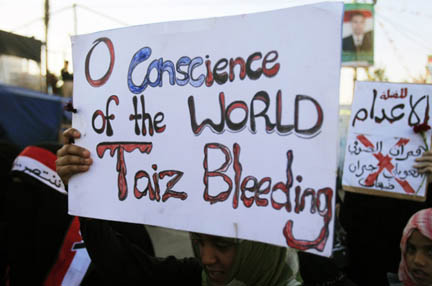
Is Taiz going to be the next Benghazi of Yemen?


by By Tom Finn, Time, Tuesday, Dec. 13, 2011

Read more: http://www.time.com/time/world/article/0,8599,2102183,00.html#ixzz1gXKFNc14
During the day, Taiz, a mountainous municipality nestled in the basin of Yemen’s rugged central highlands, has the feel of any other Yemeni city. Scrawny teenagers with wheelbarrows filled with oranges weave in and out of the traffic dodging debabs — local six-seater microbuses — and motorbikes as they splutter up and down the city’s steep, dusty alleyways. But once the sun begins to set and the mountains surrounding the bowl of the city darken into jagged silhouettes, the wail of the muezzins soon competes with the ominous thud of explosions.

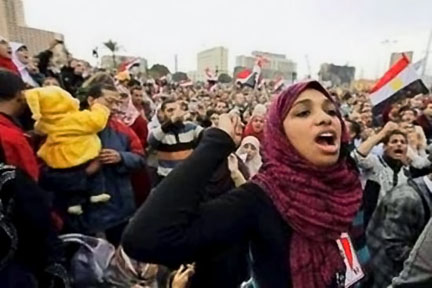
Taiz is famed for its doctors, lawyers and relative cosmopolitanism, but it was its youth who in February jump-started the movement in Yemen to oust the wily, decades-long ruler, Ali Abdullah Saleh, from power. Inspired by their counterparts in Tunis and Cairo, a group of men and women — most of them students — erected a circle of tents on a dusty boulevard in downtown Taiz and named it Freedom Square. Since then they have spent months braving a barrage of bullets, batons and tear-gas canisters from the security forces, marching through the city’s grubby streets and calling for change. (See photos of Yemen on the brink.)

But in recent weeks the conflict in Taiz has taken on a more deadly twist. Continue reading Is Taiz going to be the next Benghazi of Yemen?

Authenticity, Identity and the Spirit of the UAE Union


Spirit of the Union (UAE)

by el-Sayed el-Aswad, United Arab Emirates University

Over the past forty years there have been rapid transformations of the United Arab Emirates from rural and tribal communities to modern national states. Such transformations raise critical concerns related to authenticity, heritage, and social memory and identity construction. Heritage, indicating past and authentic lifestyles that people use in the construction of their identity, can be redefined according to a modern significance. Identity refers to the continuity of inherent constituents that last through all the various transformations individuals might undergo. Identity is not a given, but an ongoing activity that people engage in all the time.

In the UAE one observes continuous negotiations over ideas of authenticity, tradition, identity, modernity, leadership, and local-national performances. For example, this year the UAE is celebrating its 40th anniversary in terms of authenticity. The official site of the UAE National Day, “Spirit of the Union”, includes such phrase as “Our Heritage, Our Pride,” “the Union shall forever remain,” and “It is the Spirit of the Union that celebrates our culture and heritage, and yet shapes our future.”

Tradition is negotiated because it enters into the construction of social identity that is based on the concept of authenticity (aṣāla). For the Emirates, aṣāla (or aṣīl) is a multiple meaning concept that can imply values of rootedness, descent, origin, nobility, honor, self-sufficiency and social status. Authenticity also refers to good manners of people, men and women, defining gender relations. Continue reading Authenticity, Identity and the Spirit of the UAE Union

Fire on Historic Gate of Zabid


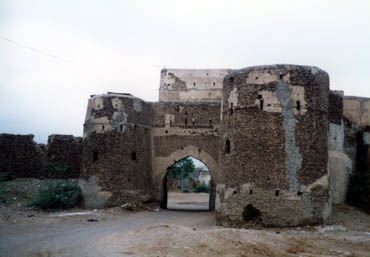
ذكرت مصادر محلية بمديرية زبيد بمحافظة الحديدة مساء يوم أمس الجمعة بأن حريقا” هائلا” تسبب في تشويه المنظر التاريخي لسقف المبنى الأثري الواقع في بوابة سهام بالجهة الشمالية لمدينة زبيد القديمة بمحافظة الحديدة ØŒ بالإضافة إلى إتلاف كمية كبيرة من الأخشاب المزينة بالنقوش الإسلامية الأثرية جراء الحريق الذي لم تعرف أسبابه حتى اللحظة .

وأشارت مصادر أمنية بالمديرية بأن ألسنة اللهب اشتعلت في المبنى الأثري التاريخي لبوابة مدينة زبيد الأثرية المعروفة ببوابة سهام ما أدى إلى احتراق سقف البوابة بالكامل إلى جانب كمية كبيرة من الأخشاب القديمة المزينة بالزخارف والنقوش التي لا تقدر بثمن.

وأضافت المصادر بأن أبناء زبيد لم يتمكنوا من أخماد الحريق الذي تصاعد بشكل مخيف في المبنى الاثري ولا تزال التحقيقات جارية لمعرفة أسباب ودوافع الحريق.

هذا وكانت زبيد قد أدرجت في قائمة التراث الإنساني العالمي في العام 1993Ù… , واعطت منظمة اليونسكو التابعة للأمم المتحدة اليمن مهلة للبدء في تنفيذ برنامج إنقاذي شامل لحماية ما تبقى من المعالم الأثرية في المدينة التاريخية والتي باتت مهددة بالاندثار قبل أن تباشر “اليونسكو” في إجراءات شطبها من قائمة التراث الإنساني بصورة نهائية.

Turning a new page in an old Yemeni book


Over a week ago Yemen’s beleaguered President Ali Abdullah Salih finally stepped down after taking power in North Yemen 33 years ago during a military coup. Having promised three times to sign a deal worked out by the Gulf Cooperation Council, the fourth time was finally the charm. Saudi television carried the signing ceremony live from Riyadh, with the Saudi King Abdullah calling this a “turning of a new page” for its neighbor to the south.

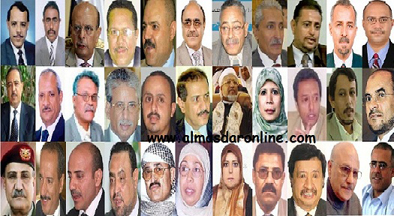
The final details were negotiated by UN envoy Jamal Benomar. The transition is being directed by the current Vice-President Abd al-Rab Mansur al-Hadi. The first stage is forming a government of national reconciliation within two weeks. The new ministers will include half from the President’s ruling party and half from the opposition Joint Meeting Parties, with 20% of the positions reserved for women. In each case a minister of one party will have a deputy minister from another party. The cabinet has now been formed (click here to read the brief resumes of the cabinet officers in Arabic). Continue reading Turning a new page in an old Yemeni book

Will Saudi Women Lose Their Virginity En Masse If They Start Driving?


by Melody Moezzi, MS.blog Online, December 3, 2011

My first thought is “no,” followed by a swift “none of your business.” But that wasn’t the conclusion of a recent report prepared for Saudi Arabia’s legislative assembly by a well-known academic. He predicted that if Saudi women were given the right to drive, those who had never had sex would quickly start losing their virginity as easily as they might their car keys.

Let’s start with the basics here: It’s a hell of a lot harder to lose your virginity in the front seat, as opposed to the back. Especially while driving. I mean, it’s difficult enough to text and drive.

But if that isn’t enough to sway the Saudi government, I recently polled several of my female friends, and I’ve come up with a report of my own. I submit the following report to the Saudi legislative assembly, which I suspect is far more scientific than the aforementioned prominent academic’s: NONE of the friends I polled, a large number of whom happen to be Muslim women originally from the Middle East, has lost her virginity while driving. Nor did a single one of them lose her virginity immediately after obtaining a driver’s license. Shocking, I know. Continue reading Will Saudi Women Lose Their Virginity En Masse If They Start Driving?

New Books in Islamic Studies


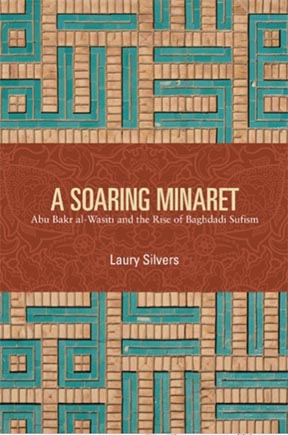
A new website has been launched called New Books in Islamic Studies, hosted by Kristian Petersen of Gustavus Adolphus College in St. Peter, Minnesota. The site contains short descriptions of relevant books, the most recent on the site being Laury Silvers, A Soaring Minaret: Abu Bakr al-Wasiti and the Rise of Baghdadi Sufism (SUNY Press, 2010).

Here is the description of Laury’s new book:

A broad portrait of early Islamic mysticism is fairly well-know. However, there are only a few key figures that have been explored in great detail and their activities shape how we understand this early history of Sufism. Laury Silvers, Professor of Religion at the University of Toronto, makes a significant contribution to the early development of Sufism by focusing on an influential but lesser-known figure, Abu Bakr al-Wasiti (d. ca. 320 AH/932 CE), the “soaring minaret.” In her new book, A Soaring Minaret: Abu Bakr al-Wasiti and the Rise of Baghdadi Sufism (SUNY Press, 2010), she situates Wasiti and his contributions within the broader historical developments in the formative period of Sufism. By doing so she deepens our knowledge of the development and spread of Baghdadi Ahl al-Hadith culture East to Khurasan, the consolidation of Baghdadi Sufism and the internalization of Khurasani traditions during the formative period. Continue reading New Books in Islamic Studies

A CIVIL SOCIETY DEFERRED


A View of Abdullahi Gallab’s A CIVIL SOCIETY DEFERRED from a precolonial perspective

By Jay Spaulding, African Arguments, November 28, 2011,

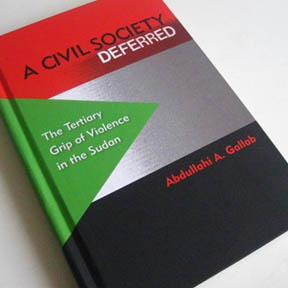
“Men make their own history, “ wrote a famous individual long ago, “but they do not make it as they please; they do not make it under self-selected circumstances, but under circumstances existing already, given and transmitted from the past.” Subsequent historians have endeavored to elaborate hierarchies of historical causation within which diverse material, socioeconomic and conceptual entities are seen to constrain the exercise of free will. Nowhere has the examination of constraint received greater attention than among the colonized communities of the not-so-distant past, including the Sudan. One of the virtues of Abdullahi Gallab’s A CIVIL SOCIETY DEFERRED lies in the author’s mastery of a wide variety of theorists of historical causation and colonial constraint. The wealth of their insights has allowed him to rearrange largely familiar information about the Sudan into an original and impressive interpretive architecture. His approach, the opposite of reductionist, resonates at many levels of understanding. A second virtue of A CIVIL SOCIETY DEFERRED is that the author knows, profits from, and builds upon the efforts of previous Sudan scholarship. The book consciously joins and illuminates an extended ongoing discussion.

The author’s central effort is to discern the colonial origins of the current Sudanese state. Few will challenge this thesis, and other contributors to this discussion will undoubtedly address the theme at length. But is there anything that one might add to perhaps embellish A CIVIL SOCIETY DEFERRED from the remote perspective of precolonial Sudanese history? I would like to propose two ideas for possible consideration. Continue reading A CIVIL SOCIETY DEFERRED

English and the Hijab in Cairo

The ongoing political protests in Egypt have captured the imagination of people everywhere. A dictator is toppled and young people twitter their way into a people power not imaginable in the past. And now actual elections with more than 40 parties involved. The final results of the transition are yet to be felt, as many observers fear that there will be a conservative religious regime which will impose more restrictions on women, people’s expressive behavior and non-Muslim minorities. Egypt’s recent past is reflected in a post-Nasser conservative shift that Sadat originally encouraged and that eventually even Mubarak could not control. A visual portrayal of this can be seen in the pictures below of students graduating from the English Department of Cairo University in 1959, 1978 and 2004. Note the fashioning of a more conservative approach even to English literature over the past five decades.


Class of 1958


Class of 1978


Class of 2004