Category Archives: Qatar

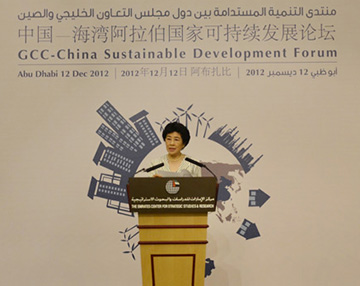
The GCC and China


The GCC States and the Viability of a Strategic Military Partnership with China

By Imad Mansour, Qatar University, The Middle East Institute, Mar 17, 2015

The term “strategic partnership” has been increasingly used in GCC circles to signify that relations with China are important and worthy of long-term investment. In a March 14, 2014 speech during his visit to Beijing, Saudi Arabia’s then Crown Prince Salman announced that “we are witnessing the transformation of the relationship with China to one of strategic partnership with broad dimensions, to the benefit of both our countries.”[1] Saudi Arabia’s position was echoed by the emir of Qatar during a 2014 visit to China in which issues of common concern to all GCC states, especially combating terrorism, were discussed.[2] Abdel-Aziz Aluwaisheg, GCC general assistant secretary for negotiations and strategic dialogue, has also noted that there is growing interest in the Gulf to develop a “strategic dialogue” with China.[3]

Despite this growing GCC recognition of China’s strategic role in the region, what exactly a “strategic partnership” or “strategic dialogue” would look like remains unclear. This essay discusses why officials in GCC member states might be hesitant to embrace the idea of China as a viable strategic military partner, while at the same time recognizing the need to further develop relations with China.

Securing Independent Military Capabilities

From the perspective of GCC leaders, the main military advantage of partnership with China is Beijing’s potential willingness to provide weapons that the United States is currently reluctant to sell. Given the United States’ lukewarm responses to recent regional unrest, the GCC countries are seeking to augment their independent capabilities, and China could be an important supplier, whether or not it is a full “strategic partner.”[4] These GCC views are based on the understanding that as economic interdependence grows, China might be more willing to provide advanced weapons systems in greater quantities. It is important to note that looking to China for arms sales is consistent with the GCC states’ broader strategy of expanding their network of suppliers.[5]

However, GCC leaders continue to assess the benefits of such an arrangement through the prism of their enduring relationship with the United States. This is largely due to historical momentum. GCC states have long procured most of their military hardware, training, intelligence systems, and combat systems directly from the U.S. government or from American businesses. In addition, the United States and its allies share GCC concerns about containing regional conflicts in Iraq and Syria, as well as the region-wide threat posed by al-Qa‘ida and its affiliates.[6] Furthermore, it seems that despite its reluctance to sell certain weapons directly to the GCC, the United States has tacitly approved GCC purchases of such weapons from China.[7] This balance―whereby the United States sells the GCC most of its conventional weapons systems, while GCC states purchase other approved weapons elsewhere―allows the GCC to accrue the benefits of remaining within the U.S. umbrella while also buttressing its defenses. Obtaining military hardware from China that the United States has not approved would involve an extremely delicate diplomatic game—one in which the GCC stands to lose more than it would currently gain. Continue reading The GCC and China
Feeling Happy in the Middle East

Given all the unhappiness, it is refreshing to find a little happiness in the Middle East, even if it is musical. Enjoy the following:

Happy in Yemen (https://www.youtube.com/watch?v=2JzNxo5m8vI)

Happy in Abu Dhabi (https://www.youtube.com/watch?v=audy0aHjdyg)

Happy in Algeria (https://www.youtube.com/watch?v=Dr3-6H6P6Ng)

Happy in Egypt (https://www.youtube.com/watch?v=5D5dO5cn1PQ)

Happy In Kuwait (https://www.youtube.com/watch?v=mQzDDg2poOc)

Happy in Jerusalem (https://www.youtube.com/watch?v=-oszKeU7lEs)

Happy in Jordan (https://www.youtube.com/watch?v=JyXGv-7b_xo)

Happy in Lebanon (https://www.youtube.com/watch?v=7RqSFiVUhDw)

Happy from Morocco (https://www.youtube.com/watch?v=qnuNA8HkVp0)

Happy in Qatar (https://www.youtube.com/watch?v=V8N5TkduFjA)

Happy from Saudi Arabia (https://www.youtube.com/watch?v=YKi4iAl_qb0)

Happy in Turkey (https://www.youtube.com/watch?v=a12vAtzbe68)

Arabian Humanities Online


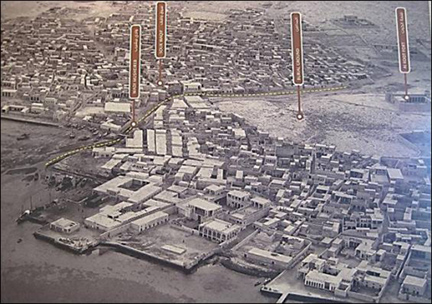
Urban structure of Doha until the 1960s; Source: Scharfenort 2012 (Exhibition in Msheireb Enrichment Center)

The second issue of the new journal Arabian Humanities, with selections in both English and French, is now available online here.

The table of contents is reproduced below:

Juliette Honvault
Éditorial
Villes et dynamiques urbaines en péninsule Arabique
Cities and Urban Dynamics in the Arabian Peninsula

Claire Beaugrand, Amélie Le Renard et Roman Stadnicki
Au-delà de la Skyline : des villes en transformation dans la péninsule Arabique [Texte intégral]
Beyond the Skyline: Cities in Transformation in the Arabian Peninsula [Texte intégral | traduction]

Nelida Fuccaro
Preface: Urban Studies in the Arabian Peninsula: 6 Thoughts on the Field [Texte intégral]
Préface : Les études urbaines en péninsule Arabique
1. Croissances, politiques et projets
Growth paths, politics and projects

Brigitte Dumortier
Ras al‑Khaïmah, l’essor récent d’une ville moyenne du Golfe [Texte intégral]
Ras al‑Khaimah : the recent dynamics of a middle size city of the Arab‑Persian Gulf

Steffen Wippel
Développement et fragmentation d’une ville moyenne en cours de mondialisation : le cas de Salalah (Oman) [Texte intégral]
Development and Fragmentation of a Globalizing Secondary City: The Case of Salalah (Oman)

Sebastian Maisel
The Transformation of ‘Unayza: Where is the “Paris of Najd” today? [Texte intégral]
La transformation de ‘Unayza : où en est le « Paris du Najd » ?
Philippe Cadène
Koweït City : planification urbaine et stratégie régionale [Texte intégral]
Kuwait City: Urban Planning and Regional Strategy Continue reading Arabian Humanities Online

Chilling Prospects for the Arab Spring

by Daniel Martin Varisco, Middle East Muddle, Anthropology News, November, 2013

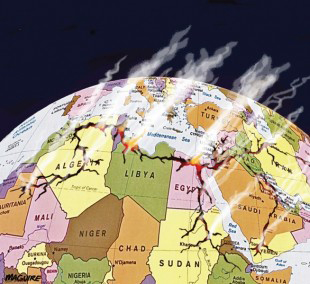
As President Franklin Delano Roosevelt prophesied, December 7th, 1941 is a day that lives in infamy, even some seven decades after the event that triggered United States entry into the Second World War. Another date of more recent infamy is December 17, 2010, when a harassed Tunisian vegetable hawker named Mohamed Bouazizi set himself on fire in front of the municipal building in the picturesque town of Sidi Bouzid. Although badly burned, he survived until January 4, just ten days before Ben Ali, the Tunisian dictator for some 23 years, boarded a plane for exile in Saudi Arabia. The first kind of infamy was the beginning of a devastating war, the second became the stimulus for what was hoped to be a sweeping political revolution across the Middle East. Three years later it seems to be politics as usual, a chilly seasonal change from the jasmine scent of the Arab Spring that blew across Tunisia, Egypt, Libya and Yemen and now swirls through the political maelstrom enveloping a surviving dictator in Syria, ongoing instability in Iraq and Afghanistan and a new regime outlook in Iran.

Seasoned pundits know that in many parts of the world spring’s prospects yield to the heat of summer, the cooling autumn and eventually the chilly reality of winter in a never-ending cycle. The Arab Spring is not one season fits all, but the overall effects have been more chilling than thrilling this year. In Tunisia the Islamic party leading the country is in a state of national paralysis following the July killing of opposition MP Mohamed Brahmi. In Egypt the elected president, Muhammad Morsi, remains in military custody and his major party of support, the Muslim Brotherhood, has been banned. The military, under General Sisi, has reinstated martial law in a move that most Egyptians, it seems, support. In both Tunisia and Egypt, the transition to power by Islamic groups who promised not to dismantle the civil state structure has angered a wide range of groups, especially secularists and more moderate Muslims. Continue reading Chilling Prospects for the Arab Spring

A Tale of Three Coups

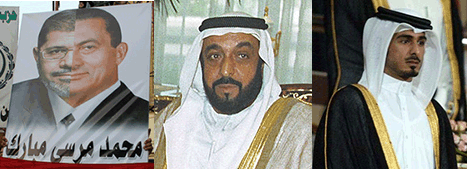
All eyes and ears are focused on Egypt with the ouster of President Morsi after massive street demonstrations and with the direct removal from office by the Egyptian military. Euphemisms and wishful political spin aside, this was a coup. The heads of state in the United States and Europe are now doubt breathing a sigh of relief, although watching a democratically elected leader pushed aside without ballots is not something to discuss very loudly in public. The pundits are weighing in on the failure of Morsi, that he failed to represent all Egyptians and was pushing too hard and too singularly for a Muslim Brotherhood agenda that would unravel decades of Egypt’s secular dynamics. Nathan Brown has an astute analysis at The New Republic. But missing from the headlines are two other coups that can be excused as non-coups. Last week the emir of Qatar, Shaykh Hamad, resigned and handed over control of the wealthy emirate to his son, Tamim, who has been well groomed for the job. Given that Hamad had come to power in a bloodless palace coup while his father was out of the country, this could be seen as coup avoidance. Obviously, father and son get along together quite well. But the third case was announcement of an attempted coup in the seemingly stable United Arab Emirates. On Tuesday, while crowds were milling in Cairo’s Tahrir Square and chanting for the end of Morsi’s regime, the Federal Supreme Court of the UAE announced that 94 Emiratis had been accused of plotting a coup. Some 56 were given jail terms of 3-10 years and 26 were acquitted.

Three coup scenarios in just a little over a week! Is this the eternal Arab Spring or just an “Indian summer” for the Middle East? Or should we rename the political tsunami that began in Tunisia and has spread across the region the “Arab springboard”? Continue reading A Tale of Three Coups

A new emir for Qatar


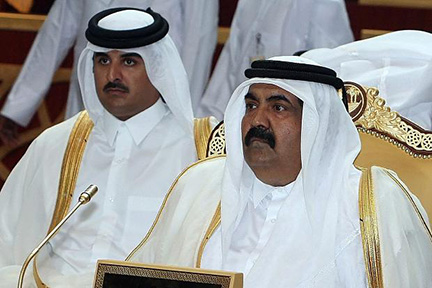
Former Emir Hamad with his son Tamim to the right

In 1988, when I was living in Doha and conducting research at the Arab Gulf States Folklore Centre, the emir of what was still a rather sleepy little gas-rich emirate was Khalifa bin Hamad Al Thani, who had named his son, Hamad bin Khalifa, heir apparent back in 1977. While his father was out of the country in Geneva, in 1995, the son ousted his father in a bloodless coup. The deposed emir lived in France and Abu Dhabi until his return to Qatar in 2004. On Tuesday Shaykh Hamad pre-empted any such repeat performance by one of his eleven sons by naming his son Tamim the new emir and effectively retiring from leadership without having to find a villa in France. Tamim, the son of Hamad’s second wife, Shaykha Mozah, was declared heir apparent back in 2003, so he has been groomed for the job, including education at Sandhurst in England. Emir Tamim already has four children, so the dynasty will not run out of heirs any time soon. Continue reading A new emir for Qatar

The Formation of Syria’s National Coalition


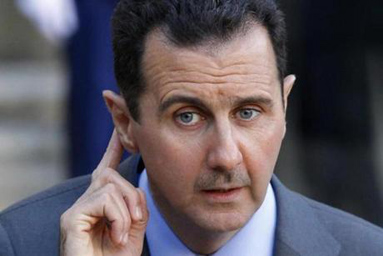
Syrian President Assad; photography by Benoit Tessier/ REUTERS

The Formation of Syria’s National Coalition: An Assessment and Analysis

By Amr al-Azm

Syria Comment, November 13, 2012

Following talks with a number of people who attended the Doha meeting of November 8-11, this is my assessment of the newly formed “National Coalition for Revolutionary Forces and the Syrian Opposition”. The coming together of the various Syrian opposition factions to finally strike a deal based on a 12 point agreement that would unify them under the umbrella of a newly created coalition body is remarkable considering the obstacles that had to be overcome. It faced intense opposition by some groups, particularly the SNC, which viewed this as a blatant effort to sideline them. Its members have fought for a leading role in the new group.

The original Riad Seif plan called for a council of 51 seats, a joint supreme military council, a judiciary commission and the formation of a provisional government selected from technocrats.

The new National Coalition that emerged in Doha on Monday ended up comprising of 65 seats. The SNC was earmarked 22 seats, the local administration councils were allocated 14 seats (one for each of the provinces in Syria), national figures were allocated initially 8 seats, eventually rising to 10 seats, with the balance (19 seats) to be distributed amongst the various remaining opposition groups and entities. The new coalition eventually managed late on Monday evening to eventually select Moaz Al-Khatib (a cleric and former imam of the Ummayad Mosque in Damascus) and two deputies (with a third still to be named by the Kurds) who are Riad Seif (both prominent dissidents and activists). A third position, which is until now poorly, understood is that of Secretary General, to be occupied by Mustapha Sabagh (head of the Syrian Business men Group). It is rumoured (by Al-Jazira and others) that the position would carry sweeping powers to rival even those of the head of the coalition Moaz Al-Khatib and seen as a principle demand by the Qataris. Continue reading The Formation of Syria’s National Coalition

Cinematic Contending with the Companions


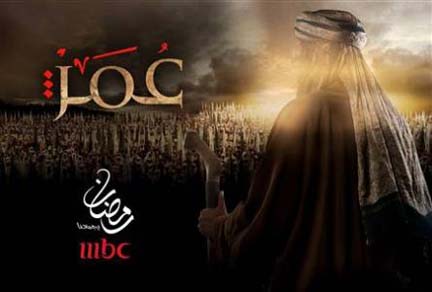
As Ramadan for the Hijri year 1433 draws to a close, the violence between Muslims on the ground is paralleled by the violence about Muslims on the screen. The daily slaughter of Syrians, continued terrorist bombings throughout the region and the uncivil rebellion in Mali dominate the news, as such atrocities should. But cinema does not lag far behind in showing blood spurting out of bodies and broken bones, all in the name of politicized religion. I am not talking about The Expendables, where aging Hollywood superheroes unite to make themselves even more money, but a Ramadan television serial that has captured the attention of Muslims across the Middle East: a retelling of the story of the second caliph ‘Umar ibn al-Khattab. Click here for the trailer and here to watch Episode #2.

Premiering 36 years after Moustafa Akkad’s acclaimed The Message recreated the life of Muhammad without actually showing Muhammad, the serial ‘Umar in 30 episodes is a millions-of-megabucks production worthy of Cecil B. DeMille. The earlier film had the blessing of the major Islamic organizations, since it avoided showing an image of the prophet Muhammad. It was a bit eerie to see Anthony Quinn as Hamza constantly speaking to the camera as though the camera-not-very-obscura was in fact the Prophet. But this new film has been railed against by the Grand Mufti of Saudi Arabia and the sheikhs of al-Azhar because it dares to show an actor playing a companion of the Prophet, notably the caliph ‘Umar ibn al-Khattab. If it had been Saladin, that would be okay it seems. Continue reading Cinematic Contending with the Companions