Category Archives: Palestine

Why are the Gods absent?

There are times when I think that the most compelling reason for atheism, or perhaps belief only in a malevolent deity, is the action of those who claim to do outrageous acts in the name of some God. Last Friday a suicide bomber walled amidst some 300 Pakistani Muslims in the town of Khyber and set off a bomb laden with ball bearings that ripped through the bodies of perhaps as many as 80 Muslims who had just finished Friday prayers in the holy month of Ramadan. In the report today by al Jazeera, one local man was quoted as saying, “Whoever did it in the holy month of Ramadan cannot be a Muslim,” he said from a hospital bed in the main northwest city of Peshawar. “It is the cruelest thing any Muslim would do.” Sadly, history shows that acts of Muslims killing Muslims, Christians killing Christians and indeed members of any one religion killing those of their own faith are rampant in our species. Religion may not be the cause of the violence, but it is often the justification on the surface. There are perhaps no more odious words than “my God told me to do this” for acts of violence and hatred directed towards others indiscriminately.

These days the Middle East is a killing field in which dictatorial regimes propped up by outside powers even after the thawing of the Cold War turn arsenals of weapons against their own people. Muslims are killing Muslims in Libya, Syria and Yemen as they have been at times in Egypt, Tunisia and Bahrain. The numbers are chilling, especially in Libya and Syria, and in some cases the overt rationale is so political that religion is merely the background. In other cases Muslims are killing non-Muslims, such as the recent bus bombing in Israel, and non-Muslims killing Muslims, such as yesterday’s bombing raids by Israel in Gaza.

One of the most challenging questions for religion is why bad things should happen to good or at least innocent people if indeed there is a loving and merciful God out there who cares about the creation he (be it Yahweh, Jehovah or Allah) or she (Kali is hardly Mother Teresa) oversees. Continue reading Why are the Gods absent?
The Future of Jerusalem: Sacred Space or Open City?


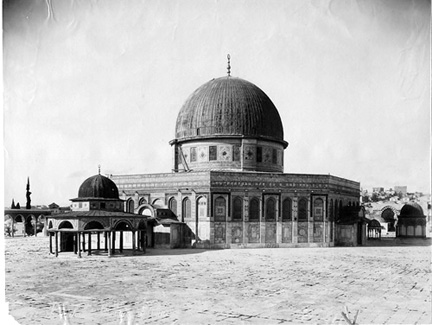
Bonfils, ca. 1870. Negative inscribed: “278. Jerusalem. Mosquee d’Omar.”

by Salim Tamari, Al-Shabaka Policy Brief, July 11, 2011

Overview

Even before the crusades, Jerusalem has had an enchanting hold on people’s imagination. Visitors imposed their aspirations, inner anguish, and dreams on what they saw as an eternal sacred city, whereas the worldly city was at great variance and often in contradiction with these imageries. Indeed, this vision of the city of God has always been in contrast with the living physicality of the city. As revealed in the leaked “Palestine Papers,” this view of the metaphoric Jerusalem has been adopted in the negotiations between Israelis and Palestinians.

In this policy brief, Al-Shabaka policy advisor Salim Tamari examines the historical origins of the sacrilization of Jerusalem and how it has obscured changes on the ground affecting the city’s current state and its future. He argues that proposals for the future of Jerusalem ignore the fact that at its core the conflict over the city is a case of colonial subjugation which must be addressed and resolved equitably.
Jerusalem and the “Palestine Papers”

The “Palestine Papers” revealed that Jerusalem occupied a central position in the implicit agreements between President of the Palestinian Authority (PA) Mahmoud Abbas and Israeli Prime Minister Ehud Olmert.1 They demonstrate that the PA has moved considerably from positions held at and since the 1991 Madrid Peace Conference. Previous Palestinian and Arab positions on Jerusalem were based on UN Security Council Resolution (UNSC) 242, passed after the June 1967 War. The resolution considers East Jerusalem occupied territory and its status no different from that of the West Bank, Gaza Strip, or the Syrian Golan Heights. Moreover, the “land for peace” arrangement that is at the heart of UNSC 242 also applies to occupied East Jerusalem.

From the official Palestinian perspective, the PLO’s approval of the two-state formula in 1988 “resolved” the status of Jerusalem as the capital of two states — Israel and the prospective Palestinian state. Jerusalem at this stage became the subject of a seemingly symmetrical formula of reciprocal political arrangements. West Jerusalem would be the capital of Israel, and East Jerusalem would be the capital of the Palestinian state.

However, with the signing of the Oslo Accords in 1993, Jerusalem was deferred to final status negotiations, along with borders, settlements, and refugees. During the second stage of negotiations, in the late 1990s, the focus shifted to Jerusalem’s “special status.” This status emanated from its sacred character, the presence of the holy basin, and the interests of other parties, including Jordan, the broader Islamic world, the Europeans, and the Vatican. This removed negotiations over Jerusalem from an issue that could be addressed simply within the rubric of UNSC 242, that is, restoring the territories to their status before the war. Continue reading The Future of Jerusalem: Sacred Space or Open City?

Tabsir Redux: The Land and the Book #1: Looking for an Omnibus?


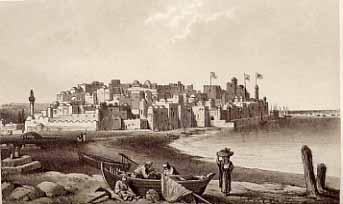
Jaffa from Thomson’s “The Land and the Book”

Almost 150 years ago one of the most popular travel accounts of the Holy Land was penned by an American missionary named William M. Thomson. Born in Ohio, my own home state, the 28-year old Thomson and his young bride arrived in Lebanon in 1834 as Protestant missionaries. This was a mere 15 or so years after the first American missionaries had made the Holy Land a mission field. At once an entertaining travel account and Sunday School commentary on the places and people of the Bible, this may have been one the most widely read books ever written by a Protestant missionary.

Reading Thomson is like reading one of the early English novels. The language is less familiar, although still thoroughly Yankee and the devotional tone has long since disappeared for a readership buying out The Da Vinci Code as soon as it hit the bookstores. The biblical exegesis, literalist yet frankly pragmatic at times, is intertwined with astute and at times humorous accounts of the people Thomson met along the way. But the style is not at all dry or discouragingly didactic. From the start Thomson engages in a dialogue with the reader, making the text (which stretches over 700 pages in the 1901 version) a rhetorical trip in itself.

Here is one of the forgotten books of a couple generations back. Easily dismissed as an Orientalist book, in the sense propounded and confounded by Edward Said, it is nevertheless a very good read. With this post I begin a series to sample the anecdotes and local color presented by Rev. Thomson. The times have indeed changed, but such textual forays into the night reading of a previous generation of Americans are well worth the effort. Let’s begin with the author’s own invitation. Continue reading Tabsir Redux: The Land and the Book #1: Looking for an Omnibus?

Tabsir Redux: The Cynical Dairy Farmer’s Guide to the New Middle East


BY Karim Sadjapour, Foreign Policy, June 15, 2011

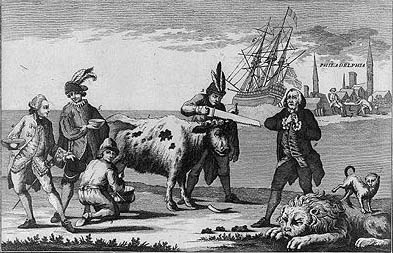
How a couple of cows explain a changing region: equal opportunity offender edition.

In the early years of the Cold War, in an effort to simplify — and parody — various political ideologies and philosophies, irreverent wits, in the spirit of George Orwell, went back to the farm. No one really knows how the two-cow joke known as “Parable of the Isms” came about, but most students of Political Science 101 have likely come across some variation of the following definitions:

Socialism: You have two cows. The government takes one of them and gives it to your neighbor.

Communism: You have two cows. The government takes them both and provides you with milk.

Nazism: You have two cows. The government shoots you and takes the cows.

Capitalism: You have two cows. You sell one and buy a bull.

Over the years, the parables gradually expanded, using the two-cow joke to explain everything from French unions (You have two cows. You go on strike because you want three cows.) to the Republican Party (You have two cows. Your neighbor has none. So what?). While in its original iteration the cows were a metaphor for currency, capital, and property, they later began to take on different meanings.

Today, the Middle East has replaced the Cold War as America’s primary foreign-policy preoccupation. As opposed to the seemingly ideologically homogenous communist bloc, however, the 22 diverse countries that compose the modern Middle East are still confusing to most Americans. Why can’t the Israeli and Palestinians stop fighting already? What’s the difference between Libya and Lebanon again?

Herewith then is a satirical effort to simplify the essence of Middle Eastern governments so that, in the immortal words of George W. Bush, “the boys in Lubbock” can read it. And, rather than symbolizing property, the cows here symbolize people, which — funny enough — is how most Middle Eastern regimes have traditionally viewed their populations.

Saudi Arabia
You have two cows with endless reserves of milk. Gorge them with grass, prevent them from interacting with bulls, and import South Asians to milk them.

Iran
You have two cows. You interrogate them until they concede they are Zionist agents. You send their milk to southern Lebanon and Gaza, or render it into highly enriched cream. International sanctions prevent your milk from being bought on the open market.

Syria
You have five cows, one of whom is an Alawite. Feed the Alawite cow well; beat the non-Alawite cows. Use the milk to finance your wife’s shopping sprees in London.

Lebanon
You have two cows. Syria claims ownership over them. You take them abroad and start successful cattle farms in Africa, Australia, and Latin America. You send the proceeds back home so your relatives can afford cosmetic surgery and Mercedes-Benzes.

Hezbollah
You have no cows. During breaks from milking on the teat of the Iranian cow you call for Israel’s annihilation. Continue reading Tabsir Redux: The Cynical Dairy Farmer’s Guide to the New Middle East

Israelis and Palestinians: Live Long and Prosper


by Leonard Nimoy, Americans for Peace Now, June, 2011

Dear Friend,

When I was a teenager, I told my dad I wanted to be an actor. In response, he gave me the only piece of advice he ever offered me–“Learn to play the accordion.” And he was serious. He said, “You can always make a living with an accordion.”

Because I ignored his advice, I never found out if he was right. Instead, I’ve lived 80 creative years pursuing acting and photography, and working as a director and poet.

If I had listened to my father, and hadn’t done any of those things, chances are you wouldn’t have recognized my name and you wouldn’t be reading this. Now that you are, I’d like to ask you to consider what I have to say. I reach out to you as someone who is troubled to see the conflict between Israelis and Palestinians continue apparently without an end in sight.

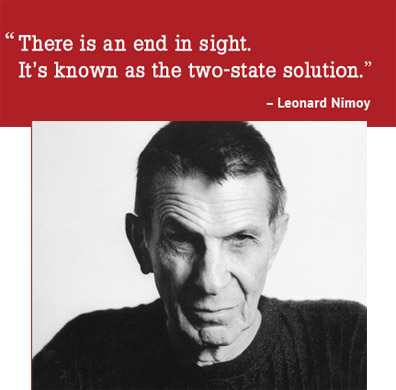
In fact, there is an end in sight. It’s known as the two-state solution–a secure, democratic Israel as the Jewish State alongside an independent Palestinian state. Even Israel’s nationalist Prime Minister Binyamin Netanyahu, has come to see this as the shape of the future. The problem is how to reach that end point. It’s something we should be concerned about–not only as world citizens, but as Americans. Continue reading Israelis and Palestinians: Live Long and Prosper

How appalling, Mr. Naipaul


Diana Abu-Jaber is the author of five award-winning books, including the forthcoming novel Birds of Paradise

From One Writer To Another: Shut Up, V.S. Naipaul

by Diana Abu-Jaber, NPR, June 3, 2011

Dear V.S. Naipaul:

You recently remarked, “I read a piece of writing and within a paragraph or two I know whether it is by a woman or not. I think [it is] unequal to me.”

I was sad to read this, to realize that you’re apparently unable to think beyond schoolyard rankings and peevish comparisons, that you’re incapable of recognizing grace and power from unexpected and unfamiliar places, such as a woman’s experience.

But what worries me more is your comment that that women write with “sentimentality, the narrow view of the world,” because, “inevitably for a woman, she is not a complete master of a house, so that comes over in her writing too.”

Your use of the word “master,” is chilling. Continue reading How appalling, Mr. Naipaul

Doomed to Disappoint


John J. Mearsheimer

by John J. Mearsheimer, Pink Tank, May 19, 2011

Barack Obama gave a major speech on the Middle East today and it is clear from the subsequent commentary that he impressed few people. The main reason is that he did not say much new or indicate that there would be any serious changes in US policy in the region. It was essentially more of the same with the some tweaking here and there. Nevertheless, he did manage to anger some people. For example, Israel’s hard-line supporters were outraged that he said, “Palestine should be based on the 1967 lines with mutually agreed swaps.” For them, the 1967 borders are “Auschwitz borders” and thus can never serve as a basis for negotiations.

Many Palestinians, on the other hand, did not like Obama’s assertion that it made little sense for them to go to the UN General Assembly this September and win recognition for a Palestinian state based on the 1967 borders. Surely they also noticed that shortly after saying that “every state has the right to self-defense, and Israel must be able to defend itself,” the president said that the Palestinians would have to be content with “a sovereign non-militarized state,” which means that they will not be able to defend themselves against Israel or any other state for that matter. Hypocrisy appears to be wired into the DNA of American foreign-policy makers. Continue reading Doomed to Disappoint

The Middle East’s oldest dictatorship


Israel’s resolute occupation of Palestinians in not just historic Palestine, but in the West Bank and Gaza Strip specifically, can be considered the oldest quasi-dictatorship in the Middle East, Bishara argues [GALLO/GETTY]

by Marwan Bishara, Al Jazeera, April 21, 2011

As the conventional wisdom goes – especially in the West – Israel is the “only democracy” in the Middle East. And that is so, particularly for its Jewish citizens. However Israel has been anything but democratic for the indigenous people of the land, the Palestinian Arabs.

By nature and precedence, foreign military occupation is temporary. Colonialism on the other hand, and more precisely civilian colonisation, is a socio-political system of ruling over another people.

Since its inception at the end of the 19th century, Zionism preached self-determination for the Jewish people in “their” homeland. In reality, Israel has directly or indirectly driven Palestinians out of their homeland, confiscated their properties, rejected their right to return to their homeland despite UN resolutions, and occupied and colonised the rest of their homeland for the last four decades.

Throughout, Israeli military and security services ruled over another people against their will. They oppressed, tortured, exploited and robbed the Palestinians of their land, water and most importantly, their freedom. There has been more political prisoners in Israeli jails than any of its neighbours.

In denial over their predicament, Israeli leaders have taken shelter in the illusion of surplus morality. Continue reading The Middle East’s oldest dictatorship