Category Archives: Palestine

No Olive Branch in Gaza


by Daniel Martin Varisco
[Originally posted on Anthropology News.]

Civil unrest continues to grip the Middle East. Adding to the battle to remove Syria’s Russian-backed Assad and the political infighting following the ousting of dictators in Tunisia, Libya, Egypt and Yemen is a recent flare up in Gaza, leaving more than 160 Palestinians dead before a fragile ceasefire took hold just before Thanksgiving Day.

Politics can often mirror geography, especially in a land considered holy by three major religions. The lowest geographical point on earth is the Dead Sea, a critical juncture point of Israel, the Palestinian Authority and Jordan. But not far away sandwiched between Israel and Egypt is the narrow strip of Gaza, which is perhaps the lowest moral point in the current political strategy of the Israeli government and its vaunted IDF.

To say that the Gaza Strip is over populated and under resourced is an understatement. An estimated 1.7 million Palestinians live in a beleaguered area of 141 square miles, isolated and walled off like a Bantustan oasis. Before the 1948 creation of the state of Israel, this was a sparsely populated area with few resources to attract settlement, but some 200,000 Palestinians fled here at the time. Formal occupation of Israel, following the 1967 6-day war, officially ended in the mid-90s with the Oslo Accords. But there has been no peace in Gaza, whether under the control of the PLO or Hamas.

Pundits flood the airwaves with condemnation of Hamas, as though calling it a terrorist organization means open season on any Palestinian living in Gaza. So why does Hamas not sue for peace, given the obvious fact that a slew of puny missiles lobbed at Israel only brings more retaliation? A potent symbol of peace in the “Holy Land” is the olive branch. Students still read about this peace symbol in Virgil’s first century BCE Aeneid, so the need for such a symbol has certainly been around along the shores of the Mediterranean for a long time. Defenders of Israel’s continuing bombing strikes and assassinations in Gaza argue that Israel has a right to defend itself because Hamas is out to somehow destroy Israel. Hence Israel’s expensive prophylactic “Iron Dome” symbolically trumps an olive branch on the cable news. But it is hard to expect Palestinians to wave olive branches when there are so few olive trees left standing in Gaza. The recent “Pillar of Cloud” military campaign that rained down on Gaza occurred during the height of the olive harvest and processing season.

For the rest of this post, click here.
That settles it


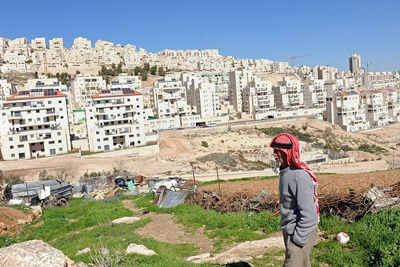
A Palestinian man walks on his property overlooking the Israeli settlement Har Homa in the Israeli-occupied West Bank; photograph from the Christian Science Monitor

Lob missiles in the direction of Tel Aviv, drop a bomb on a Hamas official, strap on a vest and blow up an Israeli bus, tear down Palestinian houses and build a wall, teach your children to hate the oppressor and get a symbolic upgrade in the UN: how can this seemingly intractable dilemma of “World of Warcraft: Land of Abraham” Israel vs. Palestine scenario ever get settled. One unilateral way is to settle it with yet more settlements. As The New York Times notes in today’s edition, the current Israeli government has their own kind of settlement in mind:

A day after the United Nations General Assembly voted overwhelmingly to upgrade the status of the Palestinians, a senior Israeli official said the government would pursue “preliminary zoning and planning preparations” for a development that would separate the West Bank cities of Ramallah and Bethlehem from Jerusalem. If such a project were to go beyond blueprints, it could prevent the creation of a viable, contiguous Palestinian state.

The development, in an open, mostly empty area known as E1, would connect the large settlement town of Maale Adumim to Jerusalem. Israeli officials also authorized construction of 3,000 housing units in parts of East Jerusalem and the West Bank.

The Obama administration, which backs virtually everything Israel does, is barking about how this is unhelpful, stopping short of the political bite that could be called condemnation. But some American diplomats see the danger in this mood: “This is not just another few houses in Jerusalem or another hilltop in the West Bank,” said Daniel C. Kurtzer, a former American ambassador to Israel and Egypt. “This is one of the most sensitive areas of territory, and I would hope the United States will lay down the law.”


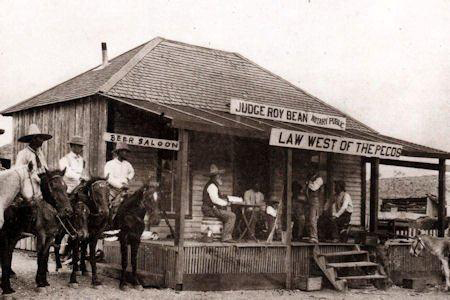
That law has about as much chance of being laid down in the current political climate as the law west of Pecos in America’s own landgrab days. Continue reading That settles it

America’s Failed Palestinian Policy


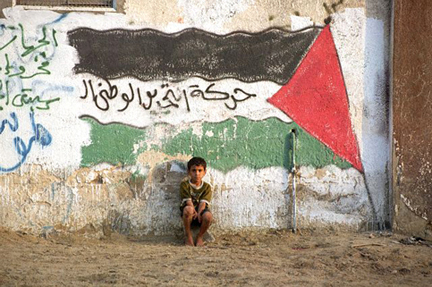
Palestinian boy in Gaza

By YOUSEF MUNAYYER, The New York Times, November 23, 2012

MORE than 160 Palestinians and 5 Israelis are dead, and as the smoke clears over Gaza, the Israelis will not be more secure and Palestinians’ hopes for self-determination remain dashed. It is time for a significant re-evaluation of the American policies that have contributed to this morass.

The failure of America’s approach toward the Israelis and the Palestinians, much like its flawed policies toward the region in general, is founded on the assumption that American hard power, through support for Israel and other Middle Eastern governments, can keep the legitimate grievances of the people under wraps.

But events in Gaza, like those in Egypt and elsewhere, have proved once again that the use of force is incapable of providing security for Israel, when the underlying causes of a people’s discontent go unaddressed.

The United States government must ask: what message do America’s policies send to Israelis and Palestinians?

Washington’s policies have sent counterproductive messages to the Palestinians that have only increased the incentives for using violence. Continue reading America’s Failed Palestinian Policy

Black Friday through Black Thursday over and over again


In the United States, after having given thanks for a turkey feast in which only one of the native birds has been officially pardoned and allowed to live a little longer, today becomes Black Friday. One official holiday (blessed by Lincoln, who is the star of a new Hollywood film) has ended and the shopping spree for the next official holiday (which officially keeps the “Christ” in Christmas) has begun. Actually in some places the shopping began last night. Whatever the real reason for the dubbing, it is obvious that this shop-to-you-drop mentality is meant to keep stores in the black rather than bleeding red. As a result, lots of gifts will be be bought to be placed under the Christmas trees of families who really do not need them. Meanwhile in the Middle East (and not just in the Middle East) Black Friday will be followed by a Black Saturday and the blackness will continue all the way through to a Black Thursday to be followed by yet another Black set of days on end.

In the aftermath of Super Storm Sandy I was without electricity in my home for 11 days. Apart from a few candles and flames in a fireplace, I was surrounded by darkness for more than a week. But there are different shades of darkness, despite the semantic homogenization in our concept of “black.” Being in the literal dark or in a situation where there is no light and thus everything is pitch black keeps us metaphorically in the dark as well. I lost power and a few tree limbs, but thousands of people during Sandy lost houses, possessions of all kinds, cars and boats. Some still remain without a home or power as I write this three weeks later. What makes today “Black Friday” here in America is inconvenience at the malls. It was inconvenient not to have electricity or hot showers and to cook on a Coleman stove for a few days, but the unfolding events in the Middle East go far beyond this kind of inconvenience. Continue reading Black Friday through Black Thursday over and over again

Paul on Gaza

The election circus is over for another four years; at least it is less a rhetorical political cliff than a slippery slope. But I recently came across a C-Span Youtube video of Representative Ron Paul (who is sure to run again for the GOP nod) speaking in congress in 2009 against a resolution to support Israel’s invasion into Gaza (which is why he will never win). It is well worth viewing again, politics aside. You can see it here: http://www.youtube.com/watch?feature=player_embedded&v=Yb3vF6Vcjr0#!

Nader on Gaza


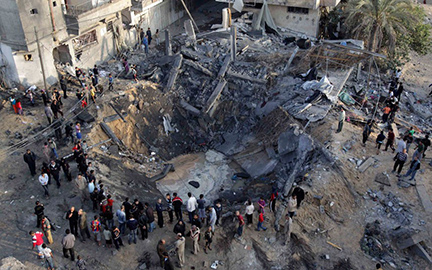
Palestinians gather around an enormous crater after an Israeli air strike levelled a building in Khan Younis in the southern Gaza Strip; photograph for REUTERS by Ibraheem Abu Mustafa

Israel-Palestine: What is the U.S. National Interest?

By Ralph Nader, The Nader Page, Tuesday, November 20, 2012

Israeli elections are coming up in January so it is Palestinian hunting season again. Israeli cynics call it a time “for mowing the grass.”

Out comes the well-worn playbook by Israel’s militaristic government that has worked to silence Israeli politicians and citizens who want a two-state solution. This is an opportunity to use and test advanced weaponry from the U.S., compliments of U.S. taxpayers, and squelch ongoing peace efforts, small and large, by Palestinians, Israelis and international peace advocates.

The playbook’s first chapter is provocation to upset a tense but workable truce with Hamas, the elected government of Gaza. Hamas was encouraged at its creation years ago by both Israeli and U.S. backers to counter the secular Palestine Liberation Organization (PLO). Bit of a blowback there.

Israeli government leaders are expert provocateurs when they wish to seize land, water or prisoners and upset any movement toward a peace that would create a viable Palestinian state back to the 1967 borders, which includes East Jerusalem. When Israel came into being in 1948, it soon broke a UN truce and doubled its territory by taking the large area known as the Negev desert, whose refugees ended up in the Gaza Strip. Now 1.6 million encircled and impoverished humans, blockaded and under siege by Israel, try to survive in an open-air prison little more than twice the size of the District of Columbia.

Israel’s strategy of breaking cease-fires and truces over the years has been documented by Princeton University history professor emeritus, Arno J. Mayer, in his scholarly book Plowshares into Swords: From Zionism to Israel (Verso, 2008). Continue reading Nader on Gaza

Unequally yoked is no joke


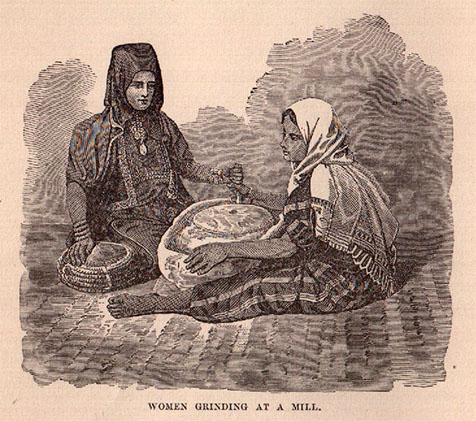
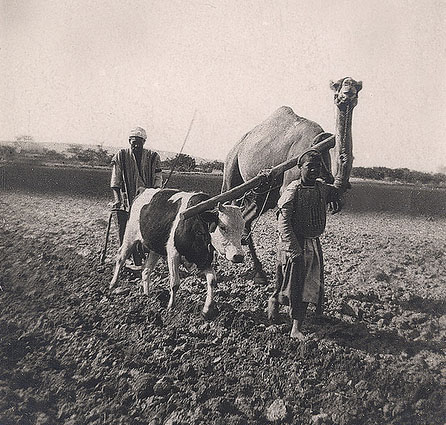
Gelatine silver print (probably made in the mid-1920s) of an American Colony photograph taken in southern Palestine between 1898 and 1911; from the John Garstang collection

“Be ye not unequally yoked together with unbelievers; for what fellowship hath righteousness with unrighteousness? And what communion hath light with darkness?” 2 Corinthians 6:14, KJV

The admonition of the Apostle Paul in his second letter to Corinth is the ultimate justification for separatism. Orthodox Jews, Fundamentalist born-again Christians and ultra-conservative Muslims all have taken to heart the sentiment of this advice, often making it into an outright ban. The latest news sensation is about a Muslim “catacomb sect” in Russia’s Tatarstan region:

Four members of a breakaway Muslim sect in Russia’s Tatarstan region have been charged with cruelty against children for allegedly keeping them underground.

Police discovered 27 children and 38 adults living in catacomb-like cells in an eight-level underground bunker.

The sect’s elderly leader, Faizrakhman Sattarov, had reportedly wanted to build his own Islamic caliphate beneath the ground…

Officials said the children, aged between one and 17 years, had never left the compound, gone to school or been treated by a doctor, and had rarely seen the light of day.

According to the Russian website Islam News, Mr Sattarov, 83, declared himself an Islamic prophet in the mid-1960s after interpreting sparks from a trolleybus cable as a divine light from God.

He and his followers began to shun the outside world in the early part of this century.

One is not sure to laugh or cry at a prophet who gets his revelation from the sparks of a trolleybus cable, but in the end a vision is a vision no matter what the alleged divine source. All three major religions have had their break-away, nothing-to-do-with-this-life prophets and the few sheep that inevitably follow them over the cliff of rationality. The problem here is what may be labeled a dogmatic emphasis on the “unsocial contract.” In other words, this is a kind of cultural suicide, hardly the umma envisioned by the Prophet Muhammad.

The metaphor in the old photograph above is what intrigues me. The supposed rationale is that a team of domestic animals should be the same, generally two oxen. That is all well and good if you actually have two of these rather expensive beasts, but what if you don’t? In many cases farmers in the region had to make due with either a donkey or a camel, but hitching two different animals may not have been as rare as assumed, nor as problematic. Notice in this image that a little boy leads the camel, allowing it to keep the pace of the ox while the ploughman bears down on the blade. Rather than focus on there being two separate animals, think about the social cooperation of boy, man, ox and camel as a unit.

When the emphasis is on what makes the animals different either from each other or from humans, the broader point of cooperation is easily lost. The same is true in religion. Separatists are doomed to failure by their very nature, except as oases sustained within a wider pluralistic context. Those sects which survive learn to adapt to competing views and accept change, no matter what level of reticence. Consider the early Mormons, who were so far out of the mainstream that they were persecuted everywhere they went. No matter the doctrines still enshrined on the main webpage of the Church of Latter Day Saints, the church has embraced the very kind of patriotism that once forced them to the arid wilderness of Utah. This is the only way they could have survived.

I am certainly no prophet, even though I have seen trolleycar sparks in my youth, but I suspect that the future of Islam will see increasing rather than decreasing pluralism. As a religion which has spread well outside its Arabian geographic origin, the ways of being Muslim are far too many to ever be bottled into one halal variety. Even in the heyday of Islamic power there was never a unanimity of belief. Like Judaism and Christianity there will continue to be those who insist they represent the “true” faith, but no religion can resist the perpetual cultural change that envelops the entire globe. Think of that Palestinian fellah in the 1920s photograph above. He could never have imagined the technological and social change in his own backyard today. Today we think we can imagine, but the future is probably not best revealed by looking at a trolleycar, sparks or not.