Category Archives: Palestine

Holy Land Photo Archive


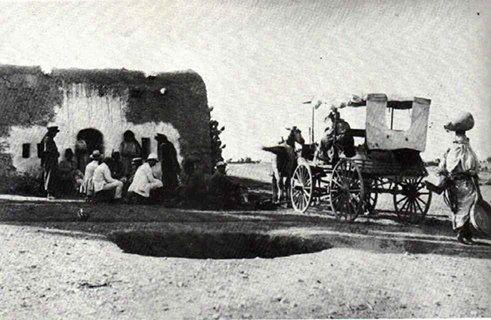
Arab Settlement Of Kakun, in the Sharon valley, with carriage of European visitors, 1911

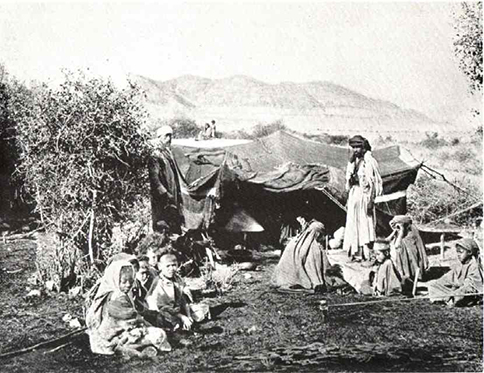
Many tourists flocked to the Holy Land in the 19th and early 20th centuries, not to mention the people who lived there. Quite a few took along cameras. There is a major archive of photographs of late Ottoman and Mandate Palestine here. The photographs are separated by area. It is well worth a look.


Bedouin camp in Jericho, 1893

Continue reading Holy Land Photo Archive

War is still hell


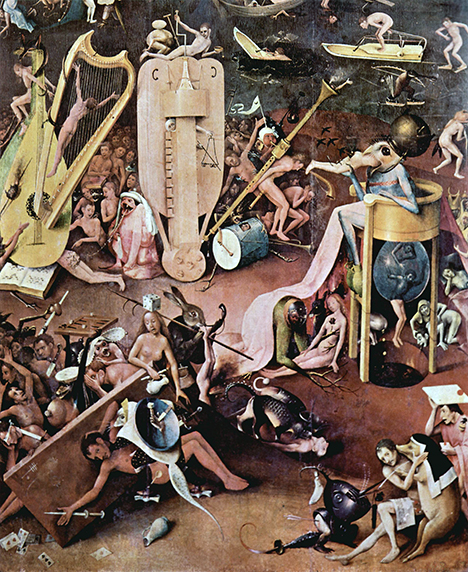
The Garden of Earthly Delights by Hieronymus Bosch, ca 1500

War is hell and it was long before General Sherman figured that out. It helps to remember exactly what “hell” means. In 1741 the Protestant firebrand Jonathan Edwards gave a rather clear picture:

The God that holds you over the pit of hell, much as one holds a spider, or some loathsome insect over the fire, abhors you, and is dreadfully provoked: his wrath towards you burns like fire; he looks upon you as worthy of nothing else, but to be cast into the fire; he is of purer eyes than to bear to have you in his sight; you are ten thousand times more abominable in his eyes, than the most hateful venomous serpent is in ours. You have offended him infinitely more than ever a stubborn rebel did his prince…

Over five centuries ago, the painter Hieronymus Bosch gave an artistic rendering, as noted above. Had he known about poison gas, I suspect we would have seen a few canisters in his registers. In the hell that is war, a Dantean perspective would place the various poison gasses near the bottom level. It now seems that the United States is certain that Syria’s Assad has used poison gas, crossing the rhetorical line drawn by President Obama awhile ago. Foreign Policy is reporting new old evidence that our government is not so much concerned about the use of such poison gas as it is in who are the intended victims. We apparently knew in advance that Saddam would use such gas when we gave him logistical support to fight off the Iranians, whose country he had ruthlessly invaded. And, of course, we did nothing when he gassed the Kurds in Halabja.

The truth is that war has always been hell, since the first historical descriptions. In reality it is never the kind of supposedly heroic “give ‘m hell” bravado of John Wayne or Rambo. Gore trumps the vanity of glory. The problem is that hell is eternally present and not in some far-off ethereal realm. A further problem is that hell has no suitable escape hatch. Thus thousands have died in Syria and many more will be killed on all sides, no matter what the United States does next. The same goes for Iraq, Afghanistan, Pakistan, Palestine and now, it seems, Egypt. Even those who think that by killing someone else because they are … (fill in the sectarian blank) they will go to an imagined heaven only deserve to end up in the hell they create for their victims.

Those of us far away from the fighting, only within Youtube range, may forget how close to hell we really are. The stench of dead bodies and the devastating odorless poison that snuffs out lives lightning quick are not part of the air we currently breathe, but we should not forget that hell is not a place but an attitude, an attitude that kills. It is also an attitude for which there is no real immunity in avoiding its reality. If only we could say “to hell with war,” but then that would be a tautology.

Al-Aqsa Arabic Manuscripts Going Online


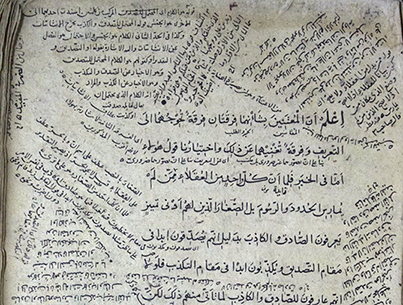
Top of page from 1347 CE copy of Miftah al-‘ulum of al-Sakaki in the al-Aqsa Mosque Library

The British Museum is sponsoring a project to digitalize Arabic manuscripts in the al-Aqsa Mosque library of Jerusalem. Details below and at their website:

EAP521: Digitisation of manuscripts at the Al-aqsa Mosque Library, East Jerusalem

The main goal of this project is to preserve the historical manuscript collection housed at the Al-aqsa Mosque Library in Jerusalem. The Al-aqsa Library located at the heart of the Old City of Jerusalem serves as a primary research center for Islamic studies and as a reference library for scholars and students from Jerusalem and other Palestinian cities. The library’s rare and most valuable collection consists of approximately 2000 manuscripts. The manuscripts were acquired by the Al-aqsa Library from prominent scholars, private collections, and from libraries in Palestine that have ceased to exist. The materials selected for this project represent 119 manuscript titles in the most immediate need of preservation.

EAP521/1: Al-Aqsa Mosque Library Collection of Historical Manuscripts [12th century-19th century]

“This manuscript collection contains 119 Arabic language titles that span over several Islamic periods from the 9th century CE to the end of the Ottoman rule in Palestine at the beginning of the 20th century. Most of the manuscripts relate to aspects of the Islamic religion, but also cover Arabic literature, the Arabic language, logic, math and Sufism and provide a unique insight into centuries of Arabic culture in Palestine. The numbers of pages of original material represent double pages, often librarians of islamic manuscripts use one number for every two pages. ”

Digitisation is planned primarily as a means of preservation in order to create high-quality archival digital copies of the original source materials that are at risk of deterioration. Environmental factors, wear and tear of manuscripts due to poor storage conditions, the lack of security at the library, and the unstable political situation in Jerusalem contribute to the sense of urgency and make digitisation of these unique manuscript materials a top priority. Continue reading Al-Aqsa Arabic Manuscripts Going Online

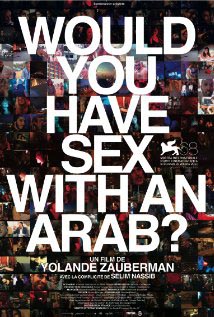
Would You Have Sex With an Arab?

Sleeping With the Enemy? Review of “”Would You Have Sex With an Arab?
By Clara Abdulaziz,http://ta3beer.blogspot.com, April, 19

“One in five Israelis is an Arab, but it is difficult to find places where they touch fingertips.”

In her latest feature-length documentary, French filmmaker Yolande Zauberman ventures out into the nightlife of Tel Aviv and asks the people she meets a deceptively simple question: “Would you have sex with an Arab?” It is clear that sex serves merely as a proxy to grapple with a much larger question: can individuals transcend identities rooted in long histories of conflict, or is identity so rigidly constructed that it in fact defines one’s humanity?

Zauberman has said that she produced the film to “give space for awareness.” It is meant to be “a little bit sexy, a little bit funny.”

It is also, quite frankly, pretty depressing.

Zauberman’s choice of Tel Aviv for her film was not arbitrary. It is famous for its non-stop club scene, and is one of the most LGBT and queer-friendly cities in the world. She shows that even here, where most young residents seem more concerned with partying than religion and politics, the boundaries of Jewish and Arab identity remain stubbornly situated within the larger Arab-Israeli conflict. Continue reading Would You Have Sex With an Arab?

Orientalism and Bibliolatry:
Framing the Holy Land in 19th Century Protestant Bible Customs Texts

I have recently published an article in a volume edited by Ian Netton, entitled Orientalism Revisited: Art, Land and Voyage (London: Routledge, 2013, pp. 187-204). I provide the introductory paragraphs below.


Orientalism and Bibliolatry:
Framing the Holy Land in 19th Century Protestant Bible Customs Texts

“The Orient was almost a European invention, and has been since antiquity a place of romance, exotic beings, haunting memories and landscapes, remarkable experiences.” Edward Said, Orientalism, 1979

“In a word, Palestine is one vast tablet whereupon God’s messages to men have been drawn, and graven deep in living characters by the Great Publisher of glad tidings, to be seen and read of all to the end of time.” William M. Thomson, The Land and the Book, 1859

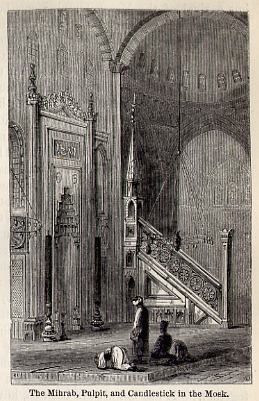
This essay begins with a famous opening phrase from Edward Said’s Orientalism not because there is a need to validate or dispute it, but because of what it leaves out. Indeed, Said’s caveat of “almost” is telling, since his text only describes the “Orient” invented through the writings of Western writers. What is remarkable about Said’s styling of the Orient as a form of politicized discourse is that the most important part of this invention is missing: the Orient invaded by Napoleon is also the Holy Land, the “vast tablet,” as American missionary William Thomson phrases it, which brings the Bible to life. Napoleon may have initiated Western imperialist ambitions in this Holy Land, but the ultimate failure of his military mission stands in stark contrast to the perpetual array of Christian pilgrims, scholars and missionaries who visited this holiest of Holy Lands for Christians and Jews. Absent from Said’s text is the genre that was most widely read in 19th century Europe and America, specifically Holy Land travel texts that cited contemporary customs and manners of Arabs and other groups encountered as illustrations of Bible characters for popular consumption, especially among Protestants.

Said’s genealogy of the discourse he identifies as Orientalism is a thoroughly academic one. Continue reading Orientalism and Bibliolatry:
Framing the Holy Land in 19th Century Protestant Bible Customs Texts

Tabsir Redux: The Cynical Dairy Farmer’s Guide to the New Middle East


BY Karim Sadjapour, Foreign Policy, June 15, 2011

How a couple of cows explain a changing region: equal opportunity offender edition.

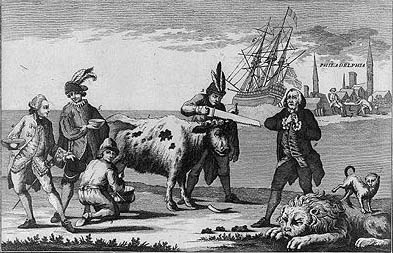
In the early years of the Cold War, in an effort to simplify — and parody — various political ideologies and philosophies, irreverent wits, in the spirit of George Orwell, went back to the farm. No one really knows how the two-cow joke known as “Parable of the Isms” came about, but most students of Political Science 101 have likely come across some variation of the following definitions:

Socialism: You have two cows. The government takes one of them and gives it to your neighbor.

Communism: You have two cows. The government takes them both and provides you with milk.

Nazism: You have two cows. The government shoots you and takes the cows.

Capitalism: You have two cows. You sell one and buy a bull.

Over the years, the parables gradually expanded, using the two-cow joke to explain everything from French unions (You have two cows. You go on strike because you want three cows.) to the Republican Party (You have two cows. Your neighbor has none. So what?). While in its original iteration the cows were a metaphor for currency, capital, and property, they later began to take on different meanings.

Today, the Middle East has replaced the Cold War as America’s primary foreign-policy preoccupation. As opposed to the seemingly ideologically homogenous communist bloc, however, the 22 diverse countries that compose the modern Middle East are still confusing to most Americans. Why can’t the Israeli and Palestinians stop fighting already? What’s the difference between Libya and Lebanon again?

Herewith then is a satirical effort to simplify the essence of Middle Eastern governments so that, in the immortal words of George W. Bush, “the boys in Lubbock” can read it. And, rather than symbolizing property, the cows here symbolize people, which — funny enough — is how most Middle Eastern regimes have traditionally viewed their populations.

Saudi Arabia
You have two cows with endless reserves of milk. Gorge them with grass, prevent them from interacting with bulls, and import South Asians to milk them.

Iran
You have two cows. You interrogate them until they concede they are Zionist agents. You send their milk to southern Lebanon and Gaza, or render it into highly enriched cream. International sanctions prevent your milk from being bought on the open market.

Syria
You have five cows, one of whom is an Alawite. Feed the Alawite cow well; beat the non-Alawite cows. Use the milk to finance your wife’s shopping sprees in London.

Lebanon
You have two cows. Syria claims ownership over them. You take them abroad and start successful cattle farms in Africa, Australia, and Latin America. You send the proceeds back home so your relatives can afford cosmetic surgery and Mercedes-Benzes.

Hezbollah
You have no cows. During breaks from milking on the teat of the Iranian cow you call for Israel’s annihilation. Continue reading Tabsir Redux: The Cynical Dairy Farmer’s Guide to the New Middle East

The Soccer Stadium that was


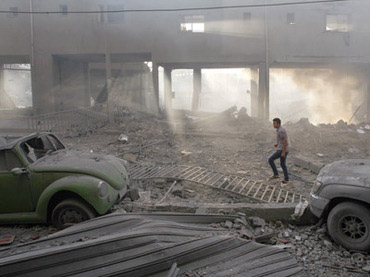
Gaza’s war-damaged Palestine Stadium

Israeli measures fuel international anti-Israeli soccer protests

By James M. Dorsey

A series of Israeli measures against Palestinian soccer culminating in an attack on a stadium in Gaza during last month’s confrontation with Hamas, the Islamist Palestinian group that controls the heavily populated strip along the Mediterranean, has fueled growing international soccer opposition to the Jewish state’s policies.

In the latest expression of discomfort, 62 professional players have called for depriving Israel of the right to host European soccer body UEFA’s 2013 Under-21 championship. Israel has already employed the championship to counter the image of being an area dominated by war and conflict that was reinforced by last month’s hostilities with Hamas that killed more than 150 Palestinians and five Israelis.

“In June we have the Under-21 here in Israel. I hope that everything will be quiet until then and we can show the different sides of Israel,” said Maccabi Tel Aviv defender Omer Vered in a BBC interview.

The statement by the players follows protests earlier this year by world soccer body FIFA, UEFA and players’ group FIFPro against Israel’s handling of a hunger strike of an imprisoned Palestinian player, Mahmoud Sarsak, accused of being a member of militant group Islamic Jihad, and the arrest of two other players suspected in involvement in violent anti-Israeli actions. Continue reading The Soccer Stadium that was