Category Archives: Palestine

For Israelis, an Anniversary. For Palestinians, a Nakba

By ELIAS KHOURY, The New York Times, May 18, 2008

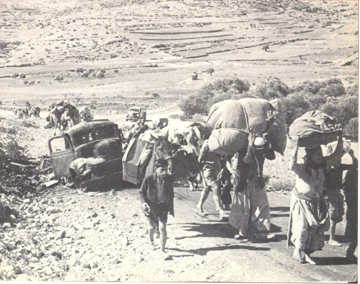
IN 1948, during the war known to the Israelis as the war of independence, the historian Constantine K. Zurayk wrote the book “Ma’na al-Nakba,” later translated as “The Meaning of the Disaster.” The title struck a resounding chord, and nakba (catastrophe) became the term Palestinians used for the cataclysm that befell them that year.

I always considered the word “catastrophe” inappropriate. It rendered the perpetrator anonymous, and it exempted the vanquished from bearing any responsibility for their defeat. Like many members of my generation, born around the time of the war, I tended to place the blame for our defeat on the traditional Palestinian leadership under the sway of the mufti of Jerusalem, and the Arab regimes of the day. Continue reading For Israelis, an Anniversary. For Palestinians, a Nakba

The Bad Business of Badal

A Palestinian filmmaker, Ibtisam Mara’ana, has recently made a film on badal (exchange) marriage from her own personal experience. Although in Arabic, it has English subtitles. To watch a five-minute clip from the film, click here.

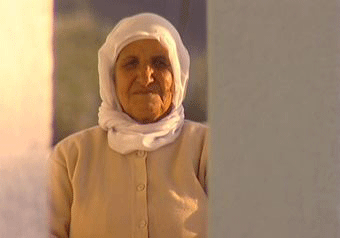
Director Ibstisam Mara’ana was predestined, like most of her relatives, to be married off through the badal, a kind of package deal in which a brother and sister from one family marry a sister and brother from another. This marriage exchange is mainly aimed at providing less marriageable daughters with a husband. Mara’ana was told that she was too old and dark, and too ugly due to a scar on her hand, and that without the godsend of the badal, she would fall by the wayside. She refused to cooperate. Instead, she made this award-winning documentary to show how women oppress women. Continue reading The Bad Business of Badal

Exodus Redux

Remember the Exodus? Even if you never saw Charlton Heston part the waters Hollywood style, the story of the mistreatment of the descendants of the patriarch Jacob of Israel and their harrowing escape from the clutches of a hard-hearted Pharaoh has been retold millions of times over the past two millennia or more. In that story the more that Moses and brother Aaron demand “Let my people go,” the more the burden on the people, including the last straw, literally the last straw, in a work force up against a mud brick wall. Things got so bad that even the supervisors tried to reason with Pharaoh, but to no avail. So Moses in frustration turned to his Lord and complained in plain King James English:

And Moses returned unto the LORD, and said, Lord, wherefore hast thou so evil entreated this people? why is it that thou hast sent me? For since I came to Pharaoh to speak in thy name, he hath done evil to this people; neither hast thou delivered thy people at all. (Exodus 5:22-23)

Then came the plagues worthy of a passionate Mel Gibson remake: Nile water turned into blood, frogs everywhere, pesky gnats and flies (hardly anything new, I should suspect), the heavy vegan-friendly killing off of horses, donkeys, camels and flocks, then festering boils, heaven-sent hail and fire (an interesting notion for resolving global warming), lots and lots of locusts (some of which may have been kosher), total darkness and then the ultimate weapon of killing every non-Israelite firstborn. One would think this would be enough for several movies, but the journey has not even begun. That exodus, hardly a march of triumph, would condemn the brickmakers of Egypt to forty years wandering in the desert. Where is Mel Brooks when you need him?

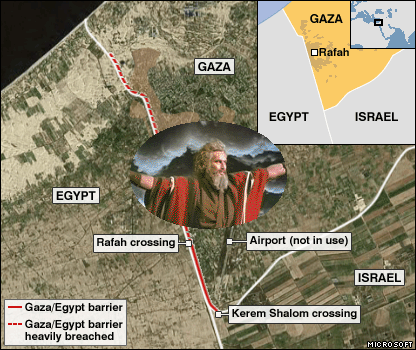
Yesterday the irony of contemporary politics put the exodus in reverse. Continue reading Exodus Redux

Who Owns the Holy Land?

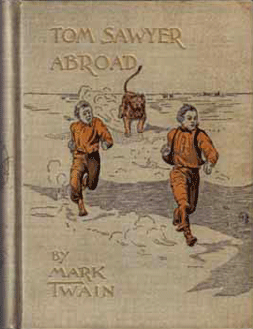
As another year draws to a close, it is hard not to think in larger terms of the course of the last century. The world has seen two world wars and far too many atrocities since 1908 to think of our technological and commercially driven age as golden. But in it all there has been humor. Believe it or not, the American writer Mark Twain was still alive one hundred years ago. His greatest books belong to the century before, from the mother of all Holy Land travelogues, Innocents Abroad, to Huckleberry Finn and his adventurous friend Tom Sawyer. Surely one of the greatest humorists ever, Mark Twain did more than tell funny stories. His work survives in part because it uses humor to remind us of the unfairness and unwavering mundaneness of life.

In Tom Sawyer Abroad Twain offers a vivid critique of the kind of Orientalism that Edward Said rightly views as a style for dominating the Orient. Continue reading Who Owns the Holy Land?

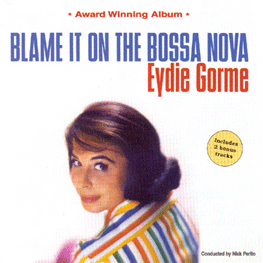
Blame it on the Bossa Nova. Or the Israel Lobby. Whatever.

by Gregory Starrett

One Monday late last March, I got back to my office after five days away and found e-mails from six different mailing lists and individual colleagues discussing, or linking to discussions of, or linking to the text of a London Review of Books article by John Mearsheimer and Stephen Walt, two prominent American political scientists, on how “The Israel Lobby” in the United States distorts U.S. foreign policy. Journalists, academics, former government officials, and others have been busily taking notice of the piece, looking for their names or the names of their friends and mentors, (or for those of their bete noirs and whipping boys), and dutifully proclaiming either that it’s about time someone outside the ranks of the Left finally noticed AIPAC’s shenanigans, or squawking about the article’s myriad inaccuracies, basic unfairness, and blatant anti-Semitism.

As far as I can tell, there are three difficulties with Mearsheimer and Walt’s work. Continue reading Blame it on the Bossa Nova. Or the Israel Lobby. Whatever.

The Problem with ‘My Problem with Jimmy Carter’s Book’

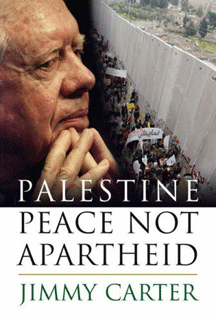
Middle East Quarterly, published by Daniel Pipes’ organization Middle East Forum, contains an article titled “My Problem with Jimmy Carter’s Book”, by Kenneth Stein, the first executive director of the Carter Center in Atlanta from 1983 to 1986, and currently a professor of Contemporary Middle Eastern History at Emory University. Stein, it will be remembered, resigned from his affiliation with the Carter Center, where he was a Middle East Fellow for over two decades, in protest over former President Jimmy Carter’s book, Palestine: Peace Not Apartheid. Touring the country explaining his objections to his former boss’s perspective on the Israeli Palestinian conflict, Stein has refrained from tarring Carter with the label “Jew-hater” (this from the ever-subtle David Horowitz), or claiming that Carter’s criticisms of Israeli policy stem from Carter having “enriched[ed] himself with dirty money”–dirty Arab oil money, specifically–from Shaykh Zayed bin Sultan al-Nahyan of the United Arab Emirates, “an unredeemable anti-Semite and all-around bigot” (this from the extraordinary Alan Dershowitz in an article) It should be noted, since Dershowitz does not, that much of the alleged dirty money that flowed through the Carter Center would have supported—and in the early years, been managed and disbursed by–Professor Stein. Continue reading The Problem with ‘My Problem with Jimmy Carter’s Book’

Water rather than Whining


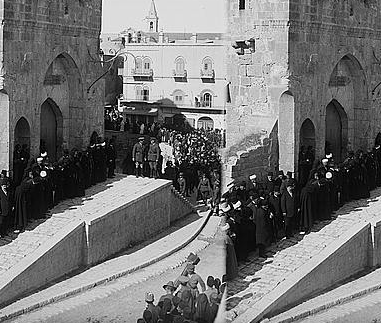
[“…I entered the city officially at noon, “December 11th”, with a few of my staff, the commanders of the French and Italian detachments, the heads of the political missions, and the Military Attaches of France, Italy, and America. The procession was all afoot, and at Jaffa gate I was received by the guards representing England, Scotland, Ireland, Wales, Australia, New Zealand, India, France, and Italy. The population received me well…” (General Allenby in Source Records of the Great War, Vol. V, ed. Charles F. Horne, National Alumni 1923)]

[Note: Almost 90 years ago, on December 9, 1917, General Allenby marched into Jerusalem to accept the surrender of the city by Ottoman Turkish officials. But unlike the current debacle in Iraq, where liberation has not been followed up by tangible development, it was the ability of British engineers to provide clean drinking water that helped smooth the transition from Ottoman rule to a mandate, ultimately as unclean and messy as it would become. It is worth reading the following excerpt by W. T. Massey, not only for strategic advice on how to win over a conquered populace, but also for a prime example of the journalistic ethnocentrism in which the West provides a “civilising hand” to the poor Oriental.]

THE TOUCH OF THE CIVILISING HAND
by W. T. Massey (1919)

It is doubtful whether the population of any city within the zones of
war profited so much at the hands of the conqueror as Jerusalem. In
a little more than half a year a wondrous change was effected in the
condition of the people, and if it had been possible to search the
Oriental mind and to get a free and frank expression of opinion,
one would probably have found a universal thankfulness for General
Allenby’s deliverance of the Holy City from the hands of the Turks.
And with good reason. The scourge of war so far as the British Army
was concerned left Jerusalem the Golden untouched. For the 50,000
people in the City the skilfully applied military pressure which
put an end to Turkish misgovernment was the beginning of an era
of happiness and contentment of which they had hitherto had no
conception. Justice was administered in accordance with British
ideals, every man enjoyed the profits of his industry, traders no
longer ran the gauntlet of extortionate officials, the old time corruption was a thing of the past, public health was organised as far as it could be on Western lines, and though in matters of sanitation and personal cleanliness the inhabitants still had much to learn, the appearance of the Holy City and its population vastly improved under
the touch of a civilising hand. Sights that offended more than one of
the senses on the day when General Allenby made his official entry had
disappeared, and peace and order reigned where previously had been but misery, poverty, disease, and squalor. Continue reading Water rather than Whining

The Gates of Gaza


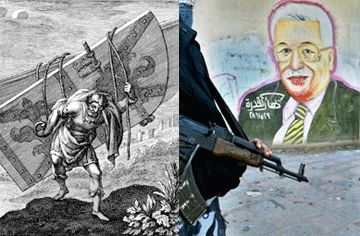
Illustration: left: “Samson carries gates” by Johann Christoph Weigel, 1695; right, Large mural of Palestinian presidential candidate Mahmoud Abbas in Gaza city, December 26, 2004, Reuters

The fragile and it seems futile political engagement of Fatah and Hamas has run into a veritable brick wall in Gaza, not surprising given all the mud slinging that has been going on. Hamas supporters have stormed what they see as the Bastille of President Mahmoud Abbas and in biblical terms carried away the gates. In reading the news reports today and looking at the pictures, especially the Hamas fighters gloating in Abbas’s former presidential office, it is as the baseball sage said “déjà vu all over again.” With fighting still continuing in Palestinian refugee camps in Lebanon, the agony of Palestinian suffering endures. Of course, this is not the first time that havoc has raged in Gaza. Since so little is held sacred in the “Holy Land,’ we might as well raid scripture and summon up an ancient moral tale that ended with a blind man’s suicide in which the temple walls came tumbling down. Today it is obvious there is no Samson in the heroic sense, and recent events confirm that the the blind still lead the blind, while much of the rest of the world simply turns a blind eye. In such times perhaps the only antidote to unstoppable tears is poetry… Continue reading The Gates of Gaza