Category Archives: Palestine

Lithographica Arabica 6: Rev. Wood’s Bible Animals, 3
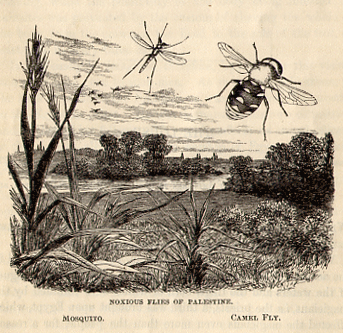
This is the third in a series on the illustrations in Rev. John George Wood’s Story of the Bible Animals. What do you get if you strain at a gnat? Read on…

Gnats

It has already been stated that only one species of fly is mentioned by name in the Scriptures. this is the Gnat, the name of which occurs in the familiar passage, “Ye blind guides, which strain at a ghat and swallow a camel” (Matt. xxiii. 24).

I may again mention here that the words “strain at” ought to have been printed “strain out,” the substitution of one for the other being only a typographical error. The allusion is made to a certain custom which is explained by reference to the preceding article on the fly. In order to avoid taking flies and other insects into the mouth, while drinking, a piece of thin linen stuff was placed over the cup, so that if any insects, as was usually the case, had got into the liquid, they would be “strained out” by the linen. Continue reading Lithographica Arabica 6: Rev. Wood’s Bible Animals, 3

Hampshire College Divests or Do They?

Divestment is a two-edged sword. Earlier this week a number of pro-Palestinian sites were ethused with the apparent decision of Hampshire College to divest its financial portfolio from investments in companies involved in the occupation of Palestine. I provide one such report below, followed by a clarification from Hampshire College that the decision was purely on financial grounds and not political.

Hampshire College becomes first college in U.S. to divest from Israeli Occupation!
Global BDS Movement, 2/12/2009

[press kit attached below] – Hampshire College in Amherst, MA, has become the first of any college or university in the U.S. to divest from companies on the grounds of their involvement in the Israeli occupation of Palestine.

This landmark move is a direct result of a two-year intensive campaign by the campus group, Students for Justice in Palestine (SJP). The group pressured Hampshire College’s Board of Trustees to divest from six specific companies due to human rights concerns in occupied Palestine. Over 800 students, professors, and alumni have signed SJP’s “institutional statement” calling for the divestment. Continue reading Hampshire College Divests or Do They?

Lithographica Arabica 5: Rev. Wood’s Bible Animals, 2

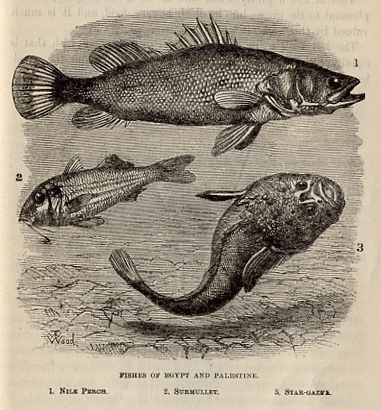
The illustrations provided in the books of Rev. John G. Wood are interesting not only for what they portray, but how they are described. Here is Wood’s folksy spin on three major fishes of Egypt and Palestine:

In order that the reader may see examples of the typical Fish which are to be found in Egypt and Palestine, I have added three more species, which are represented in the following illustration.

Continue reading Lithographica Arabica 5: Rev. Wood’s Bible Animals, 2

Lithographica Arabica 4: Rev. Wood’s Bible Animals, 1


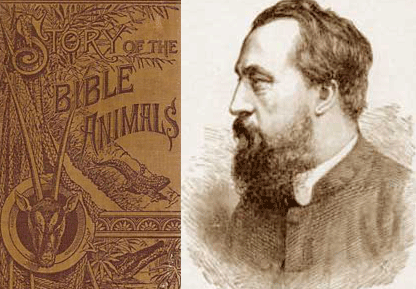
Rev. John George Wood, author of Story of the Bible Animals

Fascination with Bible Lands was so keen in the 19th century that illustrated volumes of scenes and objects were always in high demand. One of the treasures, in a figurative sense, of this age is the work of Rev. John George Wood (1827-1899), an English cleric and writer of popular books on natural history. One of the books passed on to me several years ago is Wood’s Story of the Bible Animals (Charles Foster Publishing Company, 1886), one of several editions of this popular work. The illustrations in my copy are not of the highest quality, but they can still mesmerize across their faded and fraying pages. Continue reading Lithographica Arabica 4: Rev. Wood’s Bible Animals, 1

These Sons of Adam


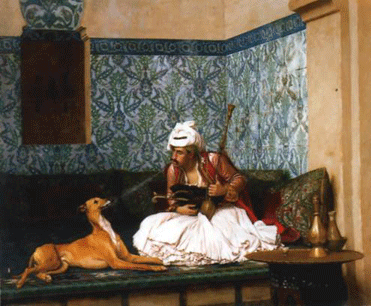
Arnaut Blowing Smoke at His Dog by Jean-Léon Gérôme, 1882.

In two previous posts, The Immovable East and An Unbelievable White Man, I published excerpts from the first-person narrative by Philip J. Baldensperger, published in 1913 about experiences in Palestine during the last half of the 19th century. His sense of humor was acute. Here are the words he imagined that a dog would bark out about life as a canine in an Arab village.

“The sons of Adam disdain dogs, but in many places they raise us up and utilise us. Thus, in the camp where I lived, there were shepherd dogs, with thick fur, and watch dogs, with a smooth coat all over, and the tall, thin greyhounds which are raised for hunting the gazelles on the broad plains of Philistia, near my first home.

I was born in camp, south of Beersheba, and belonged to a family of Azazmeh Arabs. On account of my jet black fur the called me Lail – Night… Continue reading These Sons of Adam

Picturing the Exodus

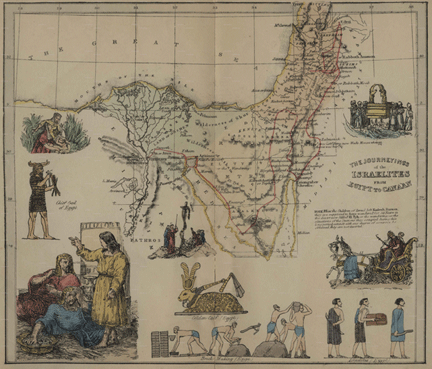
The ubiquity of GPS threatens to leave the old printed map out of the picture. This is a pity, for there is much to be learned from the way maps frame the world. As J. Z. Smith once remarked, map is not territory. True enough, but maps are the way we imagine not only territory but our place in it. When Edward Said wrote his critique of Orientalism in 1978, he cited novelists, travelers, poets and academics, but no mapmakers. But in a way Holy Land maps are what put the Holy Land on the map. Maps not only illustrated what was thought to be the lay of the land, but what people imagined was there.

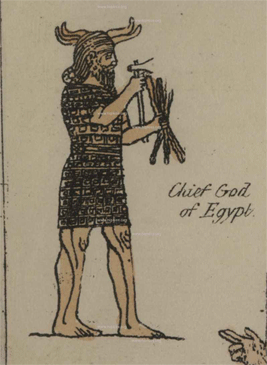
A splendid example of this is an 1856 pictorial Bible map of the Journey of the Israelites from Egypt to Canaan. I reproduce the image above, but if you
click here you can get a greatly enlarged view to see the details. Mind you, this was 1856, when few of the archeological discoveries in Bible territory had come to light. This is evident in the depiction of the “Chief God of Egypt,” (left side of map) who looks like a cross between an Assyrian and a Viking.

Continue reading Picturing the Exodus

Disproportional suffering


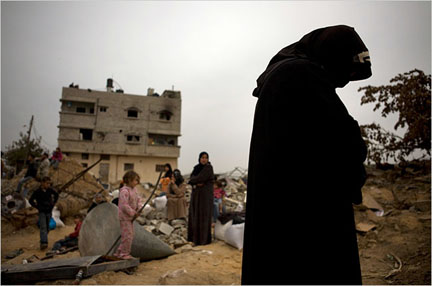
Residents returned to their homes around Gaza City on Friday. Tyler Hicks/The New York Times

Gaza is not history, nor is it likely to be soon. The bombs may have ceased on both sides, but the human toll presages a bleak future. Both sides have grievances, but the grief from death, maiming and sheer destruction of property and homes is incredibly disproportional. Even Independent observers must acknowlege this:

Up to 10 times as many Palestinians were killed as Israelis. The Palestinian Ministry of Health says 1,314 Palestinians were killed, of whom 412 were children or teenagers under 18, and 110 were women. On the Israeli side, there were 13 deaths between 27 December and 17 January, of whom three were civilians killed by rockets fired from Gaza. Of the 10 soldiers killed, four were lost to “friendly fire”.

Even if the Palestinian figure is disputed, it is clear that the death toll was massively higher for Palestinians than Israelis. Proportionality is not simply a matter of numbers, however. Continue reading Disproportional suffering