Category Archives: Palestine

Winners and Losers in a Post-Mubarak Arab World

By Yousef Munayyer, Palestine Center, The Jerusalem Fund, February 14, 2011

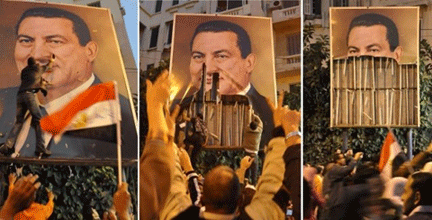
Thirty years ago the Soviet Union was at the beginning of a long campaign in Afghanistan, the average person was lucky to have an advanced recording technology called a “VHS tape,” and Mohammad Hosni Mubarak took control of Egypt, the most populous nation in the Arab Middle East. This week, the last of these beginnings came to an end when millions of Egyptian protestors succeeded in toppling one of the longest standing rulers in the 5,000-year history of Egypt.

But as with all eras, Hosni Mubarak’s established norms, some national and others regional, which have now irreversibly changed. What type of government may take form in Egypt in the coming weeks and months is yet to be seen, however, it is highly unlikely that any new government can afford to repeat the mistakes of the previous regime which eliminated pluralistic political participation in the formulation of both domestic and foreign policy.

Many different global players had an investment in the outcome of the drama that finally concluded in Egypt with Mubarak’s departure. So after this transformational moment, who are the winners and who are the losers?

The Winners

1. The People of Egypt – After only 18 days, the people of Egypt succeeded in removing a ruler who had governed Egypt for three decades. But the victory for the people of Egypt is far greater than the removal of one person like Mubarak or his family. Continue reading Winners and Losers in a Post-Mubarak Arab World
Ottoman Palestine


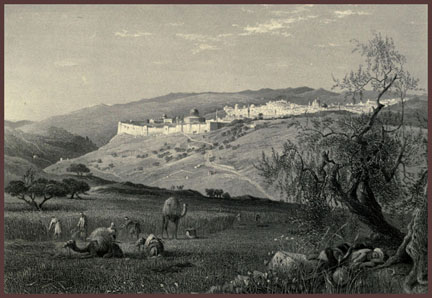
A friend recently brought my attention to an Arabic website with a fascinating collection of illustrations and photographs about Palestine under Ottoman rule. I also came across another site with illustrations of Jerusalem in the Ottoman era. I attach two examples here from the latter website, although the site does not specify the source or date of the images. Continue reading Ottoman Palestine

Buried Texts Recovered: An American Consul in the Holy Land

“The author’s object in accepting an appointment under the United States Government was not the honor or emoluments of office, but a desire to visit the lands of the Bible, that he might see for himself how far the manners, customs, and traditions of the people and topography of those countries agreed with the inspired word.”

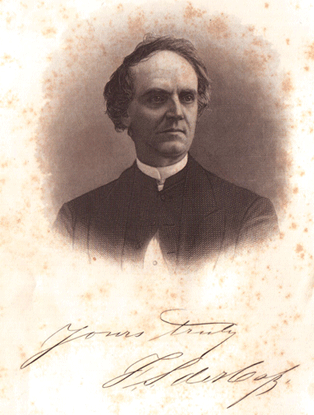
So begins one of the numerous 19th century Bible customs travel accounts by Christian enthusiasts able to travel to their “Holy Land.” The author is Frank S. DeHass, who served as the United States Consul in Palestine in the mid 19th century. His text is aptly entitled Buried Cities Recovered, or, Explorations in Bible Lands, giving the results of recent researches in the Orient, and recovery of many places in sacred and profane history long considered lost. My copy, handed down from my grandmother, was published in 1886 in Philadelphia by Bradley & Company; the tenth edition no less! This is a wonderful read and you can read the entire book online, thanks to Google Books.

Like so many other Bibliophiles of his generation, DeHass extols the virtue of actually visiting the land where Jesus was born and died. In his own words:

Recent explorations in the East have resulted in the recovery of many places in sacred and profane history long regarded as lost; and as the facts brought out by these researches are not accessible to the general reader, the author has compiled them in this concise form, and at the request of numerous friends gives them to the public, not as a scientific work for the antiquarian, but as a humble contribution to Biblical archaeology for the home circle, believing that such a volume will add greatly to the elucidation of the Scriptures, and serve to correct some of the errors which many travellers have fallen into by a too hasty or superficial view of the places visited. Continue reading Buried Texts Recovered: An American Consul in the Holy Land

Raising Dust in Palestine


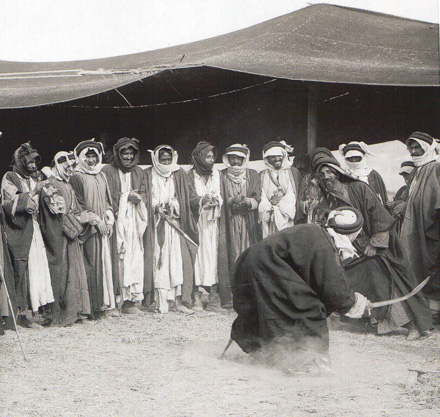
Sword dance at a Bedouin wedding in Palestine, early 1900s; Rowe 2010, opposite p. 116

We hear so much about the political turmoil between Palestinians and Israelis that the traditional culture and its transformation are all but forgotten. Bombs continue to go off or be dropped, settler slabs destabilize the opportunity for a variety of people to live together, hawks and doves flitter away in a rhetorical fog. Yet there is movement, especially in dance. Nicholas Rowe, a choreographer and dancer from Australia has recently published a moving portrait of the changing dance tradition among Palestinians, with a focus on how dance reflects political stalemate and obstacles. This is his Raising Dust: A Cultural History of Dance in Palestine (London: I. B. Tauris, 2010).

A brief description of the book is provided by the publisher: Continue reading Raising Dust in Palestine

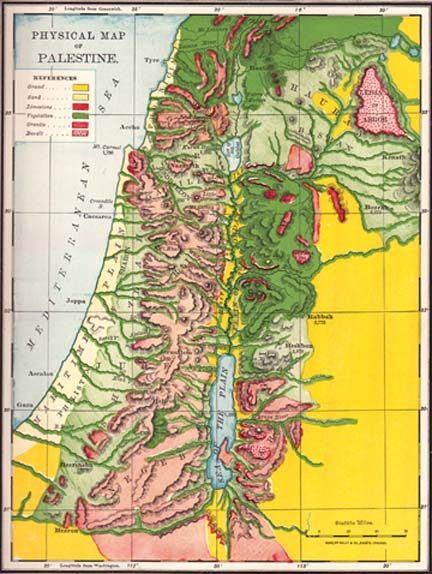
Leaves from an old Bible Atlas #8


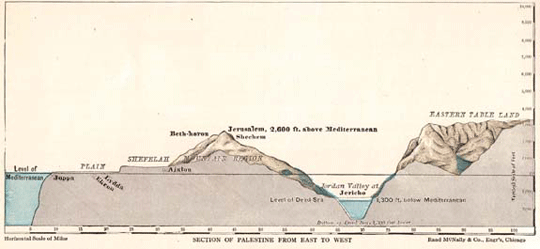
Hurlbutt’s Atlas, p. 16

The Christian fascination with the Holy Land as a window into interpretation of the Bible has a long and indeed fascinating history of its own. Here I continue the thread on Jesse Lyman Hurlbutt’s A Bible Atlas (New York: Rand McNally & Company, 1947, first published in 1882). Hurlbutt includes two diagrams showing cross-sections across Palestine. That shown above is an east-west transect, showing the Dead Sea level at 1,300 feet below sea level. These were indeed better times, more than a century ago. Today the Dead Sea has dropped at least another 85 feet and continues at an alarming rate. The north-south transect is shown below. In order to be able to read it here, I have split it, but originally it was a single horizontal diagram. Continue reading Leaves from an old Bible Atlas #8

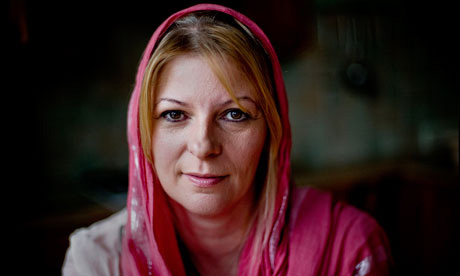
Lauren Booth on Lauren Booth


I’m now a Muslim. Why all the shock and horror?

by Lauren Booth. The Guardian, November 3, 2010

It is five years since my first visit to Palestine. And when I arrived in the region, to work alongside charities in Gaza and the West Bank, I took with me the swagger of condescension that all white middle-class women (secretly or outwardly) hold towards poor Muslim women, women I presumed would be little more than black-robed blobs, silent in my peripheral vision. As a western woman with all my freedoms, I expected to deal professionally with men alone. After all, that’s what the Muslim world is all about, right?

This week’s screams of faux horror from fellow columnists on hearing of my conversion to Islam prove that this remains the stereotypical view regarding half a billion women currently practising Islam.

On my first trip to Ramallah, and many subsequent visits to Palestine, Egypt, Jordan and Lebanon, I did indeed deal with men in power. And, dear reader, one or two of them even had those scary beards we see on news bulletins from far-flung places we’ve bombed to smithereens. Surprisingly (for me) I also began to deal with a lot of women of all ages, in all manner of head coverings, who also held positions of power. Believe it or not, Muslim women can be educated, work the same deadly hours we do, and even boss their husbands about in front of his friends until he leaves the room in a huff to go and finish making the dinner. Continue reading Lauren Booth on Lauren Booth

Leaves from an old Bible Atlas #7


Hurlbutt’s Atlas, p. 137


Hurlbutt’s Atlas, p. 133

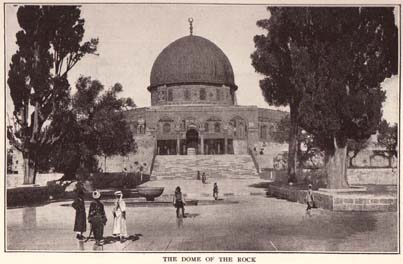
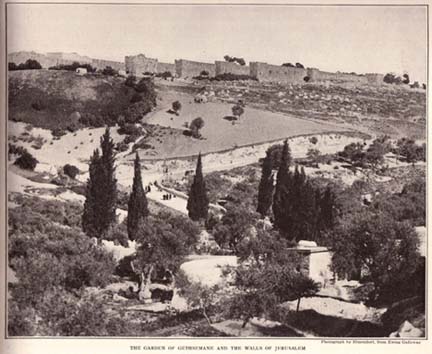
The Christian fascination with the Holy Land as a window into interpretation of the Bible has a long and indeed fascinating history of its own. Here I continue the thread on Jesse Lyman Hurlbutt’s A Bible Atlas (New York: Rand McNally & Company, 1947, first published in 1882). As might be expected, a large part of the atlas is devoted to Jerusalem. Here are two century old pictures, one of the Dome of the Rock and the other a view of the Garden of Gethsemane looking toward an uncluttered landscape beneath the old city walls of Jerusalem.