Category Archives: Books You Should Read

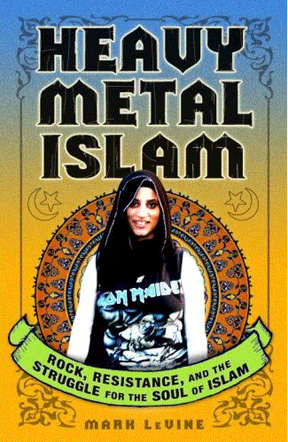
Muslim Metal

Muslim Metal
Bands crank up multiculturalism in the Islamic world

By MARK LEVINE, The Chronicle Review, July 4, 2008

The first time I heard the words “heavy metal” and “Islam” in the same sentence, I was confused, to say the least. It was around 5 p.m. on a hot July day in the city of Fez, Morocco. I was at the bar of a five-star hotel with a group of friends having a drink — at $25 a piece, only one — to celebrate a birthday. The person sitting across from me described a punk performance he had seen in Rabat not long before we had met.

The idea of a young Moroccan with a Mohawk and a Scottish kilt almost caused me to spill my drink. That the possibility of a Muslim heavy-metal scene came as a total surprise to me only underscored how much I still had to learn about Morocco, and the Muslim world more broadly, even after a dozen years studying it, and traveling and living across it. If there could be such a thing as a heavy-metal Islam, I thought, then perhaps the future was far brighter than most observers of the Muslim world imagined less than a year after September 11, 2001. Continue reading Muslim Metal
A Secular State Must Deliver

by Mohammed Bamyeh, The Immanent Flame, SSRC Blogs, June 20, 2008

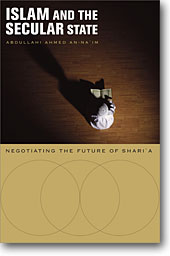
It is hard to disagree with the main arguments of Abdullahi an-Na’im’s impeccable book: a healthy religious life requires a secular state, even as political life may remain infused with the religious values of the population. And the historical examples provide added credence to the point. An Islamic state as such never existed historically, even though pre-modern states cannot be regarded as secular in the contemporary sense of the word. But there has never been a state in Islamic history that fused entirely religious and political authority after Muhammad, and it is far from obvious that Muhammad’s own Medina community constituted a state or was meant as a model for any state. All states in Islamic history had a more clearly defined political than religious character, even as they used religion for their purposes or were expected to fulfill some religious roles. In effect, they were political entities that survived to the extent that they accommodated themselves to the diversity (including legal diversity) of Islam and other local traditions. Colonial rule is to blame for rigidifying the sense of what Islam meant, namely by codifying diverse, flexible religious traditions into standard legal formats and ignoring the fluidity of communal boundaries between Muslims and non-Muslims. However, this rigid colonial perspective on the meaning of religiosity and identity was inherited by contemporary Islamic political movements and states claiming to be Islamic. Continue reading A Secular State Must Deliver

A Course on the Collision Course

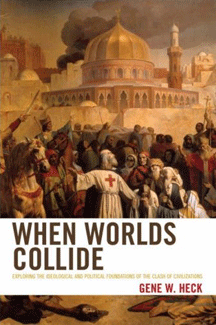
[The aftermath of 9/11 has yielded a stream of books on Islam and violence, so much so that it is rare to find a book about Islam that does not tackle the issue one way or the other. Part of this is due to media promotion of books like Bernard Lewis’s What Went Wrong? and the neocon mantra borrowed from Samuel Huntington’s Clash of Civilizations thesis. A refreshing rejoinder to all this clash talk is provided by Gene Heck in his recent When Worlds Collide: Exploring the Ideological and Political Foundations of the Clash of Civilizations. Here is an excerpt from his Introduction. Webshaykh]

What are the Causes of Modern Middle East Terror?

5. That the so-called Wahhabi movement is often unjustly maligned for alleged doctrines and precepts that do not comport with the actual teachings of the movement’s eighteenth-century founder, Muhammad ibn ‘Abd al-Wahhab, who advocated jihad by peaceful, not militant, means. Continue reading A Course on the Collision Course

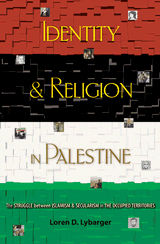
Identity and Religion in Palestine

Identity and Religion in Palestine: The Struggle between Islamism and Secularism in the Occupied Territories by Loren Lybarger (Princeton: Princeton University Press, 2007)

This remarkable book examines how the Islamist movement and its competition with secular-nationalist factions have transformed the identities of ordinary Palestinians since the first Palestinian uprising, or intifada, of the late 1980s. Drawing upon his years living in the region and more than eighty in-depth interviews, Loren Lybarger offers a riveting account of how activists within a society divided by religion, politics, class, age, and region have forged new identities in response to shifting conditions of occupation, peace negotiations, and the fragmentation of Palestinian life. Continue reading Identity and Religion in Palestine

Introducing “Reading Orientalism”


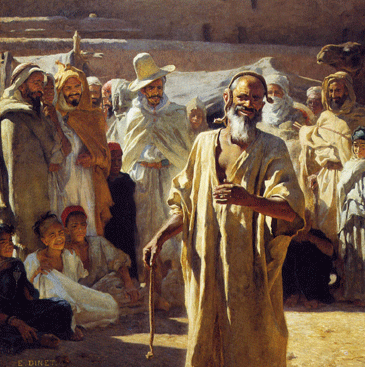
The Snake Charmer, Etienne Dinet, 1889


Last November I published Reading Orientalism: Said and the Unsaid with the University of Washington Press. The issues surrounding “Orientalism” and the legacy of Edward Said’s corpus are ongoing, but much of the debate still centers on personalities rather than pragmatic assessment of the complex intertwining of ethnocentrism, racism and sexism that extends far beyond anything imagined as an “Orient” or a “West.” Here is part of the introductory note to my book.

To the Reader

As an intellectual, I feel challenged by the theoretical incoherence; I feel driven to strive for an answer that, if it has not yet attained universal validity, will at least have transcended the evident limitations of the dichotomized past. Wilfred Cantwell Smith

And is it not further tribute to his triumph to see more clearly what he was battling? Maria Rosa Menocal

You have before you two books about one book.

The one book is Edward Said’s Orientalism, a copy of which should preferably be read before and after you tackle my critical engagement with this powerful text and the ongoing debate over it. More than a quarter century after its first publication, Orientalism remains a milestone in critical theory. Yet, as the years go by, it survives more as an essential source to cite rather than a polemical text in need of thorough and open-minded reading. I offer a commentary, not a new sacred text. Continue reading Introducing “Reading Orientalism”

Another Arabesque: Arabs in Brazil

North American to release book about Arabs in Brazil

John Tofik Karam, a grandson of Lebanese born in the United States, should release up to the end of the year, in Brazil, book ‘Another Arabesque’. The work is on the valuation of the Arab tradesman in the country in the late 20th century. To write the book, initially a master’s degree thesis, he was in Brazil for over a year.

Isaura Daniel, ANBA, Brazil-Arab News Agency, 3/26/2008

São Paulo – The North American John Tofik Karam, of Lebanese origin, is going to release in Brazil his book “Another Arabesque” through Martins Editora publishing house. The work is the result of a doctoral thesis that Karam worked on about the Arab community in Brazil and shows the valuation of the Arabs in the late 20th century.

“It shows the greater visibility that the Arabs got during the neoliberal phase,” explained Karam in a telephone interview to ANBA. According to the Lebanese descendant, up to the middle of the 20th century, Arabs were marginalized due to the stereotype of good businessman, always wanting the greatest possible gain in trade. “This idea suddenly became an advantage in the neoliberal phase,” he said. Continue reading Another Arabesque: Arabs in Brazil

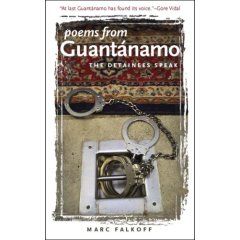
Poems from Guantánamo

Poems from Guantánamo: The Detainees Speak is a short but provocative book of poems from several of the detainees held at Guantánamo Bay. Much has been written about the legal issues and violations of human rights, but here we can hear the silenced voices of those dehumanized in detention without access to justice. Here is one of the poems:

Death Poem
by Jumah Al Dossari

Take my blood.
Take my death shroud and
The remnants of my body.
Take photographs of my corpse at the grave, lonely.

Send them to the world,
To the judges and
To the people of conscience.
Send them to the principled men and the fair-minded.

And let them bear the guilty burden, before the world,
Of this innocent soul.
Let them bear the burden, before their children and before history,
Of this wasted, sinless soul.
Of this soul which has suffered at the hands of the “protectors of peace.”

Jumah al Dossari, a thirty-three-year-old Bahraini national, is the father of a young daughter. He has been held at Guantánamo Bay for more than five years. In addition to being detained without charge or trial, Dossari has been subjected to a range of physical and psychological abuses, some of which are detailed in Inside the Wire, an account of the Guantánamo prison by former military intelligence soldier Erik Saar. He has been held in solitary confinement since the end of 2003 and, according to the U.S. military, has tried to kill himself twelve times while in the prison. On one occasion, he was found by his lawyer, hanging by his neck nd bleeding from a gash to his arm.

Marranci on the Anthropology of Islam

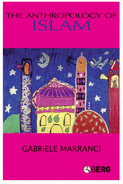
Note: The following is an excerpt from Gabriele Marranci’s latest book, The Anthropology of Islam (Oxford: Berg, 2008), which is well worth reading for insights on previous ethnographic study of Islam and guidelines for current research.

Books and ‘how-to’ guides about anthropological fieldwork are increasing in number within publishers’ catalogues. Among this large production, it is unusual to find even even chapters addressing the experience of conducting fieldwork among Muslim societies and communities. In the few cases in which some examples have been provided, they describe and discuss what I call ‘exotic’ fieldwork. Even less available is material containing reflections on the impact and issues that an anthropologist may face in conducting fieldwork within Muslim communities, in the west and in Islamic countries, during this endless ‘war on terror’. In this chapter, I have tried to start a reflection and discussion on what it means to conduct fieldwork among Muslims today. In doing so, I have provided examples from the experience of some anthropologists as well as my own. I have suggested that at the centre of a contemporary anthropology of Islam should be the human being even before the Muslim. This is vital if we wish to overcome a certain Orientalism and suppression of self-represented identities, as we can observe in classic works, from Geertz to Rabinow and Gellner. Continue reading Marranci on the Anthropology of Islam