Category Archives: Iran

Arabian Humanities Online


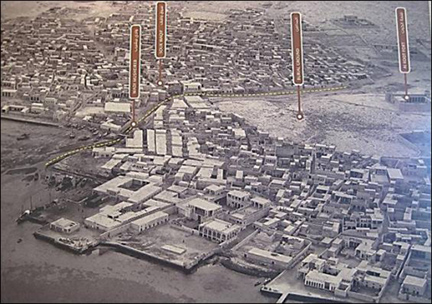
Urban structure of Doha until the 1960s; Source: Scharfenort 2012 (Exhibition in Msheireb Enrichment Center)

The second issue of the new journal Arabian Humanities, with selections in both English and French, is now available online here.

The table of contents is reproduced below:

Juliette Honvault
Éditorial
Villes et dynamiques urbaines en péninsule Arabique
Cities and Urban Dynamics in the Arabian Peninsula

Claire Beaugrand, Amélie Le Renard et Roman Stadnicki
Au-delà de la Skyline : des villes en transformation dans la péninsule Arabique [Texte intégral]
Beyond the Skyline: Cities in Transformation in the Arabian Peninsula [Texte intégral | traduction]

Nelida Fuccaro
Preface: Urban Studies in the Arabian Peninsula: 6 Thoughts on the Field [Texte intégral]
Préface : Les études urbaines en péninsule Arabique
1. Croissances, politiques et projets
Growth paths, politics and projects

Brigitte Dumortier
Ras al‑Khaïmah, l’essor récent d’une ville moyenne du Golfe [Texte intégral]
Ras al‑Khaimah : the recent dynamics of a middle size city of the Arab‑Persian Gulf

Steffen Wippel
Développement et fragmentation d’une ville moyenne en cours de mondialisation : le cas de Salalah (Oman) [Texte intégral]
Development and Fragmentation of a Globalizing Secondary City: The Case of Salalah (Oman)

Sebastian Maisel
The Transformation of ‘Unayza: Where is the “Paris of Najd” today? [Texte intégral]
La transformation de ‘Unayza : où en est le « Paris du Najd » ?
Philippe Cadène
Koweït City : planification urbaine et stratégie régionale [Texte intégral]
Kuwait City: Urban Planning and Regional Strategy Continue reading Arabian Humanities Online
Pass the Pistacios

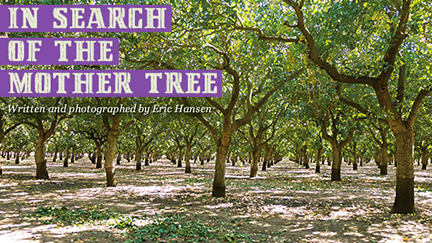
In the current issue of ARAMCO World, which is available free online, there is an interesting article on how Iranian pistacios came to California. Click here for the full article. I attach a teaser below…

In 1957, a small experimental orchard in Chico, California distributed to commercial nut-growers a promising new variety of pistachio tree from Iran, called Kerman.

The United States Department of Agriculture wanted to see how these Kerman trees might perform in the richly fertile Central Valley of California.

By 2013, the Kerman had created a billion-dollar agricultural industry, and what was once a delicacy was a long way toward becoming a common household snack. University of California pistachio specialist Louise Ferguson calls the California Kerman pistachio tree “the single most successful plant introduction of the 20th century.”

Women picturing women


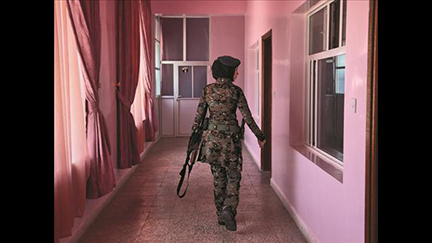
A lieutenant in the elite female counterterrorism unit patrols the women’s barracks in Sanaa, Yemen. Photo from the “Women of Vision” exhibit. Photography by Stephanie Sinclair

Associated Press, WASHINGTON (AP) – The National Geographic Museum in Washington has a new exhibit featuring the photography of 11 award-winning female photojournalists.

The exhibit is kicking off a three-year tour for “Women of Vision: National Geographic Photographers on Assignment.” It features nearly 100 photographs depicting a variety of cultures and topics. The exhibit is on view in Washington until March 9.

The photographers tackled subjects ranging from memory and teenage brain chemistry to social issues like child marriage and modern-day slavery. Visitors will also see how National Geographic magazine photo editors work with photographers to select images to tell a story.

The photographers featured in the exhibit are: Lynsey Addario, Kitra Cahana, Jodi Cobb, Diane Cook, Carolyn Drake, Lynn Johnson, Beverly Joubert, Erika Larsen, Stephanie Sinclair, Maggie Steber and Amy Toensing.


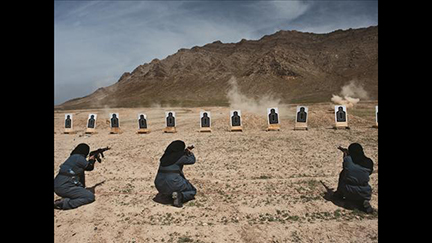
Women – mostly widows – train for police force jobs at a firing range near Kabul, Afghanistan. Photo from the “Women of Vision” exhibit. Photography by Lynsey Addario

For all the pictures, click here:

CyberOrient, Latest Issue Online

The latest issue of CyberOrient is available online.

Articles

Online and Offline Continuities, Community and Agency on the Internet
Jon W. Anderson
http://www.cyberorient.net/article.do?articleId=8355

The Earth Is Your Mosque (and Everyone Else’s Too): Online Muslim
Environmentalism and Interfaith Collaboration in UK and Singapore
Lisa Siobhan Irving
http://www.cyberorient.net/article.do?articleId=8336

Telling the Truth about Islam? Apostasy Narratives and Representations
of Islam on WikiIslam.net
Daniel Enstedt and Göran Larsson
http://www.cyberorient.net/article.do?articleId=8459

Comments

Digital Images and Visions of Jihad: Virtual Orientalism and the
Distorted Lens of Technology
Raymond Pun
http://www.cyberorient.net/article.do?articleId=8391

Reviews

Review: Arabités numériques. Le printemps du Web arabe
Luboš Kropáček
http://www.cyberorient.net/article.do?articleId=8352

Review: Media, Power, and Politics in the Digital Age. The 2009
Presidential Election Uprising in Iran
Zuzana Krihova
http://www.cyberorient.net/article.do?articleId=8386

Review: iMuslims: Rewiring the House of Islam. Islamic Civilization
and Muslim Networks
Vit Sisler
http://www.cyberorient.net/article.do?articleId=8385

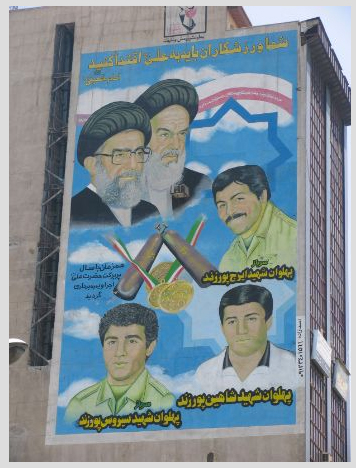
Up against a wall mural


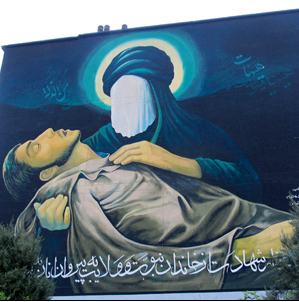
Martyrdom is the inheritance of the Prophet and his family to their followers (translated title). Three-storey high mural located on Mudarris Freeway, Abbas-Abad, Tehran, Iran, Fotini Christia, photographer.

Harvard College Library site. Here are two examples.


“You athletes should follow Ali (peace be upon him)”, Fotini Christia, photographer,

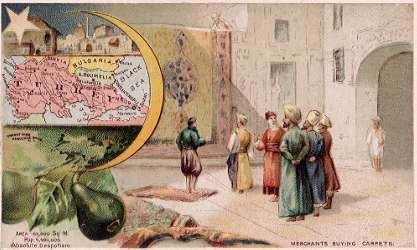
Tabsir Redux: Mocha Musings #3: Turkey and Persia


Area: 63,800 sq. mi
Population: 4,490,000
Government: Absolute Despotism
Scenes: Merchants Buying Carpets

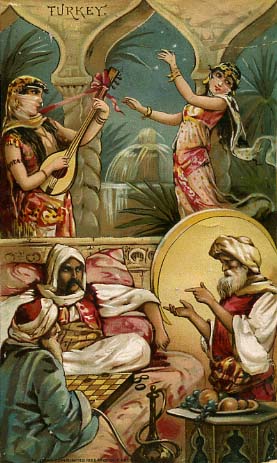
previous post I began a series on coffee advertising cards with Middle Eastern themes. One of the most colorful collections is that provided by the Arbuckle Coffee Company. In my great, great aunt’s album there were several Middle Eastern and North African nations represented, but from a different series than in the Arbuckle’s 1889 series. The 1889 version of Turkey is shown above, but my aunt’s version of Turkey is decidedly more imaginative:

Continue reading Tabsir Redux: Mocha Musings #3: Turkey and Persia

To kiss or not to kiss: Iranian style

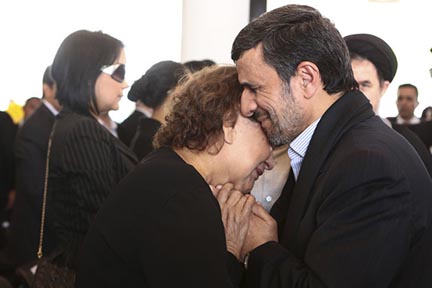
A controversial tempest in a samovar erupted last week when Iran’s President Ahmadenijad appeared to kiss the grieving mother of Hugo Chavez at the state funeral for the Venezuelan leader. The lips do touch the face of Chavez’s mother, but the context suggests an embrace of consolation rather than anything untoward. To the extent this innate human reaction of sympathy is something to be forbidden as unIslamic, religion becomes a mockery. The Muhammad presented in the Sira was a man of compassion. I suspect he would not approve of those who take the charge of modesty to such an extreme as to deny the most basic of positive human instincts.

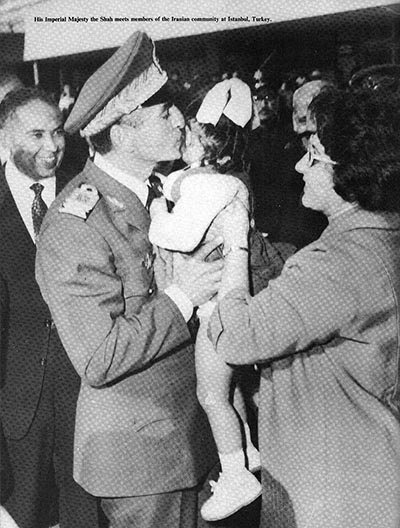
But the controversy over this alleged “kiss” reminded me of an image from a different time in Iran. I have a booklet (Iran Today) issued by the Imperial Iranian Government in the early 1960s, when Lyndon Johnson was still vice-president. This is pure propaganda for the then-young Shah’s Iran. Opposite the Table of Contents, and thus the first image in the booklet, is a full-page spread with the caption: “His Imperial Majesty the Shah meets members of the Iranian community in Istanbul, Turkey.” You will note that this image is the classic politician baby kissing. Obviously, this was seen as a positive side of the ruler who loves his people. What a difference half a century makes in the interpretation of a kiss.

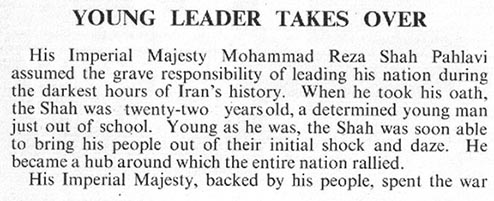
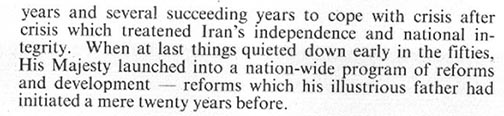
The propaganda aspect of the booklet is most evident in the unflinching praise for the Shah, as can be seen below:

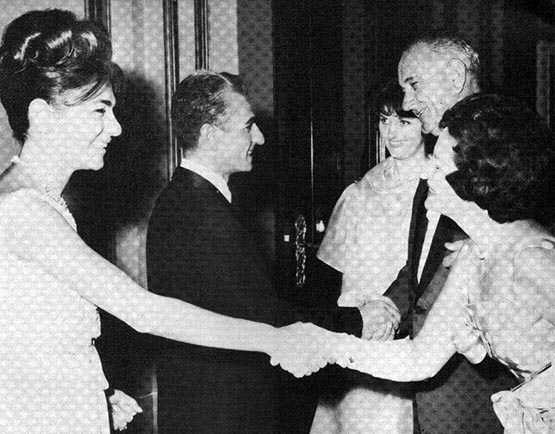
“Their Imperial Majesties the Shah and Queen Farah greet distinguished guests from the United States: Vice President and Mrs. Lyndon Johnson and their daughter, who visited Iran last summer.