Category Archives: Art

Astrolabes and Angels, Epigrams and Enigmas

AN INTRODUCTION TO THE DE REGIO MONTE CODE, CARDINAL BESSARION’S AGENDA, AND PIERO DELLA FRANCESCA’S ENIGMA

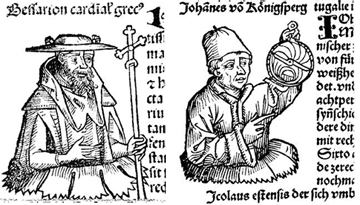
[The noted historian of Islamic science, David A. King, recently retired from his position as Professor of the History of Science at Frankfurt University, has published a new book on two of the most remarkable objects surviving from the Renaissance, one an astrolabe and the other a painting. The connection between the two is described in detail in his new book Astrolabes and Angels, Epigrams and Enigmas – From Regiomontanus’ Acrostic for Cardinal Bessarion to Piero della Francesca’s Flagellation of Christ, Stuttgart: Franz Steiner, 2007. An associated website is http://web.uni-frankfurt.de/fb13/ign/Code.htm.]

Only recently have we achieved a better understanding of two monuments to the intellectual genius of the Renaissance, both of which have caused scholars a lot of trouble over several decades. As it happens, the two are intimately related.
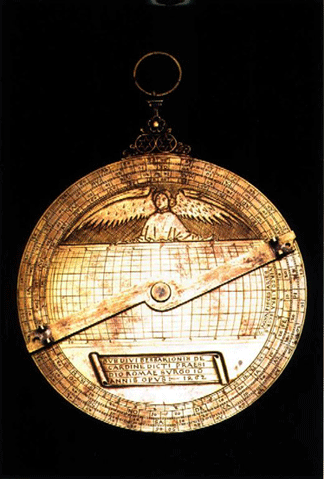

The back of the astrolabe made by Regiomontanus for Cardinal Bessarion, with an inscription or epigram and the image of an angel.

One is an astrolabe, presented to the ageing Greek Cardinal Bessarion in Rome, 1462, by his new protégé, the young German astronomer Regiomontanus. Continue reading Astrolabes and Angels, Epigrams and Enigmas
The Butler Did it in Hebron

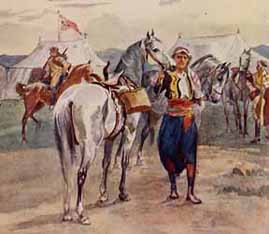
In the late 1890s a certain Elizabeth Butler, accompanying her British military husband, made one of those Protestant-style visits to Anglican nirvana, the Holy Land made somewhat less holy for her at the time by Ottoman Turkish troops. “The time of year chosen by my husband for our visit was one in which no religious festivals were being celebrated, so that we should be spared the sight of that distressing warring of creeds that one regrets at Jerusalem more than anywhere else,” she notes in the preface to her Letters from the Holy Land. Better to go in the off season, it seems, than face the reality of the individual Palestinian Arabs and Jews cluttering the biblical landscape. Her letters, written to her mother “lay no claim to literary worth,” as she humbly and astutely admits. The chief value of the work is, in her own ranking, her 16 color sketches, mostly pastoral pastiche, with the exception of an anonymous Arab attendant, shown here. Continue reading The Butler Did it in Hebron

Book of Curiosities

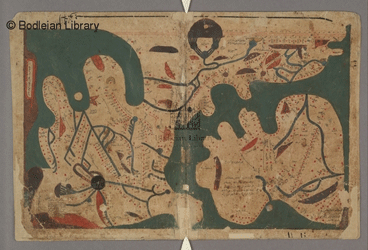
The Bodleian Library in collaboration with The Oriental Institute, University of Oxford, announces the electronic publication of The Book of Curiosities of the Sciences and Marvels for the Eyes, a newly discovered medieval Arabic treatise on the depiction of the Heavens and the Earth. The treatise is one of the most important recent finds in the history of Islamic cartography in particular, and for the history of pre-modern cartography in general. The publication of the treatise is mounted on a dedicated website employing a new method for publishing medieval maps. Continue reading Book of Curiosities

The Book Of Death #28


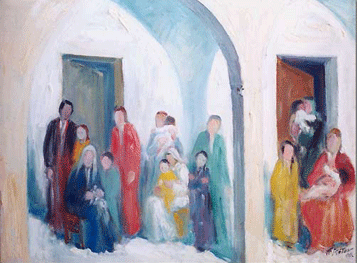
[Illustration: “Refugees” by Palestinian artisit Ibrahim Hijazy, 1996.]

by George El-Hage

Today, the seventh day of the month of Death, I decided to end our relationship. I decided to pack my suitcase and leave. Everything in our spring-like room I left for you: the velvet drapes, old books, notebooks of memories and red roses. All the silk pillows, and the ivory chairs, and the chandelier of carnations, the big bed in the other corner of the room remain for you. I took with me one bleeding suitcase which is my heart. It was so filled with surprise and sorrow that I did not have room for one little pencil. I left empty-handed except for an armful of ashes. I held dejection to my breast, the harvest of a full year of love. I embraced it with anguish and washed its forehead with dew from my eyes. Continue reading The Book Of Death #28

Napoleon Tried It: He Failed


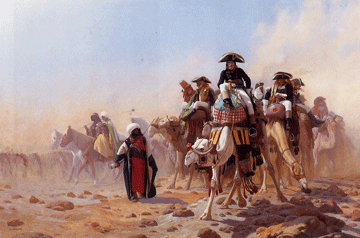
Illustration: “Napoleon and his General Staff in Egypt” by Jean-Léon Geróme, 1867

In 1798 the French leader Napoleon, a seemingly mature 28 year old at the time, set off from France with a fleet of 400 ships and 36,000 men. The goal was to conquer Egypt and “liberate” it from the corrupt Mamluk overlords. No CNN or BBC reporters were around; nor had al-Jazeera set up a satellite feed. It did not take long for the French to overwhelm the Egyptians with about 25,000 French against 15,000 local Mamluks. Napoleon won in sight of the Pyramids, but very soon after the entire mission was doomed to failure when Lord Nelson obliterated the French fleet. Napoleon himself left Cairo secretly a year later, returned to France and turned his conquest machine against fellow Europeans.
Continue reading Napoleon Tried It: He Failed

Headless in Saudi Arabia

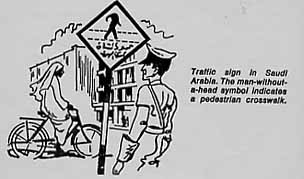
[”Traffic sign in Saudi Arabia. The man-without-a-head symbol indicates a pedestrian sidewalk.”]

I recently came across a rather plebian junior high school level text on The Middle East: History, Culture, People (by Thomas G. Kavunedos and Harold E. Hammond, Bronxville, New York, Cambridge Book Company, Inc, 1968). The book is quite forgetable, but some of the illustrations bring you to a full stop. My favorite is the illustration above. If indeed this was once the sign for a crosswalk, no wonder everyone seems to drive Mercedes in the kingdom.

Daniel Martin Varisco