
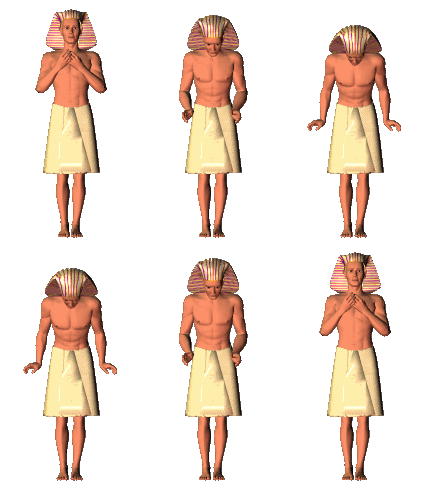
If you like animations for your web pages and you also like Egypt, ancient or modern, you will enjoy the Egyptian Animations webpage on Heather’s Animations.
If you like animations for your web pages and you also like Egypt, ancient or modern, you will enjoy the Egyptian Animations webpage on Heather’s Animations.
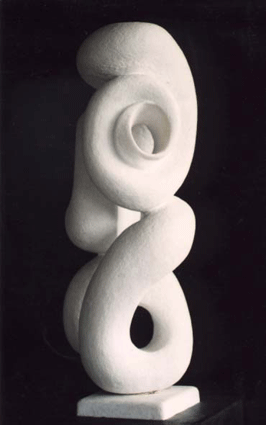
Spiritus, by Sami Rifai, Lebanon, Micheal-Angelo white Marble, 133x40x40 cmby, 1988
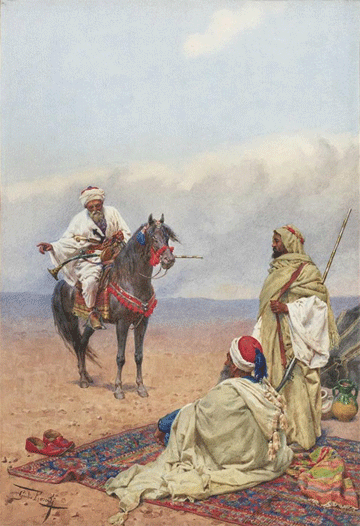
A Horseman Stopping at a Bedouin Camp, Giulio Rosati , 1858 – 1917
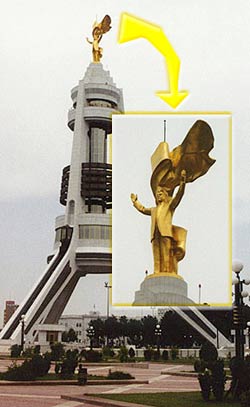
Statue of Saparmurat Niyazov, Turkmenistan’s former president, soon to be removed
by By DAVID L. STERN, The New York Times, May 5, 2008
ALMATY, Kazakhstan — A 246-foot tall, rocket ship-like monument to the late ruler of Turkmenistan, topped with a golden statue of himself that rotates to always face the sun, will be removed from the center of the Turkmen capital, state news media there have reported.
A decision by President Gurbanguly Berdymukhammedov to move the monument was his latest step in dismantling the personality cult of Saparmurat Niyazov, whose often bizarre decrees turned the isolated, energy-rich country into the punch line of a bad international joke.
The president had already reversed Mr. Niyazov’s order renaming the days of the week and months of the year in honor of himself and his family. He had also ended the bans on opera, ballet and the circus, which Mr. Niyazov had decreed un-Turkmen, and lifted restrictions on the Internet. Continue reading A Turkmen Dismantles Reminders of Old Ruler
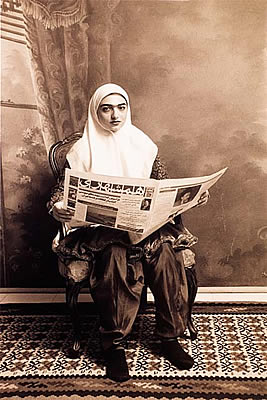
Shadi Ghadrian
Untitled (Qajar Series), 1998
Silver bromide print, Los Angeles County Museum of Art.
Shadi Ghadirian (Iran, b. 1974), who works in the medium of photography, uses her art to express herself as an Iranian and as a woman. Ghadirian’s best-known body of work, the Qajar Series, was inspired by nineteenth-century studio portraits of women depicted in the fashion of the day: thick, black eyebrows; headscarves; and short skirts worn over baggy trousers. In order to re-create the earlier photographic settings, Ghadirian employed painted backdrops and dressed her models in vintage clothing from the late 1800s. She added modern objects to these traditional scenes, such as a Pepsi can, a boom box, or, as in these two images (figs. 61, 62), a bicycle and an avant-garde Tehran newspaper. She has said of her work, “My pictures became a mirror reflecting how I felt: we are stuck between tradition and modernity.â€
For the full exhibit on Islamic Art at the Los Angeles Museum of Art, click here.
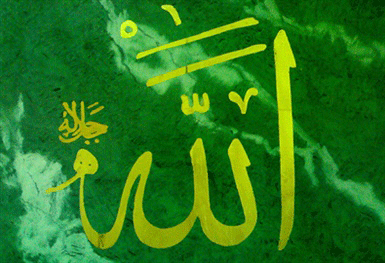
“O Children of Adam: Beautify yourselves for every act of worship, and eat and drink [freely], but do not waste: truly, He loves not the wasteful.†(Qur’an: 7:31)
by Ayesha Mattu for Religion Dispatches, April 22, 2008
In Islamic tradition it is considered that humans were created as khalifas (trustees) of the earth and of its animal, mineral and plant resources. As caretakers, it is said, we may utilize these resources as long as we respect the balance that must be maintained in all aspects of our lives –spiritual, physical and mental.
There is extensive support for environmental protection in Islamic theology – from the Prophet Muhammad’s self-practice and repeated exhortations to plant trees or to not waste water, to the stern limitations on military engagement stating that civilians, animals, trees and water sources were not to be harmed. And this theology was regularly put into official practice over the centuries. As American Muslim scholar Zaid Shakir has said: “The protection of natural habitat, the well-being of animals, and related responsibilities were often overseen by appointed officials, members of the world’s first environmental protection agencies.â€
Dr. Derek Wall of the UK’s Green Party has remarked (in an article for the UK’s Guardian titled “Green Islam”) that contemporary Muslim scholars like George Washington University’s Seyyed Hossein Nasr have been advocating Islamic environmentalism since the 1970s while Swiss academic Tariq Ramadan has been evolving a thoughtful understanding of “spiritual ecologyâ€.
Some might say, rightly, that our green legacy has been forgotten as the race to industrialization has created environmental devastation and dead zones in more- and less-developed countries alike. Some may even suspect the environmental movement of being another Western initiative to impede the progress of Muslim nations. In spite of this, we are beginning to see Muslim community-based organizations in the global North and non-governmental organizations in the global South reviving these deep-rooted green practices in a manner informed both by modern realities and Islamic principles.
For the rest of this article, click here.
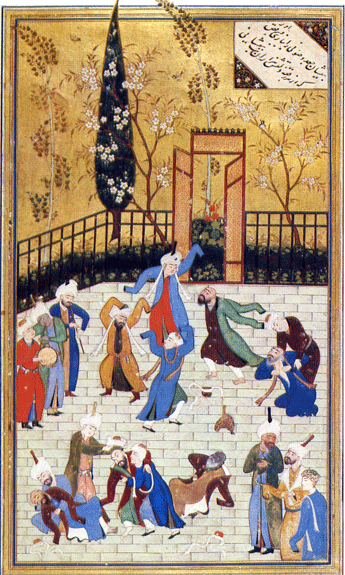
Scene from the Divan of Hafiz, Herat School, 1523, Freer Gallery of Art, Washington, D.C.
O beautiful wine-bearer, bring forth the cup and put it to my lips
Path of love seemed easy at first, what came was many hardships.
With its perfume, the morning breeze unlocks those beautiful locks
The curl of those dark ringlets, many hearts to shreds strips.
In the house of my Beloved, how can I enjoy the feast
Since the church bells call the call that for pilgrimage equips.
With wine color your robe, one of the old Magi’s best tips
Trust in this traveler’s tips, who knows of many paths and trips.
The dark midnight, fearful waves, and the tempestuous whirlpool
How can he know of our state, while ports house his unladen ships.
I followed my own path of love, and now I am in bad repute
How can a secret remain veiled, if from every tongue it drips?
If His presence you seek, Hafiz, then why yourself eclipse?
Stick to the One you know, let go of imaginary trips.
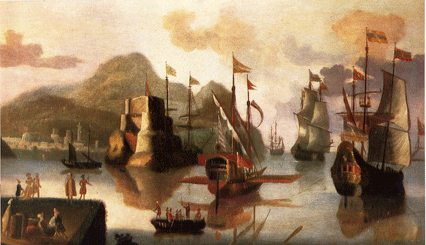
Muscat Harbor, ca 1677, attributed to the Flemish painter Jan Peeters (1624-ca 1677)