Category Archives: Art

Lithographica Arabica 1


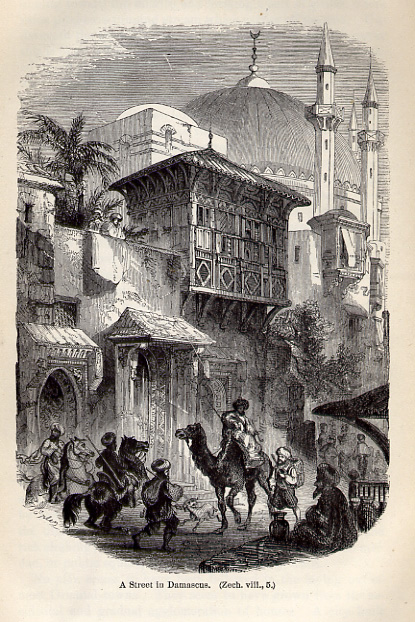
“A Street in Damascus” from Bible Lands by Henry Van-Lennep, 1875, p. 456

Watching vivid color, cable television on an HD screen obscures the art of old black and white movies, which were once able to conjure up fantasies in black, white and shades of gray. Glancing at glossy National Geographic photographs similarly buries further into the archived past all those simple lithographic line drawings storehoused in 19th century travel accounts, Orientalist writings and Bible Custom compendiums. I admire the fruits of progress, but the nostalgia for reaching back into the museum of my book-reading memories demands equal time.

For those who share the tactile thrill of fingers thumbing through brown-edged paper and caressing delicate bindings of century-plus-old books, I dedicate a new theme on Tabsir devoted to the art of lithographic representation of the Middle East. Lithographica Arabica — long live the line drawings and antiquated woodcuts of bibliophilic bliss. Continue reading Lithographica Arabica 1
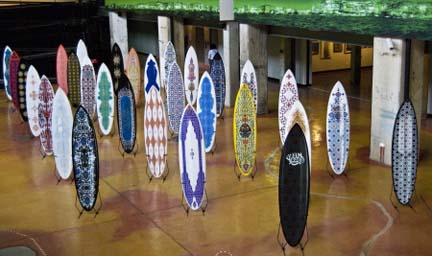
Surfs Up Da’wa

Sydney art fuses surf with Islam

By Nick Bryant, BBC News, Sydney, December 6, 2008

An Australian artist has produced a range of Islamic surfboards in an attempt to create a greater understanding between East and West.

Phillip George was inspired by his trips to the Middle East and by riots in 2005 when Lebanese Australians were targeted on a beach in Sydney.

He has called the range the Inshallah – or God Willing – surfboards and has put them on exhibition in Sydney.

There are 30 surfboards in all, each adorned with intricate Islamic motifs. Continue reading Surfs Up Da’wa

Art Against Reason

M.Y. ART PROSPECTS is pleased to present Against Reason, a solo exhibition by Emna Zghal.

December 11 – January 17, 2009 | Opening Reception December 11, 6-8PM

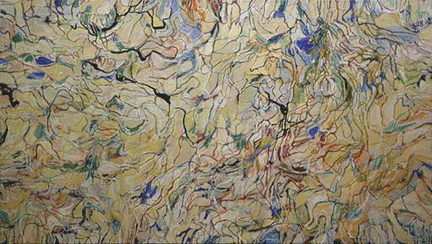
Against Reason features Zghal’s latest oil paintings with a smaller selection of prints and watercolors. Drawn from lyrical forms found in nature, she uses a wide spectrum of tones and minute strokes to create highly conceptual, abstract pieces. Turning away from contemporary conventions, she rigorously pursues her idiosyncratic themes of abandonment, lostness, and bewilderment.

Zghal is moved by the brilliant colors of a garden, the subdued beauty of a forest, the reflections within moving water. Her work brings to mind the abstractions of Lee Krasner and Joan Mitchell, particularly in her use of repetitive, swirling strokes with careful but unstrained release of color. Continue reading Art Against Reason

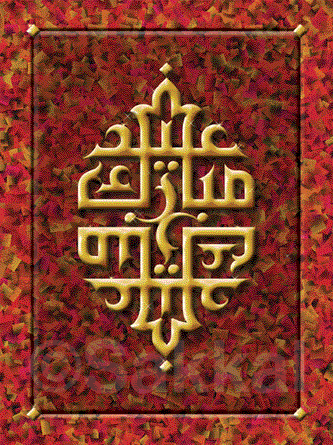
Eid Mubarak


Source: Sakkal Designs

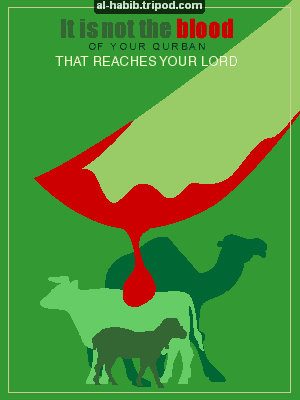
Looking for online Eid e-cards? Here are a few sites worth looking at:

123 Greetings

Eid E-Cards

afary.com

alhabib


Source: http://al-habib.tripod.com/islamic-greeting-card/card_adha.htm

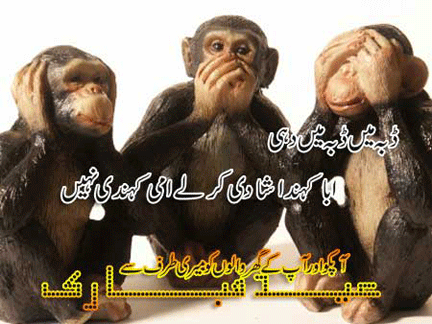
There are some fascinating eid cards available online, some of which go far beyond images of Mecca and roses. The strangest I have found thus far is at photofurl.com:

I am tempted to say that the artist was just monkeying around in Photoshop, but as an anthropologist I would have to stop myself and admit that these are in fact three apes…

If anyone has other interesting examples of eid e-cards, please send information about them along or post the urls here in the comment section.

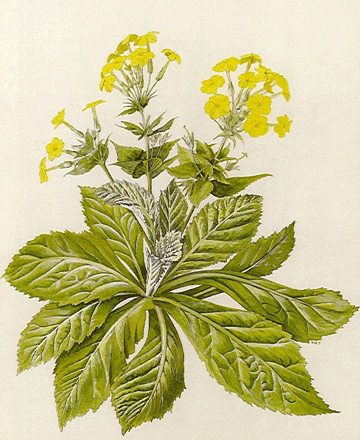
Flora primulaceae


Drawing of a Yemeni primula plant by Hugo Haig-Thomas

Hugo Haig-Thomas–A Biography of a Special Artist
Painter and Diplomat of Her Majesty Queen Elizabeth II. of Great Britain

By John Gilbert Bodenstein, President of The European Art Foundation

It is a pleasure to read the biography of Hugo Haig-Thomas, a special artist of our time. Some artists combine their creative activity with a normal career. In Germany Johann Wolfgang Goethe, for example, produced some of his literary works whilst holding an appointment which occupied him during the day. In France the German writer Rainer Maria Rilke was secretary to the sculptor Auguste Rodin. And the famous European author Ernst Juenger was an officer in both World Wars.

Haig-Thomas likewise was for a number of years a member of Her Majesty’s Diplomatic Service, but throughout his service he continued to paint and draw. Continue reading Flora primulaceae

Introducing “Reading Orientalism”


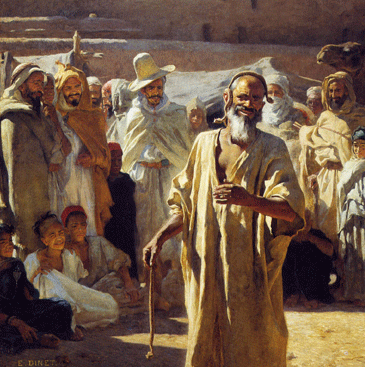
The Snake Charmer, Etienne Dinet, 1889


Last November I published Reading Orientalism: Said and the Unsaid with the University of Washington Press. The issues surrounding “Orientalism” and the legacy of Edward Said’s corpus are ongoing, but much of the debate still centers on personalities rather than pragmatic assessment of the complex intertwining of ethnocentrism, racism and sexism that extends far beyond anything imagined as an “Orient” or a “West.” Here is part of the introductory note to my book.

To the Reader

As an intellectual, I feel challenged by the theoretical incoherence; I feel driven to strive for an answer that, if it has not yet attained universal validity, will at least have transcended the evident limitations of the dichotomized past. Wilfred Cantwell Smith

And is it not further tribute to his triumph to see more clearly what he was battling? Maria Rosa Menocal

You have before you two books about one book.

The one book is Edward Said’s Orientalism, a copy of which should preferably be read before and after you tackle my critical engagement with this powerful text and the ongoing debate over it. More than a quarter century after its first publication, Orientalism remains a milestone in critical theory. Yet, as the years go by, it survives more as an essential source to cite rather than a polemical text in need of thorough and open-minded reading. I offer a commentary, not a new sacred text. Continue reading Introducing “Reading Orientalism”