Category Archives: Art

Picturing the Exodus

The ubiquity of GPS threatens to leave the old printed map out of the picture. This is a pity, for there is much to be learned from the way maps frame the world. As J. Z. Smith once remarked, map is not territory. True enough, but maps are the way we imagine not only territory but our place in it. When Edward Said wrote his critique of Orientalism in 1978, he cited novelists, travelers, poets and academics, but no mapmakers. But in a way Holy Land maps are what put the Holy Land on the map. Maps not only illustrated what was thought to be the lay of the land, but what people imagined was there.

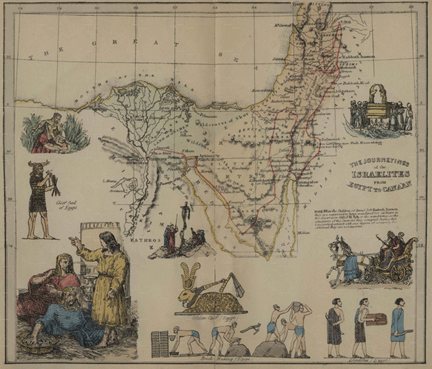
A splendid example of this is an 1856 pictorial Bible map of the Journey of the Israelites from Egypt to Canaan. I reproduce the image above, but if you
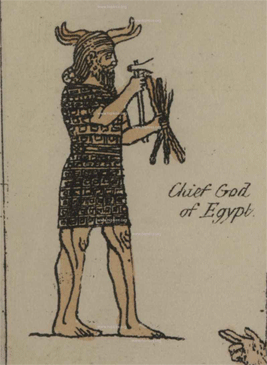
click here you can get a greatly enlarged view to see the details. Mind you, this was 1856, when few of the archeological discoveries in Bible territory had come to light. This is evident in the depiction of the “Chief God of Egypt,” (left side of map) who looks like a cross between an Assyrian and a Viking.
Continue reading Picturing the Exodus

Lithographica Arabica 3: Druse Girl


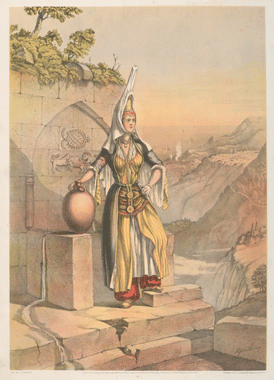
“Druse Girl”(1862) drawn by Henry J. Van-Lennep, Henry J. (1815-1889), Lithographer,
C. Parsons; Printer of plates, W. Endicott & Co. From “The Oriental Album: Twenty Illustrations, in oil colors, of the people and scenery of Turkey, with an explanatory and descriptive text.” By Rev. Henry J. Van Lennep. Online in NYPL Digital Gallery.

For Lithographica Arabica #2, click here.

Islamic Art at the Freer


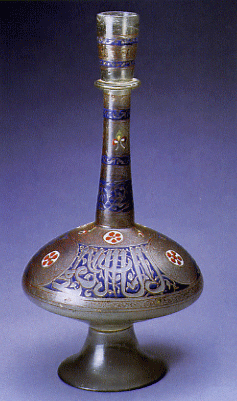
Bottle made for the Yemeni Rasulid Sultan al-Malik al-Mujahid ‘Ali ibn Dawud,
Freer Gallery of Art, Washington, DC.

One of my favorite haunts in Washington DC is the Freer Gallery of Art, part of the Smithsonian row. It boasts an extraordinary collection of Islamic art, well worth viewing and reviewing. But why wait until a trip to Washington, unless you are still braving the leftover throngs at the upcoming inaugural? The Freer’s website hosts high-quality images of many of the objects in its collection. As a Yemenophile, one of my favorites is a beautiful glass bottle made for the Yemeni Rasulid sultan al-Malik al-Mujahid ‘Ali ibn Dawud, who reigned from 1322-1363. The bottle was crafted in Syria and is “enameled and gilt colorless honey-tinted glass” (Rosamond E. Mack, Bazaar to Piazza: Islamic Trade and Italian Art, 1300-1600, Berkeley: University of California Press, 2002, p. 118).

Entitled to consideration and respect


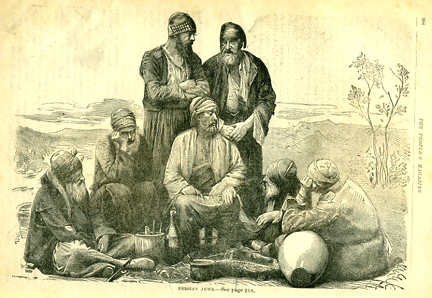
Illustration of “Persian Jews” from the People’s Magazine, 1879

The current fighting in Gaza is a tragedy of Greek dramatic proportions. On the one hand a highly sophisticated military machine wielded at present with Hawkish intent, on the other a ragtag guerilla group bent on lobbing barbs at the Hawk’s fortified lair. And in the middle frightened civilians in a humanitarian nightmare of medieval mindset. The problem is that neither side is really willing to treat the other with consideration and respect. In this unethical tie, of course, the onus must be on the stronger to recognize the limited options of the weaker.

The tragedy does not end with the present loss of life, limb and hope for Gazans. Unfortunately, it overshadows a historical trajectory that created the rise of Zionism as a political ideal in Europe. There is no excuse for the present punishing policies of Israel towards the residents of Gaza. Indeed, it is all the sadder given the sordid history of anti-Semitism in both the Christian-dominated West and Islamic-dominated Near East. Recently I picked up an old magazine from 1879, published exactly 140 years ago. On one page I was struck by the extraordinary pathos of an image of “Persian Jews.” Continue reading Entitled to consideration and respect

Lithographica Arabica 2: An Oriental Cafe


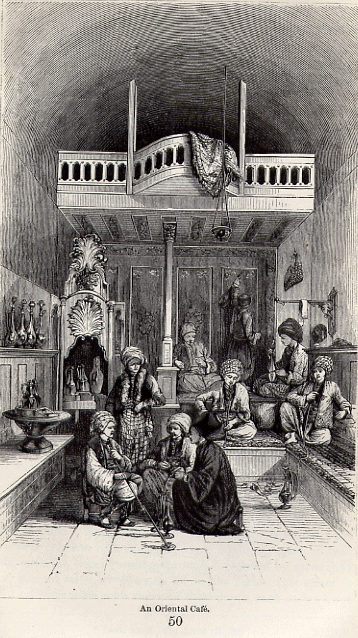
“An Oriental Café” from Bible Lands by Henry Van-Lennep, 1875, p. 779

For those who share the tactile thrill of fingers thumbing through brown-edged paper and caressing delicate bindings of century-plus-old books, I dedicate a new theme on Tabsir devoted to the art of lithographic representation of the Middle East. Lithographica Arabica — long live the line drawings and antiquated woodcuts of bibliophilic bliss.

The café (more properly kahweh) is a nearer approach to Western ideas, and deserves a passing notice, being an important institution of the East. Continue reading Lithographica Arabica 2: An Oriental Cafe

David vs Goliath, the IDF vs Hamas


Lithograph letter illustrating The Child’s Bible Illustrated from a 19th century serial publication.

When the once holy land of Biblical proportions is the issue on the front page of every newspaper, politics must make way for metaphor. The Israeli plan to bring down Hamas echoes with Samson bringing down the temple on the Philistines. Lots of Philistines were killed that memorable day, but only with a martyr’s mentality. Plug in “Gazans” or “Israelis” for “Philistines,’ and the martydom makes both scenarios equally mad. Moving forward in Biblical time, the Philistines did not disappear as a thorn in the side of Israel. Today, well beyond the world of the prophets, the jet fighters and tanks of the IDF have replaced David’s sling, but search as the military scanners may there is no Goliath in modern Gaza. Was Sophocles still writing for the stage, the ongoing Israel/Palestine tragedy would make Oedipus Rex look like Twelfth Night. How unbiblical a thought. Continue reading David vs Goliath, the IDF vs Hamas

The flower that made men mad


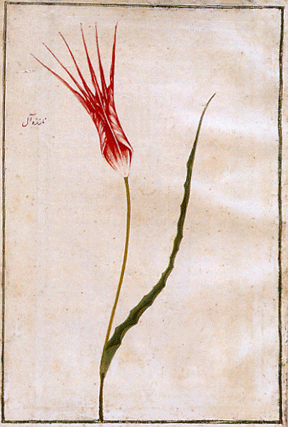
Nazende al (Flattering Red) from ‘The Book of Tulips’ ca 1725

by Anna Pavord

But as in any love affair, after the initial coup de foudre you want to learn more about the object of your passion. The tulip does not disappoint. Its background is full of more mysteries, dramas, dilemmas, disasters and triumphs than any besotted aficionado could reasonably expected. In the wild, it is an Eastern flower, growing along a corridor which stretches either side of the line of latitude 40 degrees north. The line extends from Ankara in Turkey eastwards through Jerevan and Baku to Turkmenistan, then on past Bukhara, Samarkand and Tashkent to the mountains of the Pamir-Alai, which, with neighbouring Tien Shan is the hotbed of the tulip family.

As far as western Europe is concerned, the tulip’s story began in Turkey, from where in the mid-sixteenth century, European travellers brought back news of the brilliant and until then unknown lils rouges, so prized by the Turks. In fact they were not lilies at all but tulips. In April 1559, the Zürich physician and botanist Conrad Gesner saw the tulip flowering for the first time in the splendid garden made by Johannis Heinrich Herwart of Augsburg, Bavaria. He described its gleaming red petals and its sensuous scent in a book published two years later, the first known report of the flower growing in western Europe. The tulip, wrote Gesner, had ‘sprung from a seed which had come from Constantinople or as others say from Cappadocia.’ From that flower and from its wild cousins, gathered over the next 300 years from the steppes of Siberia, from Afghanistan, Chitral, Beirut and the Marmaris peninsula, from Isfahan, the Crimea and the Caucasus, came the cultivars which have been grown in gardens ever since. More than 5,500 different tulips are listed in the International Register published regularly since 1929 by the Royal General Bulbgrowers’ Association of the Netherlands. Continue reading The flower that made men mad

Picturing Bethlehem

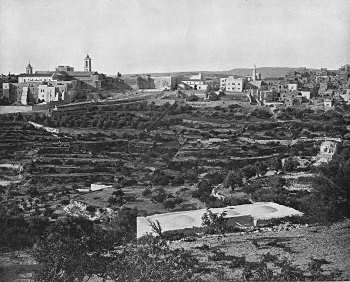
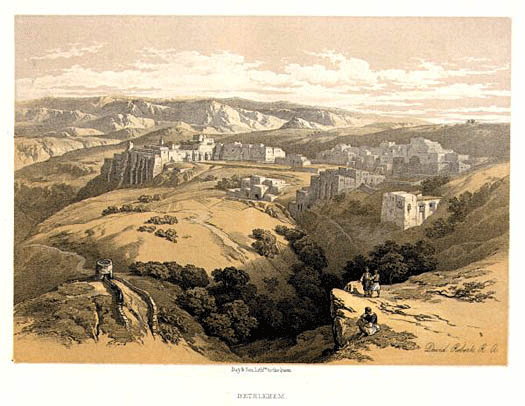
December eyes are fixed on Bethlehem, which has been an inspiration for artists over many years and indeed centuries. On this Christmas day, take a look at Bethlehem as it might have looked more than a century ago.


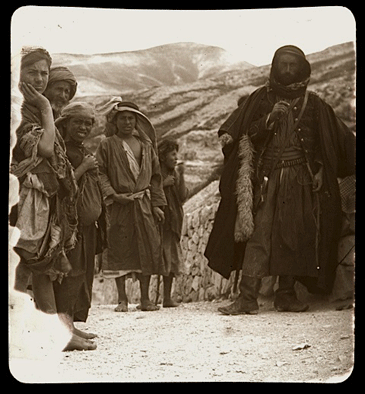
Left hand element of a stereoscopic photograph of the Bethlehem region circa 1900. Courtesy of Glenn Bowman.


Approaching Bethlehem. Source: Earthly Footsteps of the Man of Galilee.

The following two illustrations of Bethlehem can be found on the website (Jerusalem in 19th Century Art) put up by James E. Lancaster.


Bethlehem Tinted lithograph printed by Day & Son, after David Roberts, published about 1855.


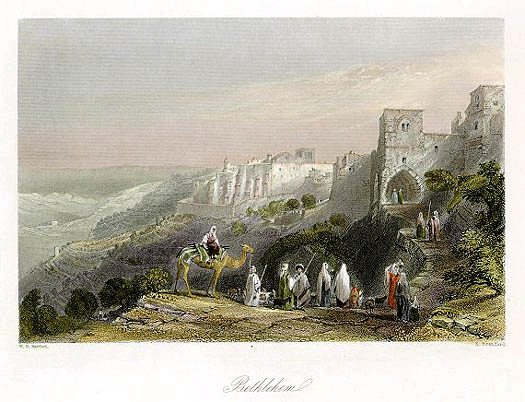
Bethlehem Engraved by S.Brandard after a picture by W.H.Bartlett, published in The Christian in Palestine, about 1840. Steel engraved print with recent hand colour.