Category Archives: Art

Leaves from an old Bible Atlas #2


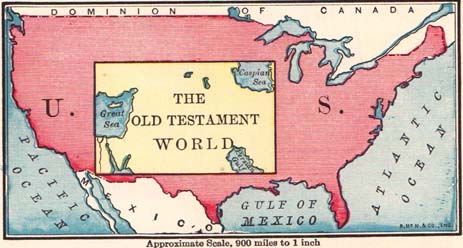
Comparative view of the United States and Old Testament world, approximate scale, 900 miles to 1 inch (in the original map which is only 3 3/4 inches across)

The Christian fascination with the Holy Land as a window into interpretation of the Bible has a long and indeed fascinating history of its own. Here I continue the thread on Jesse Lyman Hurlbutt’s A Bible Atlas (New York: Rand McNally & company, 1947, first published in 1882). I love the irony of the map above. Long before the political map devolved into Blue States vs. Red States, here is the Old Testament squarely in an expanded Bible Belt.

Here is Hurlbutt’s summary of the physical space defined as the Old Testament world:

The Old Testament world embraces the seas and lands between 30° and 54° east longitude, or from the mouth of the Nile to the head of the Persian Gulf; and between 27° and 40° north latitude, from the parallel south of Mt. Sinai to the north of Mount Ararat. The total extent of territory is about 1,400 miles from east to west and 900 miles from north to south, aggregating 1,260,000 square miles. If the space occupied by the Mediterranean Sea and other large bodies of water is deducted from this, the land will include about 1,110,000 square miles, or one-third of the extent of the United States, excluding Alaska. Unlike the United States, however, nearly two-thirds of this area is a vast and uninhabitable desert, so that the portion actually occupied by man is less than an eighth of that included int he American Union.

I wonder what Sarah Palin would think about Hurlbutt excluding Alaska, but at least it was not a state yet and some still referred to it as Seward’s folly.

To be continued …
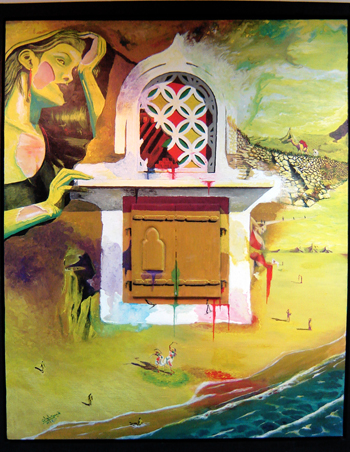
Pictures at a Yemeni exhibition


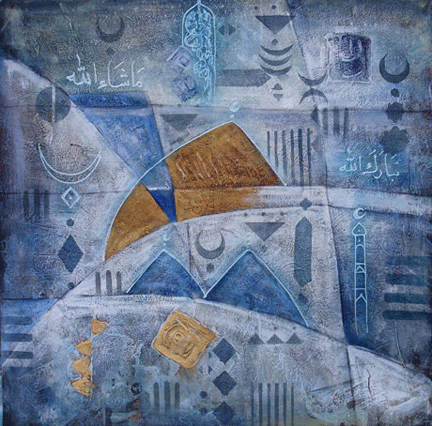
Painting by Qais Saleh Ahmed Aluan, founding member and vice-director of the Bait al-Fann (House of Art) in Yarim (Ibb Governorate)

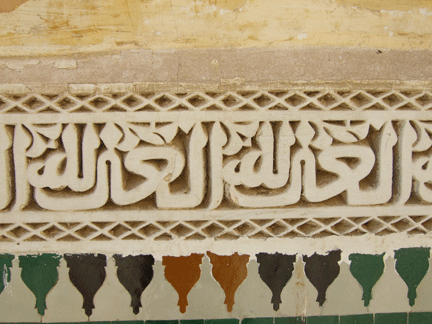
The media focus on Muslim grievances over images of the Prophet Muhammad obscures the fact that there is a vibrant artistic tradition throughout the Islamic world. Take Yemen, for example. There are art centers in various parts of the country. Here is a Youtube trip through Bayt al-Fann (The House of Art) in Hodeidah. I only wish they had used music by Mussorgsky…

Ottoman Haifa


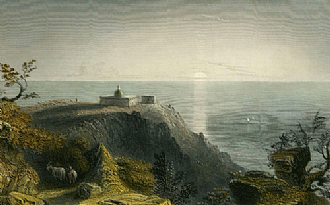
William Henry Bartlett, Mount Carmel Looking towards the Sea, engraving,
collection of Dr. Y. Rimon, Haifa

The Haifa City Museum in Israel is sponsoring a special exhibition entitled “Ottoman Haifa: Aspects of the City, 1516-1918” from August 29, 2009 – October 2, 2010. The curator is Ron Hillel. Details are provided at the exhibition website, with the description copied below.

During the Ottoman period, many marked changes occurred in Haifa and its environs. The foundations of today’s city were laid, economic, social, and religious. Even though Ottoman rule ended less than 100 years ago, the general sense is that all this happened in the remote past. This exhibition is intended to revive that heroic era, to make it tangible.

The exhibition follows Haifa’s development during the Ottoman period. The city’s growth is linked by indissoluble bonds to its technological and economic progress. Its development is documented in geographic illustrations and maps and with the invention Continue reading Ottoman Haifa

Colorful Lithographic Orientalism #6: Kurds and Persians


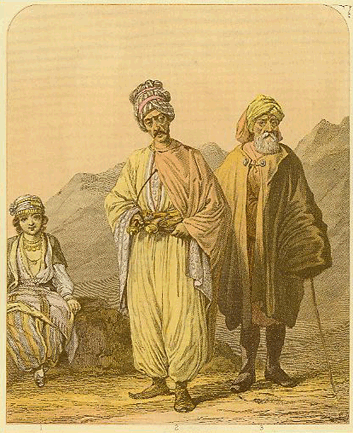
Kurds

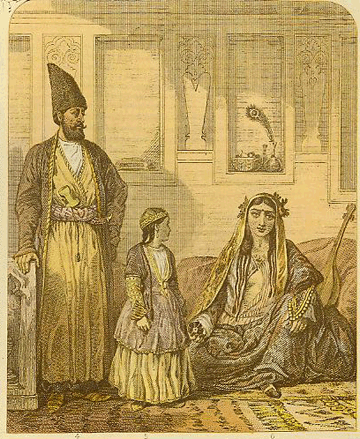
As noted in a previous post, I recently went through a late 19th century scrapbook that belonged to my great, great aunt. She had cut out pictures that interested or amused her. Several of these have Orientalist themes. Sometimes a picture is worth a thousand words; other times the picture says enough for itself. In this series, I leave the image to speak for itself. If you would like to comment on what you see or imagine, please do so in the comments section.


Persians

For #5, click here

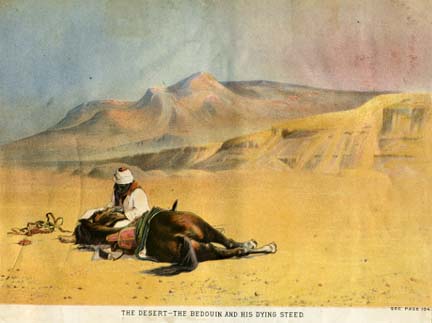
Colorful Lithographic Orientalism #5: Steed

As noted in a previous post, I recently went through a late 19th century scrapbook that belonged to my great, great aunt. She had cut out pictures that interested or amused her. Several of these have Orientalist themes. Sometimes a picture is worth a thousand words; other times the picture says enough for itself. In this series, I leave the image to speak for itself. If you would like to comment on what you see or imagine, please do so in the comments section.

For #4, click here

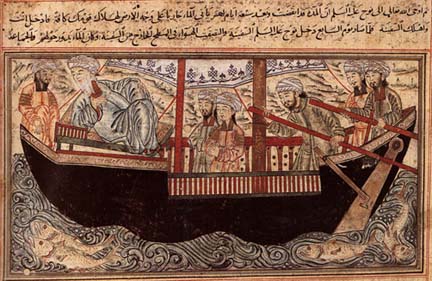
Noah and the ark, seven centuries ago


The story of Noah is shared in the three main monotheisms and still inspires creationists who are convinced that opportunist quasi-Neptunist forces from the great Deluge laid down almost all sedimentary layers on Earth. Above is an illustration from the Jami‘ al-tawarikh, produced in 1314/1315 for the Iranian vizier Rashid al-Din. In this case the ark was not the biblical box but a typical Arab dhow of the time with two masts, two steering oars and a rudder. The manuscript is housed in the Nasser D. Khalili Collection of Islamic Art in London.

Illustration from Art of the First Cities, edited by Joan Aruz (New York: Metropolitan Museum of Art, 2003), p. 491.