Category Archives: Egypt

The Wind and the Whirlwind


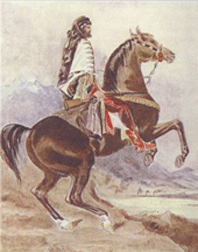
Wilfrid Scawen Blunt on Pharaoh, drawn by Lady Anne Blunt

[Note: The following poem was written by Blunt in response to the British occupation of Egypt in the late 19th century, but its words are apt for the present occupation of Iraq and Afghanistan today.]

by Wilfrid Scawen Blunt

I have a thing to say. But how to say it?
I have a cause to plead. But to what ears?
How shall I move a world by lamentation,
A world which heeded not a Nation’s tears?

How shall I speak of justice to the aggressors,
Of right to Kings whose rights include all wrong,
Of truth to Statecraft, true but in deceiving,
Of peace to Prelates, pity to the Strong?

Where shall I find a hearing? In high places?
The voice of havock drowns the voice of good.
On the throne’s steps? The elders of the nation
Rise in their ranks and call aloud for blood. Continue reading The Wind and the Whirlwind
Fat Chance Fatwas

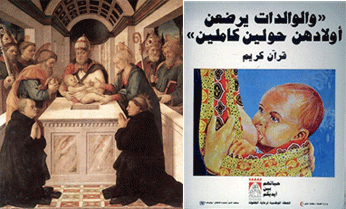
Breastmilk and urine: two unlikely bodily fluids to be news fit to print in the New York Times. But an article by Michael Slackman in Tuesday’s edition pours it on, the kind of hook that tabloids feed on, and then it gets milked for less than it is worth. Here is the hook at the front:

First came the breast-feeding fatwa. It declared that the Islamic restriction on unmarried men and women being together could be lifted at work if the woman breast-fed her male colleagues five times, to establish family ties. Then came the urine fatwa. It said that drinking the urine of the Prophet Muhammad was deemed a blessing.

For the past few weeks, the breast-feeding and urine fatwas have proved a source of national embarrassment in Egypt, not least because they were issued by representatives of the highest religious authorities in the land.

Continue reading Fat Chance Fatwas

Tableaux Manners Egyptian Style

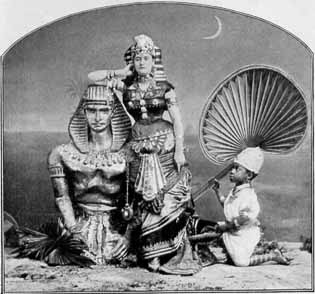
The year was 1875. As reported in The Cosmopolitan (for January, 1898), the governor of New York proposed a fund raiser for the expected visitors in the upcoming American centennial celebrations. New York City’s high society was mobilized under the direction of Mrs. Elizabeth Hamilton Cullen, granddauther of Alexander Hamilton and wife of General G. W. Cullen. Mrs. John Jacob Astor and Mrs. Belmont assisted in gathering 230 elite ladies and gentlemen to pose in various tableaux from “The Puritan Family at Prayer” to “Miss Egypt” shown here. Here is a nostalgic tidbit of vintage American Orientalism when the digs in Egypt were still very fresh. But for a nation that had only abolished slavery slightly over a decade before, it is clear that the race to end racism had only just begun. Continue reading Tableaux Manners Egyptian Style

“when I asked him what a Moslem was”

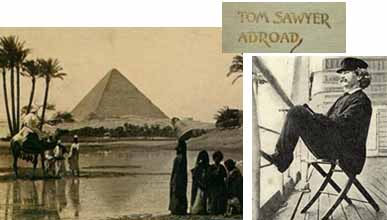
According to all three major monotheisms even God needed time to take a rest and so the sabbath was created. With the spate of mosque bombings, torture of prisoners and outright mayhem dominating the news about the Middle East these days, it might help to sit back and read what the American humorist Mark Twain wrote about his Missouri-born creation Tom Sawyer set loose in the Holy Land more than a century ago. Continue reading “when I asked him what a Moslem was”

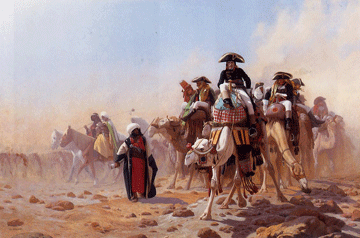
Napoleon Tried It: He Failed


Illustration: “Napoleon and his General Staff in Egypt” by Jean-Léon Geróme, 1867

In 1798 the French leader Napoleon, a seemingly mature 28 year old at the time, set off from France with a fleet of 400 ships and 36,000 men. The goal was to conquer Egypt and “liberate” it from the corrupt Mamluk overlords. No CNN or BBC reporters were around; nor had al-Jazeera set up a satellite feed. It did not take long for the French to overwhelm the Egyptians with about 25,000 French against 15,000 local Mamluks. Napoleon won in sight of the Pyramids, but very soon after the entire mission was doomed to failure when Lord Nelson obliterated the French fleet. Napoleon himself left Cairo secretly a year later, returned to France and turned his conquest machine against fellow Europeans.
Continue reading Napoleon Tried It: He Failed

Alaa Al Aswany: Voice of Reason

This month’s National Geographic Magazine has an extended interview with the Egyptian author (and dentist) Alaa Al Aswany, whose recent Arabic novel, The Yacoubian Building, is a major bestseller.

“Just who is the Arab world listening to? Not only radical sheikhs and militant politicians. The man whose voice has captivated the Arab public is a Cairo dentist by day and a novelist by dawn. Alaa Al Aswany’s novel The Yacoubian Building is a phenomenon—the best-selling novel in the Middle East for two years and the inspiration for the biggest budget movie ever produced in Egypt. The novel paints a poignant and uncompromising picture of life in modern Cairo, as seen through the eyes of a carnival of characters—from the richest and most powerful to the poorest. An outspoken critic of the Mubarak regime and a friendly, self-effacing man, Dr. Al Aswany studied dentistry, and the American way of life, in the U.S. He has a humanist’s love of pondering what makes people do what they do.”

To read the interview online, click here.