Category Archives: Egypt

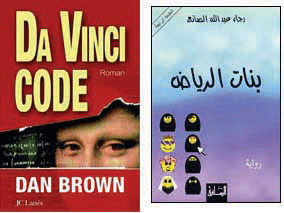
The Da Vinci Code and the Girls of Riyadh

By Hussein Shobokshi for the Yemen Observer, June 27, 2006

Dan Brown’s novel The Da Vinci Code has been translated into 40 languages, including Arabic. The book has been adapted into a film showing all over the world, reaping millions of dollars. The story, as the majority of people know, questions the life of Jesus and claims that he married Maria Magdalene and fathered her child.

The suggestion has caused much controversy and has been strongly condemned by various Christian sects, which eventually led to the film being banned in Egypt and Lebanon (the book is sold in Egypt, but is censored in Lebanon). What was noticeable however was that the request for censorship in the Egyptian Parliament was made by Muslim MPs, who wanted to express their solidarity with the Copts and to defend Jesus. Continue reading The Da Vinci Code and the Girls of Riyadh

Inscribing The Body


1. John MacIntyre Tattooing in Los Angeles

Inscribing The Body: Tattoos in Traditional and Modern Cultures

by el-Sayed el-Aswad
University of Bahrain

From ancient Egyptian culture, whence comes early evidence of tattooing, to contemporary art, the body has been employed as a living canvas for inscriptions and designs such as those of tattoos embodying symbols, icons, archetypes and mythological or folkloric themes. Tattoos, especially those consisting of lines and dots, have been found on preserved mummies, including that of Amunet, a priestess of the goddess Hathor at Thebes dating back to the XI Dynasty, 2000 B.C.E. Although amulets are widely used for protective, magical and ascetic purposes (and were predominantly used in ancient Egypt), they are replaceable or not permanent. Notions related to authenticity, ethnicity, gender, identity, sanctity, fertility, femininity, masculinity, class, and aestheticism, to mention a few, are inscribed permanently in various forms on the body.

Though tattooing is prohibited in Islam, because it is viewed as a factor in mutilating, maiming or altering the body’s physical features, local or traditional practices are still existent among the folk in various Muslim societies. Continue reading Inscribing The Body

The Seller of Sweet Words

[Note: The most notable, at least in the Nobel laureate sense, Arab writer of literature is the Egyptian Naguib Mahfouz, who passed away in 2006 . Among his many novels, several of which are available in English translation by Doubleday Press, is the classic “Midaq Alley”, written more than six decades ago, but still a vibrant testament to the universality of human foibles in a literary mirror. Below is one of my favorite character descriptions in the novel. If you have not yet read “Midaq Alley”, then do so as soon as you can, and taste the sweet words (even in translation) for yourself.]

Many things combine to show that Midaq Alley is one of the gems of times gone by and that it once shone forth like a flashing star in the history of Cairo. Which Cairo do I mean? That of the Fatimids, the Mamlukes, or the Sultans? Only God and the archaeologists know the answer to that, but in any case, the alley is certainly an ancient relic and a precious one. How could it be otherwise with its stone-paved surface leading directly to the historic Sanadiqiyya Street. And then there is its café known as Kirsha’s. Its walls decorated with multicolored arabesques, now crumbling, give off strong odors from the medicines of olden times, smells which have now become the spices and folk cures of today and tomorrow…

Although Midaq Alley lives in almost complete isolation from all surrounding activity, it clamors with a distinctive and personal life of its own. Fundamentally, and basically, its roots connect with life as a whole and yet, at the same time, it retains a number of the secrets of a world now past. Continue reading The Seller of Sweet Words

The Ninth International Symposium on Comparative Literature

Call for Papers
The Ninth International Symposium on Comparative Literature
November 4-6, 2008
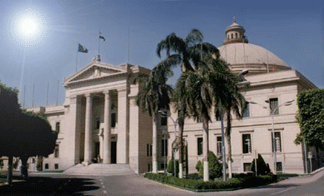
Department of English Language and Literature, Cairo University
“Egypt at the Crossroads: Literary and Linguistic Studies”
Deadline for abstracts: March 15, 2008

Because of its geographical, historical, and cultural placement, Egypt has been—since time immemorial—both literally and metaphorically at the crossroads. Enjoying the strategic location that it does—at a meeting point between Africa and Asia, facilitating contact between the two continents and Europe, and at a juncture between the Mediterranean and the Red Sea—Egypt is a rich amalgam of diverse cultural heritages: Ancient Egyptian, Greek, Roman, Persian, Coptic, Islamic. Influenced by all these and, in modern times, the French and British, the inhabitants are in the happy position of being hybrid—African, Arab, Mediterranean—but indubitably and inimitably Egyptian. It is, perhaps, this unique situation that inspired the Egyptian geographer Gamal Hamdan (1928-1993) to write of Egypt as having a “natural gift” which may explain “the secret of Egypt’s survival and vitality through the ages and in spite of the ages.” Continue reading The Ninth International Symposium on Comparative Literature

Creative Reckoning Today

[Note: If you are in the New York Metropolitan area, you may be interested in a lecture by Jessica Winegar at Alwan for the Arts this evening.]

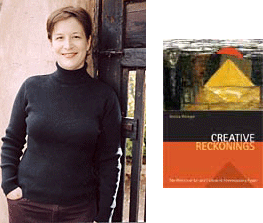
Creative Reckoning: The Politics of Art and Culture in Contemporary Egypt Creative Reckoning

Book Reading by Jessica Winegar

Tuesday, September 25, 2007 7 PM

Free and open to the public

Refreshments will be served

Creative Reckonings: The Politics of Art and Culture in Contemporary Egypt (Stanford University Press, 2006) is an ethnographic study of the intense debates over cultural authenticity and artistic value that occur in a postcolonial society undergoing market liberalization. Based on 33 months of fieldwork in Egypt, the book examines the creation, circulation, and commodification of art in the context of a globalizing cultural economy. Continue reading Creative Reckoning Today

Egyptian Cosmology and the Grand Canyon


[Isis Temple of the Grand Canyon]

In mid August, this year, I traveled to the Grand Canyon in Arizona. I was stunned by the views of spectacular buttes and rises, some of which are named after Egyptian gods, goddesses and kings such as “Isis,” “Osiris,” “Horus,” “Set” and “Cheops” (the Pharaoh who built the Great Pyramid of Egypt). This exposure triggered substantial questions concerning the relationship between ancient Egyptian culture and Native Americans inhabiting the Grand Canyon recognizing that anthropological and historical studies of archaic cosmologies of ancient societies are still open for further development. I found a very interesting article on the subject of “Ancient Egyptian Treasures in the Grand Canyon: Suppressed Archeological Information and Metaphysical Paradox?” written by Barry McEwen in which he refers to an article written by David Hatcher Childress who reveals deep concern about the Smithsonian Institution cover up of important findings of G.E. Kinkaid and Professor S.A. Jordan. To quote Childress, “Perhaps the most amazing suppression of all is the excavation of an Egyptian tomb by the Smithsonian itself in Arizona. A lengthy front page story of the PHOENIX GAZETTE on 5 April 1909… gave a highly detailed report of the discovery and excavation of a rock-cut vault by an expedition led by a Professor S. A. Jordan of the Smithsonian. The Smithsonian, however, claims to have absolutely no knowledge of the discovery or its discoverers.” Continue reading Egyptian Cosmology and the Grand Canyon

Between Cairo and Oxford: An American Dilemma

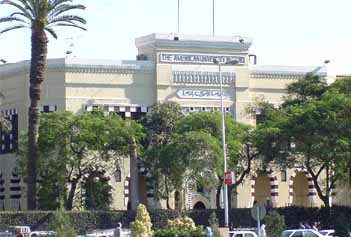
About seven years ago, I decided to accept an academic position at the American University in Cairo (AUC). This was well before 9/11, but it nonetheless sparked the same question from nearly every friend and relative: are you sure it’s safe? It was a reasonable question based on what little most Americans know about Egypt. “The Middle East” is known to be violent and volatile, hence Egypt must be so. Third World countries all hate Americans, so Egyptians must. And besides, Egypt is a desperately poor country, and we all know that poverty breeds violence.

Such perceptions have little to do with Egyptian realities. Continue reading Between Cairo and Oxford: An American Dilemma

At a Tomb in Abydos

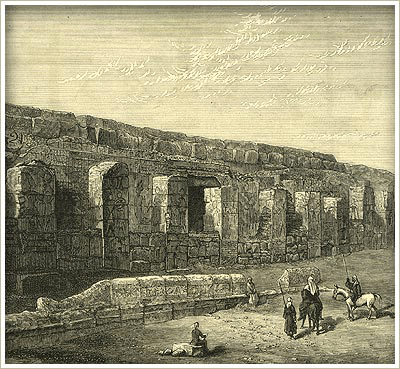
Temple at Abydos

by Augustus Wight Bomberger

How little hath life changed, O ancient King!
This fan so delicate and bracelet rare,
These dainty, jeweled trinkets for the hair,
Were thine own gifts, I know, and thine this ring.
And Bener-Ab, thy daughter, “Sweet of Heart,”
Who wore them once, was precious of a truth
And dear to thee in all her winsome youth,
Unspotted from the world, unspoiled of art:
So dear that thou at times didst reckon less
Thy royal sceptre than her soft caress;
Yet for that cause wert all the more a king,
Five thousand years ago when thou didst reign
In great Abydos — city of the plain.
And now — ah me, how close these symbols bring
Thy soul to mine across the vast of years – Continue reading At a Tomb in Abydos