Category Archives: Egypt

Open season on Egypt’s opposition, but Islam is not the solution

By Andrea Teti, Department of Politics and International Relations, University of Aberdeen

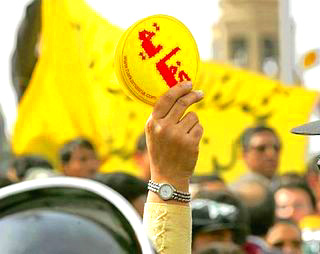
Following a wave of strikes and an equally spectacular tsunami of price increases in a range of essential goods over recent months, the April 8th local elections seemed for a brief moment to have become a focus for Egypt’s diverse opposition. A few days before a general strike proclaimed for April 6th, the coalition for democratic change Kifaya! (Enough!) published a statement saying it expected the Muslim Brotherhood’s active support. In the event, the Brotherhood defended Kifaya!’s right to strike, but did not participate in it. Then, following a wave of pre-election arrests and dirty tricks by the ruling National Democratic Party – resulting in a mere 21 MB candidates making it onto ballots out of the 5,754 put forward – the MB declared the elections beyond repair, and boycotted them. The NDP’s electoral victory (97% of posts) was as striking as the estimated 5% voter participation rate. Continue reading Open season on Egypt’s opposition, but Islam is not the solution
Bint al-Shati’: A Female Voice In Islamic Law

from al-Ahram, July 2004

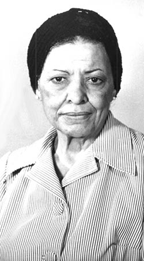
Aisha Abdel-Rahman, better known as Bint Al-Shati’, might have become famous for her fiction and poetry but it was her stories on rural Egypt which launched her writing career in Al-Ahram. The “Daughter of the Shore”, writes Professor Yunan Labib Rizk, had a weak spot for the countryside and its people

From the outset of her career, Aisha Abdel-Rahman, a prominent scholar and writer, preferred to go by the name Bint Al-Shati’ (Daughter of the Shore). She adopted this pen-name, which alludes to her birthplace in Damietta, out of respect for her family’s customs — her father was a scholar in a religious institute in that northern Egyptian coastal city — and because it was also a custom of that age for women writers to conceal their true identities.

Bint Al-Shati’ first made her mark in Al-Ahram in the summer of 1935 when the newspaper allocated considerable front-page space to the problems of rural Egypt. She was only 23 at the time (she was born in 1913), which is not so odd in itself — it was Al-Ahram ‘s policy to give a chance to young and talented aspiring writers, of whom some later became its prominent featured writers and literary and intellectual celebrities. What was odd, given her conservative family background, was the level of education she attained. Her father, an Azharite, would not allow her “modern schooling” so he educated her himself, and so solid was his instruction that she came out first among all the female students who sat for the competency certificate for teachers “from their homes” in 1929. Thus encouraged, she received her secondary school baccalaureate in 1934. This was the only certificate she was armed with when she began writing for Al-Ahram the following year. But then whoever said that degrees make a writer? Continue reading Bint al-Shati’: A Female Voice In Islamic Law

Dreams Stifled, Egypt’s Young Turn to Islamic Fervor

By MICHAEL SLACKMAN
The New York Times, February 17, 2008

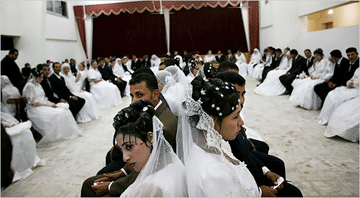
CAIRO — The concrete steps leading from Ahmed Muhammad Sayyid’s first-floor apartment sag in the middle, worn down over time, like Mr. Sayyid himself. Once, Mr. Sayyid had a decent job and a chance to marry. But his fiancée’s family canceled the engagement because after two years, he could not raise enough money to buy an apartment and furniture.

Mr. Sayyid spun into depression and lost nearly 40 pounds. For months, he sat at home and focused on one thing: reading the Koran. Now, at 28, with a diploma in tourism, he is living with his mother and working as a driver for less than $100 a month. With each of life’s disappointments and indignities, Mr. Sayyid has drawn religion closer.

Here in Egypt and across the Middle East, many young people are being forced to put off marriage, the gateway to independence, sexual activity and societal respect. Stymied by the government’s failure to provide adequate schooling and thwarted by an economy without jobs to match their abilities or aspirations, they are stuck in limbo between youth and adulthood. Continue reading Dreams Stifled, Egypt’s Young Turn to Islamic Fervor

Politics of Piety: A Case Study in Cairo


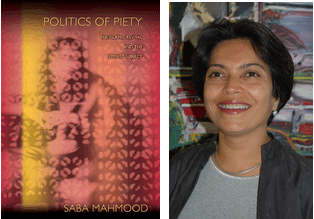
[In 2005 anthropologist Saba Mahmood published “Politics of Piety: The Islamic Revival and the Feminist Subject” (Princeton University Press). This important ethnography of the women’s mosque movement in Cairo not only presents an informative case study but challenges notions of how Muslim women’s involvement in pious movements should be analyzed in a feminist framework. The following excerpt is from the beginning of Mahmood’s book.]

Over the last two decades, a key question has occupied many feminist theorists: how should issues of historical and cultural specificity inform both the analytics and the politics of any feminist project? While this question has led to serious attempts at integrating issues of sexual, racial, class, and national difference within feminist theory, questions regarding religious difference have remained relatively unexplored. The vexing relationship between feminism and religion is perhaps most manifest in discussions of Islam. This is due in part to the historically contentious relationship that Islamic societies have had with what has come to be called “the West,” but also due to the challenges that contemporary Islamist movements pose to secular-liberal politics of which feminism has been an integral (if critical) part. The suspicion with which many feminists tended to view Islamist movements only intensified in the aftermath of the September 11, 2001, attacks launched against the United States and the immense groundswell of anti-Islamic sentiment that has followed since. If supporters of the Islamist movement were disliked before for their social conservatism and their rejection of liberal values (key among them ‘women’s freedom’), their now almost taken-for-granted association with terrorism has served to further reaffirm their status as agents of a dangerous irrationality. Continue reading Politics of Piety: A Case Study in Cairo

Exodus Redux

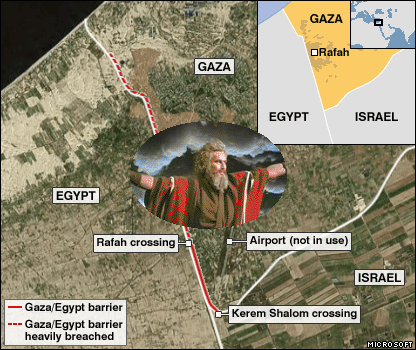
Remember the Exodus? Even if you never saw Charlton Heston part the waters Hollywood style, the story of the mistreatment of the descendants of the patriarch Jacob of Israel and their harrowing escape from the clutches of a hard-hearted Pharaoh has been retold millions of times over the past two millennia or more. In that story the more that Moses and brother Aaron demand “Let my people go,” the more the burden on the people, including the last straw, literally the last straw, in a work force up against a mud brick wall. Things got so bad that even the supervisors tried to reason with Pharaoh, but to no avail. So Moses in frustration turned to his Lord and complained in plain King James English:

And Moses returned unto the LORD, and said, Lord, wherefore hast thou so evil entreated this people? why is it that thou hast sent me? For since I came to Pharaoh to speak in thy name, he hath done evil to this people; neither hast thou delivered thy people at all. (Exodus 5:22-23)

Then came the plagues worthy of a passionate Mel Gibson remake: Nile water turned into blood, frogs everywhere, pesky gnats and flies (hardly anything new, I should suspect), the heavy vegan-friendly killing off of horses, donkeys, camels and flocks, then festering boils, heaven-sent hail and fire (an interesting notion for resolving global warming), lots and lots of locusts (some of which may have been kosher), total darkness and then the ultimate weapon of killing every non-Israelite firstborn. One would think this would be enough for several movies, but the journey has not even begun. That exodus, hardly a march of triumph, would condemn the brickmakers of Egypt to forty years wandering in the desert. Where is Mel Brooks when you need him?

Yesterday the irony of contemporary politics put the exodus in reverse. Continue reading Exodus Redux

Veiled Voices


Brigid Maher, Director of “Veiled Voices”

Veiled Voices is a one-hour documentary that investigates the grassroots movement of Muslim women in the Middle East who act as religious leaders. It introduces the viewer to a world rarely seen by outsiders: the world of devout Arab Muslim women leading other women in prayers and lessons. Veiled Voices concentrates primarily on Ghina Hammoud, a divorced mother separated from her children, who has a television program and a charitable foundation in Lebanon, and Huda al-Habash, who has a loving and supportive husband and children, and runs lessons and programs in a mosque in Syria. Veiled Voices also travels to Egypt, where women struggle for public recognition in roles of authority over men; this is contrasted with Syria, where some male religious authorities, such as the Grand Mufti, are encouraging of women in leadership roles. The film shows women empowered, while exploring the struggles they face on both a personal and a public level. Continue reading Veiled Voices

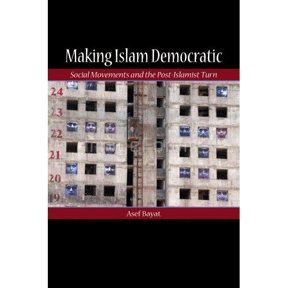
Making Islam Democratic: Social Movements and the Post–Islamist Turn

Book Review of Making Islam Democratic: Social Movements and the Post–Islamist Turn (Asef Bayat)

by Richard Bulliet
Published on NYU Center for Dialogues website

Discussions of contemporary Islam in the United States tend to be held in black and white, with the religion depicted either as a backward, dangerous and hateful force, or as a misunderstood and moderate foundation for peaceful living. Discussions in Europe range over a somewhat larger spectrum because they are often based on experiences with immigrant communities, and usually engage cultural issues in addition to security–related ones.

The most colorful and useful expositions for readers in search of a deep understanding of Islam today, however, are those based on detailed and long–term observations made in Muslim–majority countries, where interactions with Euro–American sensibilities do not confound the issue. Having said that, the drawback with such in–depth analyses is that they typically examine a single country, leaving it to readers to decide how similar or dissimilar Muslim life in Morocco, say, is from that in Bangladesh or Somalia. Continue reading Making Islam Democratic: Social Movements and the Post–Islamist Turn