Category Archives: Egypt

Picturing the Exodus

The ubiquity of GPS threatens to leave the old printed map out of the picture. This is a pity, for there is much to be learned from the way maps frame the world. As J. Z. Smith once remarked, map is not territory. True enough, but maps are the way we imagine not only territory but our place in it. When Edward Said wrote his critique of Orientalism in 1978, he cited novelists, travelers, poets and academics, but no mapmakers. But in a way Holy Land maps are what put the Holy Land on the map. Maps not only illustrated what was thought to be the lay of the land, but what people imagined was there.

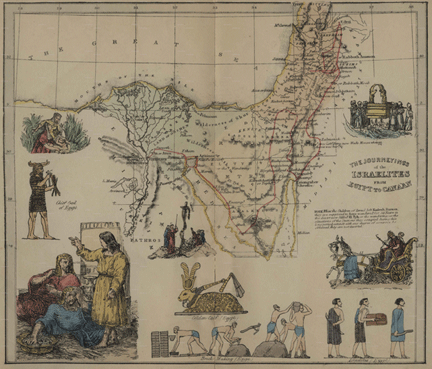
A splendid example of this is an 1856 pictorial Bible map of the Journey of the Israelites from Egypt to Canaan. I reproduce the image above, but if you
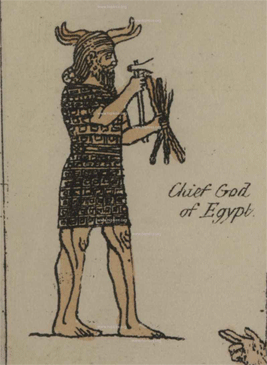
click here you can get a greatly enlarged view to see the details. Mind you, this was 1856, when few of the archeological discoveries in Bible territory had come to light. This is evident in the depiction of the “Chief God of Egypt,” (left side of map) who looks like a cross between an Assyrian and a Viking.
Continue reading Picturing the Exodus

The Territory with which We Are Threatened


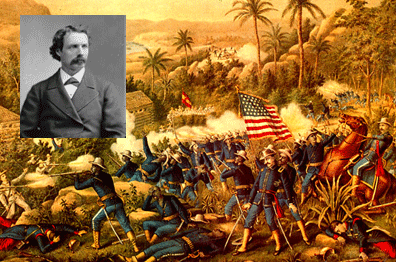
Whitelaw Reid as a young correspondent

[In 1898 the United States was fresh from its imperialist expansion in the Spanish American War. Ironically, the situation faced by the United States today in Iraq has a parallel with the war in Cuba, as can be readily seen from this essay by the well-known journalist and Republican politician Whitelaw Reid. The irony continues in the example given by Reid of Egypt’s colonial occupation of Egypt. Although written over a century ago in one of America’s most popular periodicals, the sentiments are relevant to the ongoing occupation of Iraq. Whether or not history repeats itself, some historical observations are well worth repeating. Webshaykh]

by Whitelaw Reid

Men are everywhere asking what should be our course about the territory conquered in this war. Some inquire merely if it is good policy for the United States to abandon its continental limitations, and extend its rule over semi-tropical countries with mixed populations. Others ask if it would not be the wisest policy to give them away after conquering them, or abandon them. They say it would be ruinous to admit them as States to equal rights with ourselves, and contrary to the Constitution to hold them permanently as Territories. It would be bad policy, they argue, to lower the standard of our population by taking in hordes of West Indians and Asiatics; bad policy to run any chance of allowing these people to become some day joint arbiters with ourselves of the national destinies; bad policy to abandon the principles of Washington’s Farewell Address, to which we have adhered for a century, and involve ourselves in the Eastern Question, or in the entanglements of European politics. Continue reading The Territory with which We Are Threatened

Lucie Wood Saunders, 1928-2008

Lucie Wood Saunders, 1928-2008

One of AMEWS’ earliest members and warmest supporters, Lucie Wood Saunders, passed away on July 26, 2008. Lucie received her PhD in Anthropology from Columbia University in 1959. Her dissertation research was on parallel cousin marriage in Arab families. She carried out research in Egypt, at the invitation of Laila el Hamamsy, Director of American University of Cairo’s Social Research Center, starting in 1961 and into the 1980’s in the Egyptian Delta village, Tafahna el-Ashraf. She worked with Sohair Mehanna of the SRC, authoring many articles with her on Tafahna el-Ashraf. Lucie was among the first Anthropologsits to write on issues of gender in the Delta villages. Her research inspected family and gender relations, the local zar cults, women and development issues around small businesses such as poultry, and medical anthropology. Her early work focused more on psychological issues and her later work more on economic issues. Continue reading Lucie Wood Saunders, 1928-2008

Exiled Egyptian activist sentenced

Al-Jazeera, August 2, 2008

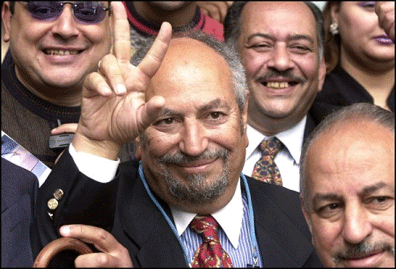
Saad Eddin Ibrahim, an outspoken critic of the Egyptian government, has been sentenced to two years in prison.

The sociologist and human rights activist, who is currently in the United States, was convicted for “tarnishing Egypt’s reputation,” the country’s official MENA news agency said.

Shady Talaat, Ibrahim’s laywer, said the ruling by a Cairo court was flawed and that he would use his right to appeal. Continue reading Exiled Egyptian activist sentenced

Music in the World of Islam

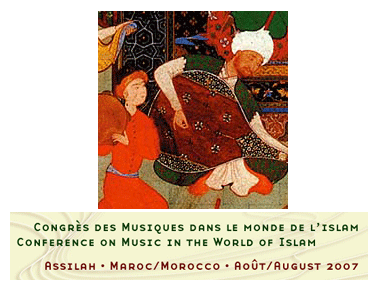
A year ago from August 8-13 an international conference on “Music in the World of Islam” was held in Assilah, Morocco, jointly sponsored by The Assilah Forum Foundation (Assilah, Morocco) and the Maison des Cultures du Monde (Paris, France). The papers from this conference are now available in pdf format online. Music and dance are described for Afghanistan, Algeria, Andalusia, Azerbeijan, Bangladesh, Bosnia, Central Asia, East Africa, Egypt, Ethiopia, India, Indonesia, Iran, Iraq, Kurdistan, Kuwait, Liberia, Malaysia, Morocco, Russia, Syria, Tajikistan, Turkey and Yemen.

A description of the conference is described by its main organizer, Pierre Bois: Continue reading Music in the World of Islam

Uncovering Evidence of a Workaday World Along the Nile


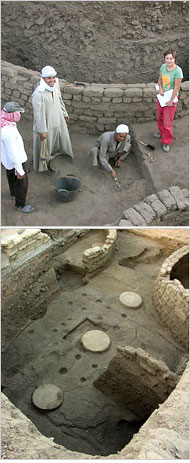
Parts of an administration building, above, and a large silo, top, at the site of an ancient provincial capital on the Upper Nile; Top, N.Moeller/Tell Edfu Project; above, G. Marouard/Tell Edfu Project.

By JOHN NOBLE WILFORD, The New York Times, July 1, 2008

Archaeologists have long fixed their sights on the grandeur that was ancient Egypt, the pyramids, temples and tombs. Few bothered to dig beneath and beyond the monumental stones for glimpses into the living and working spaces of ordinary Egyptians.

That is changing slowly but steadily. In the last two or three decades, excavations have uncovered urban remains and swept aside the conventional wisdom that the Egypt of the pharaohs, in contrast to Mesopotamia, was somehow a civilization without cities.

“We can now confirm that this was not the case,” said Nadine Moeller, an Egyptologist at the Oriental Institute of the University of Chicago. Dr. Moeller was speaking of her own recent findings, as well as those of other excavators who practice what is known as settlement archaeology. Continue reading Uncovering Evidence of a Workaday World Along the Nile