Category Archives: Poetry

THE STORY OF CRUEL PSAMTEK


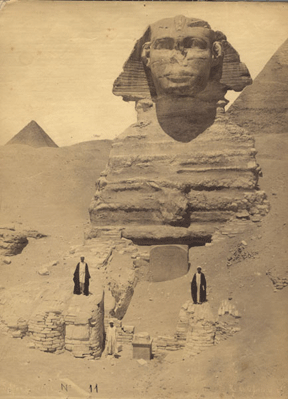
The Great Sphinx, G. Lékégian & Co.

THE STORY OF CRUEL PSAMTEK

HERE is cruel Psamtek, see.
Such a wicked boy was he!
Chased the ibis round about,
Plucked its longest feathers out,
Stamped upon the sacred scarab
Like an unbelieving Arab,
Put the dog and cat to pain,
Making them to howl again.
Only think what he would do –
Tease the awful Apis too
Basking by the sacred Nile
Lay the trusting crocodile ;
Cruel Psamtek crept around him,
Laughed to think how he had found him,
With his pincers seized his tail,
Made the holy one to wail ;
Till a priest of Isis came,
Called the wicked boy by name,
Shut him in a pyramid,
Where his punishment was hid. Continue reading THE STORY OF CRUEL PSAMTEK

Ozymandias Redux


One of the great Victorian Orientalist poems, Ozymandias, was penned by Percy Bysshe Shelley almost two centuries ago in 1818. Substitute the name “Hosni Mubarakias” and experience the déjà vu that is Egypt, and indeed the entire world.

I met a traveler from an antique land
Who said: “Two vast and trunkless legs of stone
Stand in the desert… Near them, on the sand,
Half sunk a shattered visage lies, whose frown,
And wrinkled lip, and sneer of cold command,
Tell that its sculptor well those passions read
Which yet survive, stamped on these lifeless things,
The hand that mocked them and the heart that fed;
And on the pedestal these words appear:
My name is Ozymandius, King of Kings,
Look on my works, ye Mighty, and despair!
Nothing beside remains. Round the decay
Of that colossal wreck, boundless and bare
The lone and level sands stretch far away.”

The memories of past kings and pharaohs are not sacred, as looters were able to enter the Cairo Museum and damage some of the objects there. Looting is as old as the pyramids. Such was the fate with most of the pharaohs’ well concealed (and conceited) wealth for the afterlife. Now the objects preserved in the museum are also in danger.

Egypt will survive the fall of its latest pharaoh, but right now the sneer of cold command is once again sinking in the sand.

Iraqi Voices Project


Photo of Khawla Hadi, Kimberly Wedeven Segall and Marwa al-Mtowaq. Iraqi Voices Panel, March 2009; photo by Luke Rutan, Seattle Pacific University.

Iraqi Voices Project: Poetry Workshops, Alternative History, and Community Awareness

by Kimberly Wedeven Segall

The dead . . .
come in shifts . . .
in our dreams . . .
over the houses we left behind.

–Dunya Mikhail, The War Works Hard

How can universities work alongside communities to build understanding of the Iraqi refugee crisis? Historically, Iraq as a state was established in 1920, centered on Baghdad, and controlled first by the British and then by Iraqi governments. As the force of the state made demands upon the people, it caused its residents “to rethink existing political identities, values, and interests,” to engage in “strategies of cooperation, subversion, and resistance,” [1] as Charles Tripp argues, and to construct narratives “to understand and to justify their political engagement.” [2]

How do memories challenge the narratives the West has presented on Iraq? How does family memory record and preserve history, after so much history has been destroyed in the post-occupation loss of valuable historical records and objects from Iraq’s museums?

The Iraqi Voices Project, 2008-2009, was designed as a workshop forum. Reading and responding to Iraqi poetry, the workshop created a forum for telling stories of displacement in Iraq and building awareness of the challenges in relocating in Seattle, Washington. Continue reading Iraqi Voices Project

THE STORY OF PYRAMID THOTHMES


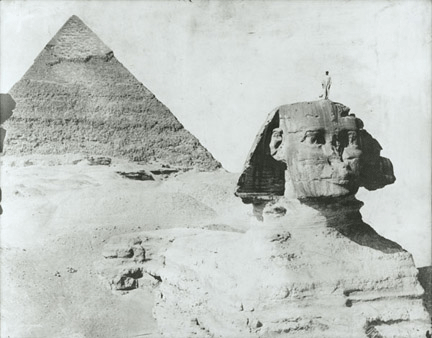
Sphinx and Pyramid at Giza

THE STORY OF PYRAMID THOTHMES

THOTHMES, who loved a pyramid,
And dreamed of wonders that it hid,
Took up again one afternoon,
His longest staff, his sandal shoon,
His evening meal, his pilgrim flask,
And set himself at length the task,
Scorning the smaller and the small,
To climb the highest one of all.

The sun was very hot indeed,
Yet Thothmes never slacked his
Until upon the topmost stone
He lightly sat him down alone
To make himself some pleasant cheer
And turned to take his flask of beer,
For he was weary and athirst. Continue reading THE STORY OF PYRAMID THOTHMES

THE STORY OF PRINCE AGIB


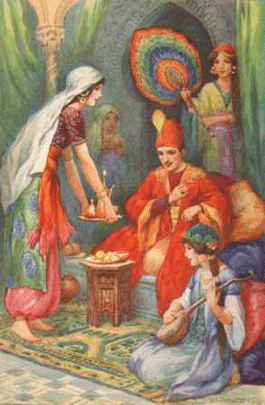
Illustration of Prince Agib by Harry G. Theaker from The Arabian Nights

THE STORY OF PRINCE AGIB

by W. S. Gilbert

STRIKE the concertina’s melancholy string!
Blow the spirit-stirring harp like any thing!
Let the piano’s martial blast
Rouse the Echoes of the Past,
For of Agib, Prince of Tartary, I sing!

Of Agib, who amid Tartaric scenes,
Wrote a lot of ballet-music in his teens
His gentle spirit rolls
In the melody of souls –
Which is pretty, but I don’t know what it means

Of Agib, who could readily, at sight,
Strum a march upon the loud Theodolite :
He would diligently play
On the Zoetrope all day,
And blow the gay Pantechnicon all night.

One winter -I am shaky in my dates-
Came two starving minstrels to his gates,
Oh, Allah be obeyed,
How infernally they played
I remember that they called themselves the” Oiiaits.” Continue reading THE STORY OF PRINCE AGIB

A Biography of Defiance


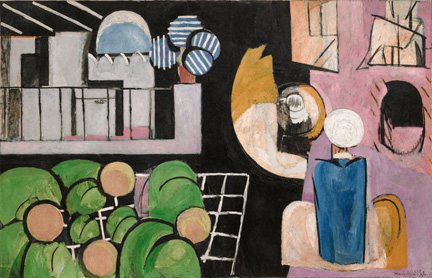
Henri Matisse, The Moroccans, 1915-16,The Museum of Modern Art, New York,

A biography of defiance by Hassan El Ouazzani

It was better for the world not to have existed. It was better
for the dynasty to have kept its desire for another evening party.
It was better for the master to have been tired that night, for the earth
to have been dismal. It was better for something to have happened so that
the very semen be assassinated,
the semen whose descendant
is this one resident
in the home
of anguish.

That one
to whom the sky did offer but the robe of fire
now consuming his limbs. Continue reading A Biography of Defiance

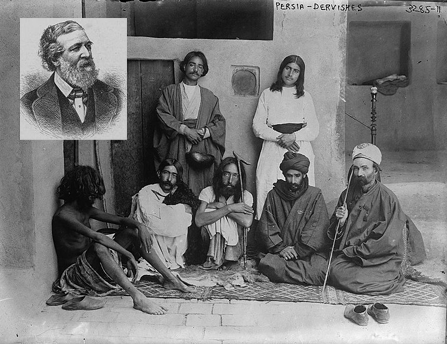
Of Dervishes, Fools and Prime Ministers


The poet Robert Browning left a large corpus, including his translation of Goethe’s masterful West-östlicher Diwan. One of his longer poems is an Oriental tale entitled Ferishtah’s Fancies. Recently in a used book shop I bought a copy of the 1885 edition published in Boston by Houghton, Mifflin and Company. There is an ironic epigraph for this Orientalist tale from Shakespeare’s King Lear (Act III, Scene 6) at the forefront:

You, Sir, I entertain you for one of my Hundred; only I do not like the fashion of your garments: you will say, they are Persian; but let them be changed.”

Browning’s verse is as antiquated today as the tale he spun, but still worth looking at if only for the nostalgia of Victorian English prose. Here is an excerpt from the encounter of Dervish Ferishtah with a former high official now beggared:

The Mellon-seller

Going his rounds one day in Ispahan, –
Half way on Dervishhood, not wholly there, –
Ferishtah, as he crossed a certain bridge,
Came startled on a well-remembered face.
“Can it be? What, turned melon-seller – thou?
Clad in such sordid garb, thy seat yon step
Where dogs brush by thee and express contempt? Continue reading Of Dervishes, Fools and Prime Ministers

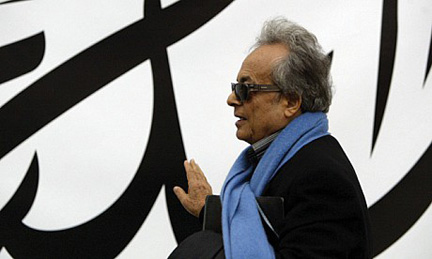
The Poet Adonis


A Revolutionary of Arabic Verse
By CHARLES McGRATH, The New York Times, October 17. 2010

ANN ARBOR, Mich. — Every year around this time the name of the Syrian poet Adonis pops up in newspapers and in betting shops. Adonis (pronounced ah-doh-NEES), a pseudonym adopted by Ali Ahmad Said Esber in his teens as an attention getter, is a perennial favorite to win the Nobel Prize in Literature. This year Ladbrokes, the British bookmaking firm, had his chances at 8-1, which made him seem a surer bet than the eventual winner, Mario Vargas Llosa, a 25-1 long shot. Why Adonis appeals to the oddsmakers, presumably, is that he’s a poet, and poets have been under-represented among Nobelists lately; that he writes in Arabic, the language of only one Nobel winner, Naguib Mahfouz; and that as is the case with so many recent winners, most Americans have never heard of him.

In the Arab world it’s a very different matter. There he is a renowned figure, if not everywhere a beloved one. He is an outspoken secularist, equally critical of the East and West, and a poetic revolutionary of sorts who has tried to liberate Arabic verse from its traditional forms and subject matter. Some of his poems are immensely long and immensely difficult and resemble Pound’s Cantos at their most impenetrable. Others reveal a Paul Muldoonish playfulness, a Jorie Graham-like expansiveness and fascination with blank space. His poems are as apt to cite Jim Morrison as the Sufi mystics, and his 2003 volume “Prophesy, O Blind One” includes some long, leggy lines about traveling that could have been written by Whitman, if only Whitman had spent more time in airports. Continue reading The Poet Adonis