Category Archives: Poetry

Tabsir Redux: Gibran Kahlil Gibran: A Timeless and Universal Vision

By George Nicolas El-Hage

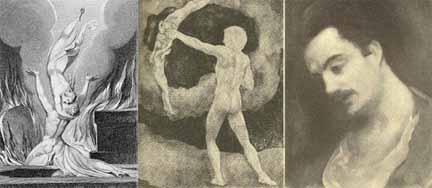
Poetry and art are twins. Both are the offspring of suffering and joy. Gibran translated Blake’s “Innocence and Experience” into a “Tear and a Smile.” Nevertheless, the unending drama of human existence unfolds itself in the pages of both men. Only the elected and gifted soul is capable of creativity, of reading the world differently, and of rebelling against evil clothed in a lamb’s garment. Art knows no boundaries. It transcends all national limits and is only satisfied with the universal. There, time and place lose their ability to imprison the artist in a closed cell. The inspired poet becomes a winged soul floating over life, embracing the infinite. It is in the midst of this vast expanse where the responsibility of the artist becomes eternal and his mission turns holy that we can speak of Kahlil Gibran and William Blake together. Continue reading Tabsir Redux: Gibran Kahlil Gibran: A Timeless and Universal Vision

Princeton Online Arabic Poetry


For lovers of early Arabic poetry and for students of Arabic there is a wonderful new resource called the Princeton Online Arabic Poetry Project. Thus far the site has classic poems by Imru’l-Qays (Mu‘allaqa), Yazid b. Mu`awiya (And Pearls Rained Down), Rabi`a al-`Adawiyya (My Cup and my Wine), Abu Nuwas (Don’t Cry for Layla), Abu Nuwas (The Wretch Paused), al-Mutanabbi (to Sayf al-Dawla). By clicking on the poem you can see the Arabic scroll down automatically as it is read. You can also at any time click on a line to see its translation. Check it out.

Making room for Hafiz


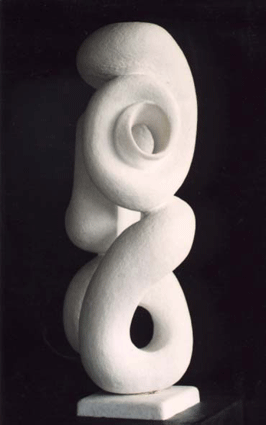
Spiritus, by Sami Rifai, Lebanon, Micheal-Angelo white Marble, 133x40x40 cmby, 1988

Ghazal 98: News From Abroad
by Hafiz, translated by A. Z. Foreman

Last night, the wind brought wind of one I love who’d gone away.
I too shall yield my heart unto the wind, now. Come what may.

At length my love has come to this: I can confide in none
but blazing lightnings every night and dawn winds every day.

Defenseless in your deep curled locks, and out of me, my heart
never once said “Let me recall the body where I lay”

Today, I see my friends were wise to counsel against lovefall.
Elate my counselors’ souls, O Lord, for all the truth they say.

Remembering you, my heart was bloodstruck every time wind blew
open the rosebud’s robe out on the grass in gentle play.

My weakened being leaked out through my fingertips till dawn,
whose wind blew hope of you, and brought the life back to my clay.

Your spirit of good will, Hafiz, will earn you what you yearn for.
When good-willed men cry out, all souls are ransomed to obey.

Rumi over Khamenei

Iran’s spiritual leader isn’t a hardline Islamist, but a mystic poet

By Melody Moezzi, Christian Science Monitor, May 11, 2011

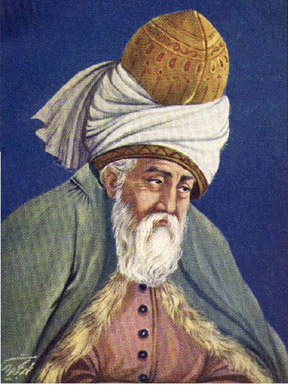
Iran’s officially recognized “spiritual leader” today may be Ayatollah Khamenei, but for hundreds of years before the current establishment of mullahs and ayatollahs, Iranians of all creeds have looked to another spiritual leader: Jalal ad-Din Rumi. While this 13th century Persian Sufi poet is known in much of the West as “Rumi,” he is referred to more affectionately in Iran as “Mowlaana,” or the master.

Among Iranians, he is a spiritual guide and guru whose words hold unmatched moral authority. Over 700 years after his death, it is nearly impossible to spend a day walking around any Iranian city, suburb, or village and not hear his echo. His words live on in everyday parlance: No matter one’s station, religion, or occupation, everyone in Iran knows at least a handful of Rumi’s poems by heart. They are taught in classrooms as an essential part of the basic curriculum, but more than that, they are learned in homes, cafes, bazaars, parks, and houses of worship. No place is beyond this poet’s influence. Continue reading Rumi over Khamenei

Tabsir Redux: The Book Of Death #28


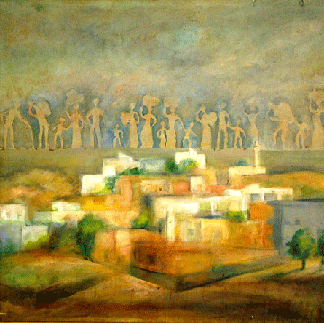
[Illustration: “Refugees” by Palestinian artisit Ibrahim Hijazy, 1996.]

by George El-Hage

Today, the seventh day of the month of Death, I decided to end our relationship. I decided to pack my suitcase and leave. Everything in our spring-like room I left for you: the velvet drapes, old books, notebooks of memories and red roses. All the silk pillows, and the ivory chairs, and the chandelier of carnations, the big bed in the other corner of the room remain for you. I took with me one bleeding suitcase which is my heart. It was so filled with surprise and sorrow that I did not have room for one little pencil. I left empty-handed except for an armful of ashes. I held dejection to my breast, the harvest of a full year of love. I embraced it with anguish and washed its forehead with dew from my eyes. Continue reading Tabsir Redux: The Book Of Death #28

Illuminated Verses: The Poetries of the Islamic World


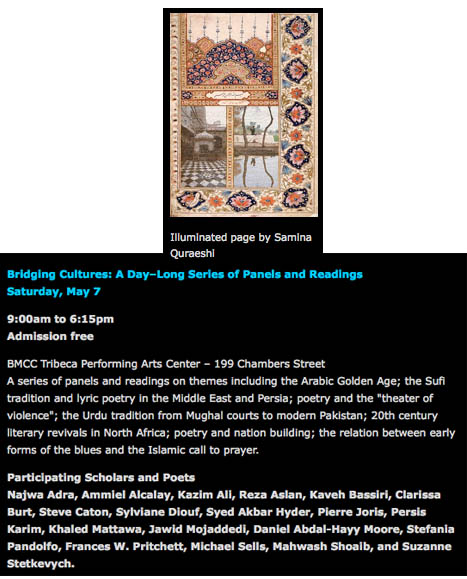
Illuminated Verses explores some of the rich and varied poetic traditions of the Islamic world. For a schedule of panels, click here (and scroll to bottom to download pdf of program).

Here is the program for Saturday, May 17, 2011:

Detailed Schedule

•9:00-9:15am
Welcome by Poets House Executive Director Lee Briccetti and City Lore Executive Director Steve Zeitlin

•9:20-9:55am
Illuminated Verses: the Poetries of the Islamic World
An opening panel setting up large questions and contexts with Reza Aslan and Michael Sells.

•10: 00-11:00am
Origins and Orality: the Poetry of the Arabian Peninsula
An examination of the poetries of the Arabian Peninsula from the Golden Age to contemporary oral tribal poetry. With anthropologists Najwa Adra and Steve Caton and literary scholar Suzanne Stetkevych. Continue reading Illuminated Verses: The Poetries of the Islamic World

Viewing the Shanamah in Manhattan


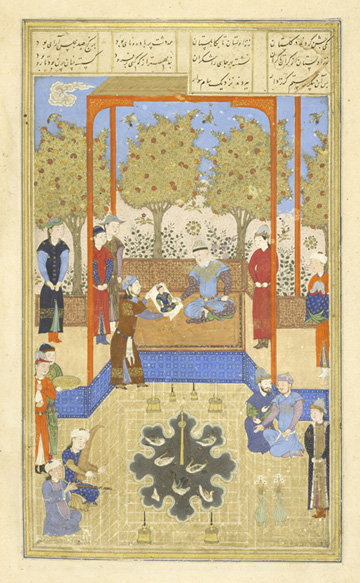
Portrait of the infant Rustam shown to Sam (folio 30b)

On Thursday night I had the privilege of attending a reading of portions of the Shanamah by Iraj Anvar.
The reading was held as part of the superb series called “Illuminated Verses: Poetries of the Islamic World,” which is a series of readings and events that began in March with a lecture by Bruce Lawrence on the Quran and continues through May 7. This is an extraordinary opportunity to hear and learn more about the variety of poetic production in Islamic cultures worldwide.

While the reading of the Shanamah is over, you can still see the exhibit of the mid 15th century Muhammad Juki’s manuscript of the Shanamah at the Asia Society through May 1.

Tabsir Redux: Arabia, A Poem from 1815


[Tabsir Redux is a reposting of earlier posts on the blog, since memories are fickle and some things deserve a second viewing.]

While reading old books on Arabia in Oxford’s Bodleian Library two summers ago, I came across a rare book indeed. I had the privilege of being the first person ever to read the book, as the folios were still uncut. Considering that the book was published in 1815 and soon thereafter entered the library, it might be readily assumed that it is a book not worth reading. In fact it proved to be a delight and a rarity. The book is called Arabia, A Poem and the author is a man named Johnson Grant. The author was an Oxford chap of St. John’s and is billed as the Domestic Chaplain to the Countess Dowager of Balcarres. No doubt the Countess enjoyed the work, although generations of Oxford students and scholars have somehow passed it by.

It is a rather long poem with extensive commentary. Not surprisingly, the Christian chaplain does not think Islam is the right religion. Continue reading Tabsir Redux: Arabia, A Poem from 1815